The short version
- A semi-custom chip is a processor a chipmaker builds for one customer, using its standard building blocks in a mix the customer picks.
- The PS5, Xbox Series X|S and Steam Deck all use semi-custom AMD chips. The ROG Ally and ROG Xbox Ally use off-the-shelf ones that any company can buy.
- Custom chips let a console maker tune for one exact machine, which is a big reason console games run so well on modest hardware.
- They're expensive to design, so chipmakers want very large orders. That's why reports say Sony may be the only company getting a custom RDNA 5 handheld chip.
Off the shelf vs semi-custom
When a company builds a console or handheld, it has two broad choices for the main chip.
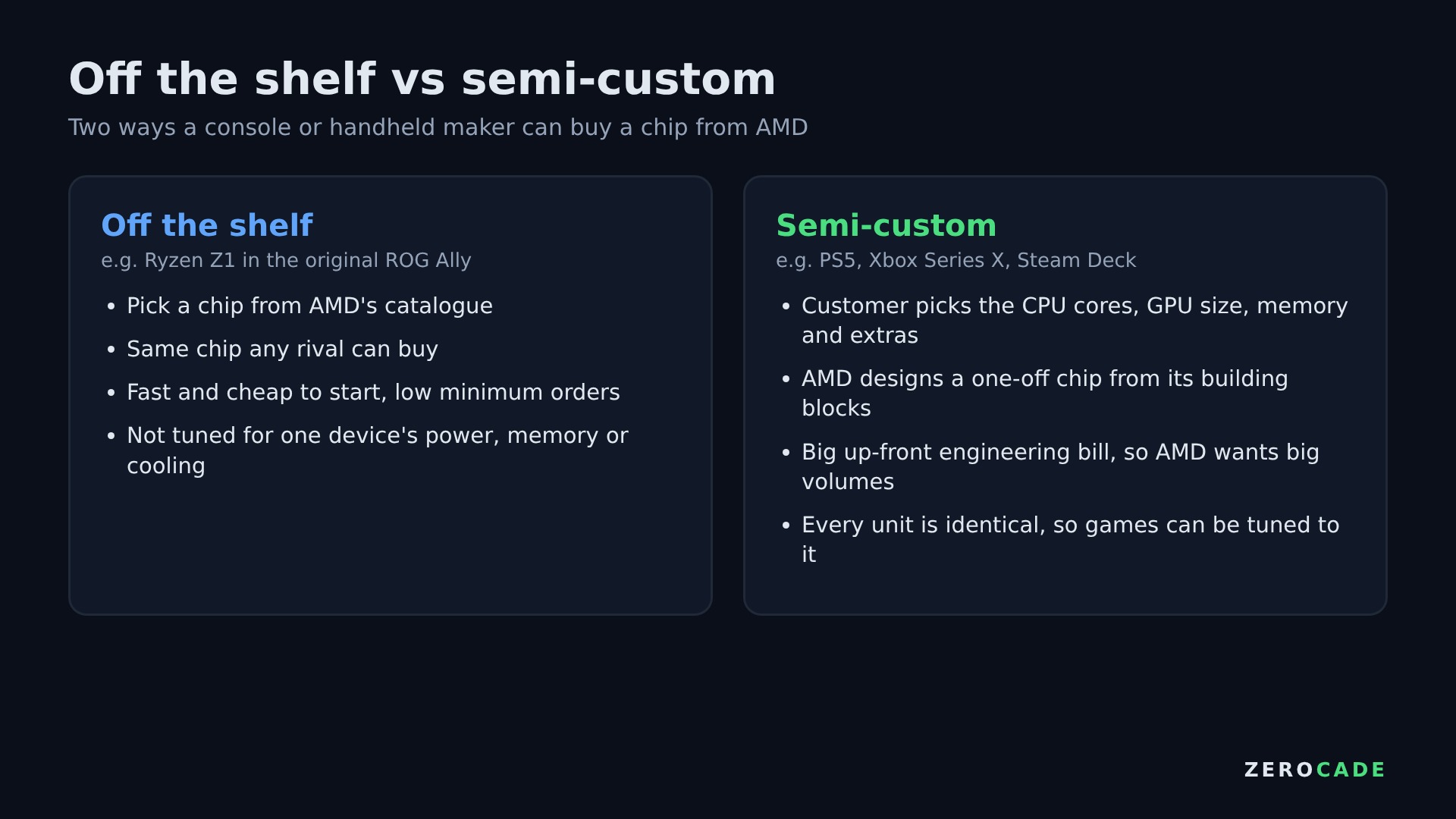
Image: Zerocade
Off the shelf means picking a chip from a catalogue. ASUS did this with the original ROG Ally in 2023, which used AMD's Ryzen Z1 series. The newer ROG Xbox Ally (₹69,990) and ROG Xbox Ally X (₹1,14,990) do the same with the Ryzen Z2 A and Ryzen AI Z2 Extreme. It's quick and relatively cheap, but rivals can buy exactly the same chip.
Semi-custom means the customer sits down with the chipmaker and specs out a new chip. How many CPU cores? How big a GPU? What kind of memory, and how fast? Any extra hardware of its own? The chipmaker then builds that design from its existing parts, like CPU cores and GPU blocks, rather than inventing everything from scratch. That's the "semi" in semi-custom.
What a console maker actually gets
Here's what the PS5 and Xbox Series X ended up with from the same AMD parts bin in 2020:
| PS5 | Xbox Series X | |
|---|---|---|
| CPU | 8 Zen 2 cores, up to 3.5GHz | 8 Zen 2 cores, 3.8GHz |
| GPU | 36 RDNA 2 compute units, up to 2.23GHz | 52 RDNA 2 compute units, 1.825GHz |
| GPU power | 10.28 TFLOPS | 12.15 TFLOPS |
Same building blocks, very different choices. Sony went for fewer compute units running faster. Microsoft went for more units running slower. Both added their own hardware around the chip too, like Sony's custom storage system for fast loading.
The Steam Deck is a handheld example. Valve worked with AMD on a custom chip with 4 Zen 2 cores and 8 RDNA 2 compute units, built to run at 4 to 15W so the battery would last. Interestingly, AMD later sold a very similar chip to other handheld makers as the Ryzen Z2 A, the chip inside the ROG Xbox Ally.
Why it matters for games
The biggest benefit isn't raw power. It's that every unit is identical.
A PC game has to run on thousands of combinations of processor, graphics card and memory. A console game targets one chip. Developers know exactly how fast it is, how much memory it has and how it behaves, so they can tune every scene to fit. That's why a PS5 with a GPU roughly similar to a mid-range PC card can run games that look better than you'd expect.
Custom chips also let console makers add features PCs don't have yet. The PS5 Pro, for example, runs Sony's own PSSR upscaler on hardware AMD built to Sony's spec. Sony and AMD are working the same way on future graphics tech under the name Project Amethyst. Mark Cerny said in 2025 that it only existed in simulation, and that he hoped to bring it to a console in a few years.
Who makes which console chip
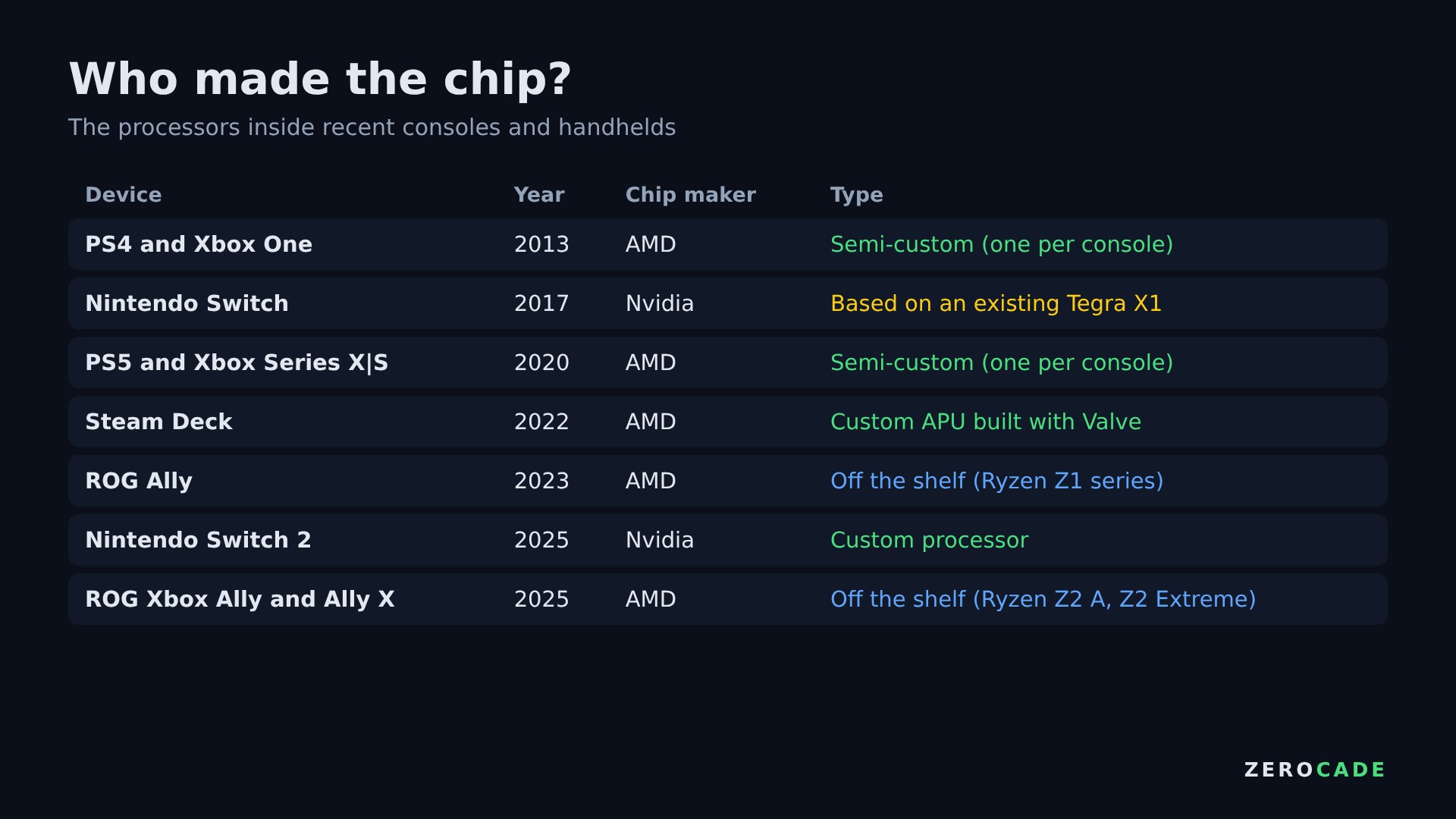
Image: Zerocade
AMD dominates, but not completely. Nintendo works with Nvidia. The original Switch used a chip based on Nvidia's existing Tegra X1, which is closer to off the shelf. The Switch 2 uses a custom processor made by Nvidia.
Why chipmakers want huge orders
Designing a chip costs a lot of money before the first one is made. Engineers have to lay out the design, simulate it, test early samples, and pay for the masks used to print it at the factory. That cost is roughly the same whether the customer sells 1 million devices or 100 million.
So it only makes sense when the volume is huge. Consoles fit perfectly: the PS5 and Xbox Series X|S have sold a combined 120 million units. For AMD, those sales once mattered a lot. When the PS4 and Xbox One arrived in 2013, AMD's console chip sales helped keep the company afloat during a rough patch in its PC business. Its first semi-custom win was the PS4.
This is where the PS6 handheld rumour comes in. Leakers claim AMD would want a commitment of around 10 million chips before building a dedicated Xbox handheld processor. That figure is disputed, but the logic holds: a niche device rarely justifies a custom chip, and companies that can't promise big orders get the catalogue version instead.
The trade-off
A semi-custom chip is a big bet. It takes years to design, it locks a console maker into one supplier for a whole generation, and if the device doesn't sell, the design money is gone. An off-the-shelf chip is less exciting, but it's cheaper, faster to market and easier to swap out for next year's model.
That's why you see both. Big platforms like PlayStation and Xbox consoles go custom. Smaller or newer devices usually start off the shelf. Next time you see a leak about a console chip, check which of the two it is. It tells you a lot about how big the company expects that device to be.