The short version
- Smurfing means a skilled player making a new or second account so they get matched against much weaker players.
- It hurts ranked games because matchmaking judges skill from your history, and a fresh account has none.
- Games fight it with phone-number checks, faster rank calibration and bans, but none of these fully stops it.
- A Sony patent published on November 5, 2026 describes spotting second accounts from how a player presses buttons and moves through menus. It's a patent, not an announced feature.
Where the word comes from
The term goes back to the 1990s and the strategy game Warcraft II. As the story goes, two well-known players got tired of opponents dodging them, so they made new accounts named after the Smurfs cartoon characters and kept winning. "Smurf" stuck as the word for a strong player hiding behind a new name.
Today it covers a few different habits:
- New-account smurfing: making a fresh account to start at the bottom of the ranks.
- Alt accounts: keeping a second, lower-ranked account to play with weaker friends or to relax.
- Deranking: deliberately losing matches to push an account's rank down.
- Account selling: levelling up accounts to sell them, which also puts mismatched players into games.
Why smurfing breaks matchmaking
Ranked modes use skill-based matchmaking, which tries to put you against players of similar ability. Our guide on what SBMM is explains how it works.
The catch is that matchmaking can only judge you by your record. A new account has no record, so the system starts it near the middle or bottom and adjusts as you win or lose. A smurf wins match after match while the system catches up, and every one of those wins is someone else's loss.
That hurts most in team games. In a 5v5 shooter or a MOBA, one smurf can decide a match on their own, and the beginners on the other team learn nothing except that the game feels unfair. Some of them quit.
How games fight it today
Most big competitive games already use a mix of these:
- Phone number checks. Some games require a verified phone number before you can play ranked, which makes extra accounts harder to create.
- Level gates. Many games make you reach a minimum account level before ranked opens, so smurfing takes hours of play first.
- Faster calibration. Some games raise or drop a new account's rank much faster after a run of big wins, so a smurf climbs out of beginner games sooner.
- Smurf detection. Some publishers look at a new account's stats, such as accuracy, win rate and how fast it ranks up, and push suspicious accounts up quickly or ban them.
- Rules in the terms of service. Many games forbid account sharing or selling outright.
None of these is perfect. Phone checks can be dodged with spare numbers, and detection based on stats can wrongly flag a genuinely talented new player.
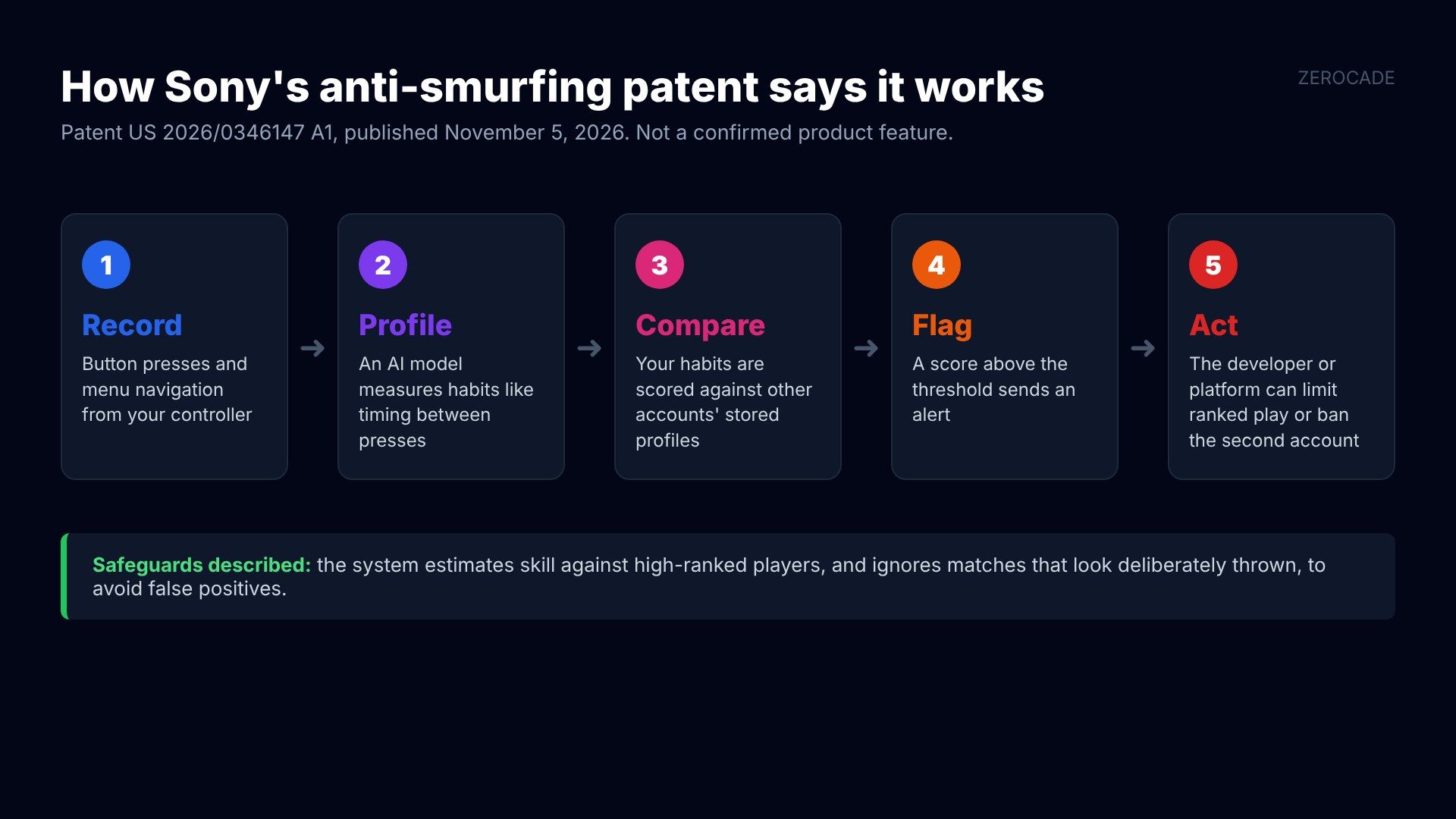
Image: Zerocade
What Sony's patent describes
The patent is US 2026/0346147 A1, filed by Sony Interactive Entertainment and published by the US patent office on November 5, 2026. Patentlyze, which tracks patents, lists five inventors and a filing date of April 30, 2025. It was first reported by Wccftech on November 6.
Instead of looking at your results, the system looks at how you play:
- It records your controller input across both gameplay and menus.
- An AI model picks out habits, such as the timing between button presses and the way you move through menus.
- Those habits are compared with profiles stored for other accounts, and a similarity score is worked out.
- If two accounts score above a set threshold, the system sends an alert.
- The game's developer or the platform can then decide what to do, from limiting ranked play to banning the second account.
The patent also tries to avoid catching innocent players. It describes estimating a player's skill against high-ranked opponents, and ignoring matches that look deliberately thrown, so a deranking smurf can't hide by losing.
The idea is that your habits work like a fingerprint. You can make a new account, but you probably can't change the way your thumbs move.
Image: Sony Interactive Entertainment
Is this coming to PS5 or PS6?
Nobody knows. Some coverage has tied the patent to the PS6, but Sony hasn't said it will use the system at all. Companies patent far more ideas than they ever release, and a patent only protects an idea. It doesn't mean a product is planned.
There are also open questions, on paper:
- Shared consoles. Siblings or friends who play on one console with one controller could look alike, or they could look completely different.
- Privacy. Recording detailed input habits is personal data. How long it's kept and who sees it would matter, especially under India's data protection rules.
- Developer choice. The patent leaves the final decision to developers or the platform, so each game could treat a flagged account differently.
What to watch for
Watch for Sony or a PlayStation studio mentioning input-based smurf detection in a ranked mode, or in the PS6's online features once Sony reveals them. Until then, the most effective protections are still level gates and fast calibration, so if a new ranked game you're playing has neither, expect to meet a few smurfs early on.