The short version
- MSRP means manufacturer's suggested retail price. It's a guide, not a promise. Stores and card makers set the price you actually pay.
- The RTX 5070 Ti launched at $749 (about ₹66,000). On November 6, the cheapest one in a US store was $1,339.99 (about ₹1.18 lakh), nearly 79% higher, according to Notebookcheck.
- The main reason this year is memory. Graphics cards need GDDR7, and memory makers are selling as much as they can to AI data centres instead.
- Nvidia hasn't stopped making these cards. It said in January it was still shipping every GeForce model.
What MSRP actually means
When Nvidia or AMD launch a graphics card, they announce a price. For the RTX 5070 Ti that was $749. That's the MSRP, and it's what reviews, launch posts and comparison charts quote.
But Nvidia sells very few cards itself. Most are made by partner brands like Asus, Gigabyte, MSI and Zotac. Nvidia sells them the GPU chip, usually bundled with the memory, and they build the rest: the circuit board, the cooler, the fans and the box. Then they sell the card to stores, and the stores pick the shelf price.
So MSRP is really a signal of where a basic model should land. Nobody in the chain is forced to sell at it. Nvidia's own product pages show this: the US RTX 5070 family page lists prices as "Starting at", with no fixed number.
Why partner cards cost more even in normal times
Even when supply is fine, most cards sit a little above MSRP. Partner cards come in tiers:
- Base models (Asus Prime, Gigabyte Windforce) aim at MSRP or close to it.
- Overclocked models (the "OC" in Gigabyte Aero OC) run a bit faster out of the box and cost more.
- Premium models (Asus TUF and ROG Strix, MSI Suprim) add bigger coolers, quieter fans, RGB lighting and stronger power delivery. These can sit $100 to $300 over MSRP at the best of times.
That's the normal gap. What's happening now is different.
What's happening to RTX 50 prices right now
According to a Notebookcheck report on November 6, citing VideoCardz, here's what US shoppers saw for the RTX 5070 Ti:
- The cheapest model in stock was $1,179.99 on October 29.
- By November 6, the cheapest was $1,339.99, a Gigabyte Aero OC sold by Newegg.
- An Asus Prime OC was $1,399.99 at B&H, and an Asus TUF OC $1,499.99.
- A Gigabyte Gaming OC was listed at about $1,400 at Best Buy.
One detail matters: the October and November figures are the cheapest card on each day, not the same card getting pricier. Still, the lowest you could pay rose by $160 in a week.
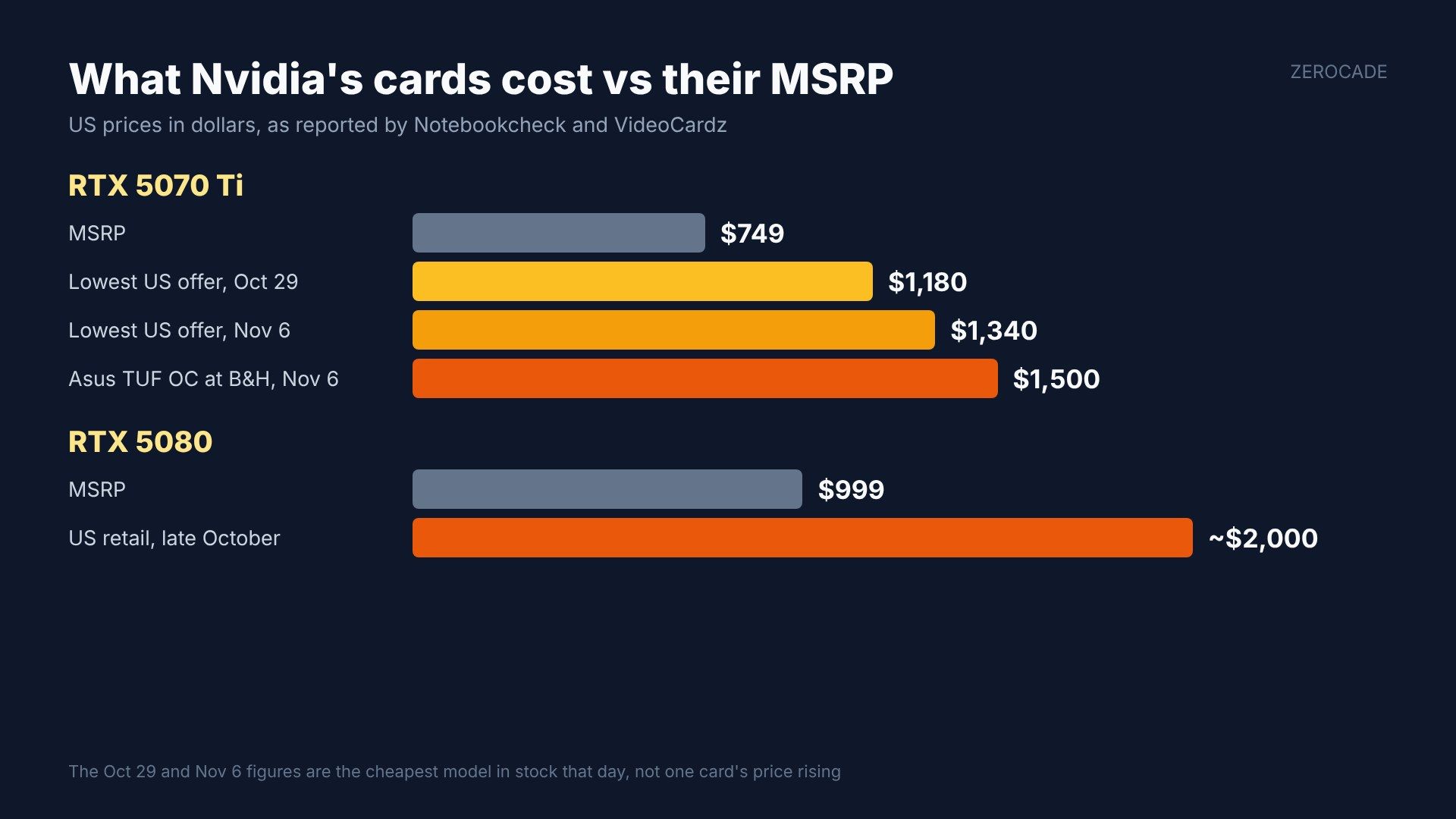
Image: Zerocade
It isn't just the 5070 Ti. The RTX 5080 is nearing double its $999 MSRP, as we covered in the RTX 5080 nearing $2,000. Notebookcheck puts the RTX 5090 at nearly $7,000. Both the 5080 and 5090 have also vanished from Nvidia's own US store, though neither has been officially discontinued. AMD isn't immune either; see our report on Radeon RX 9000 price rises.
The real reason: memory
A graphics card's own memory, its VRAM, sits right next to the GPU chip. The RTX 5070 Ti has 16GB of GDDR7 on a 256-bit bus. If you're not sure what that does, our guide on what VRAM is and how much you need explains it.
The problem is that the same three companies (Samsung, SK hynix and Micron) make memory for graphics cards and for AI servers. AI accelerators use stacked HBM memory, which is far more profitable, so factory space keeps moving towards it. Our explainer on what HBM is covers why it's so valuable. SK hynix has even warned the shortage could last until 2030, as we reported in its memory shortage forecast.
Less GDDR7 means fewer cards can be built. Back in January 2026, Asus said the 5070 Ti wasn't end-of-life, but that memory supply constraints were affecting production and restocking. Fewer cards on shelves, with demand holding up, is how a $749 card ends up selling for $1,339.99.
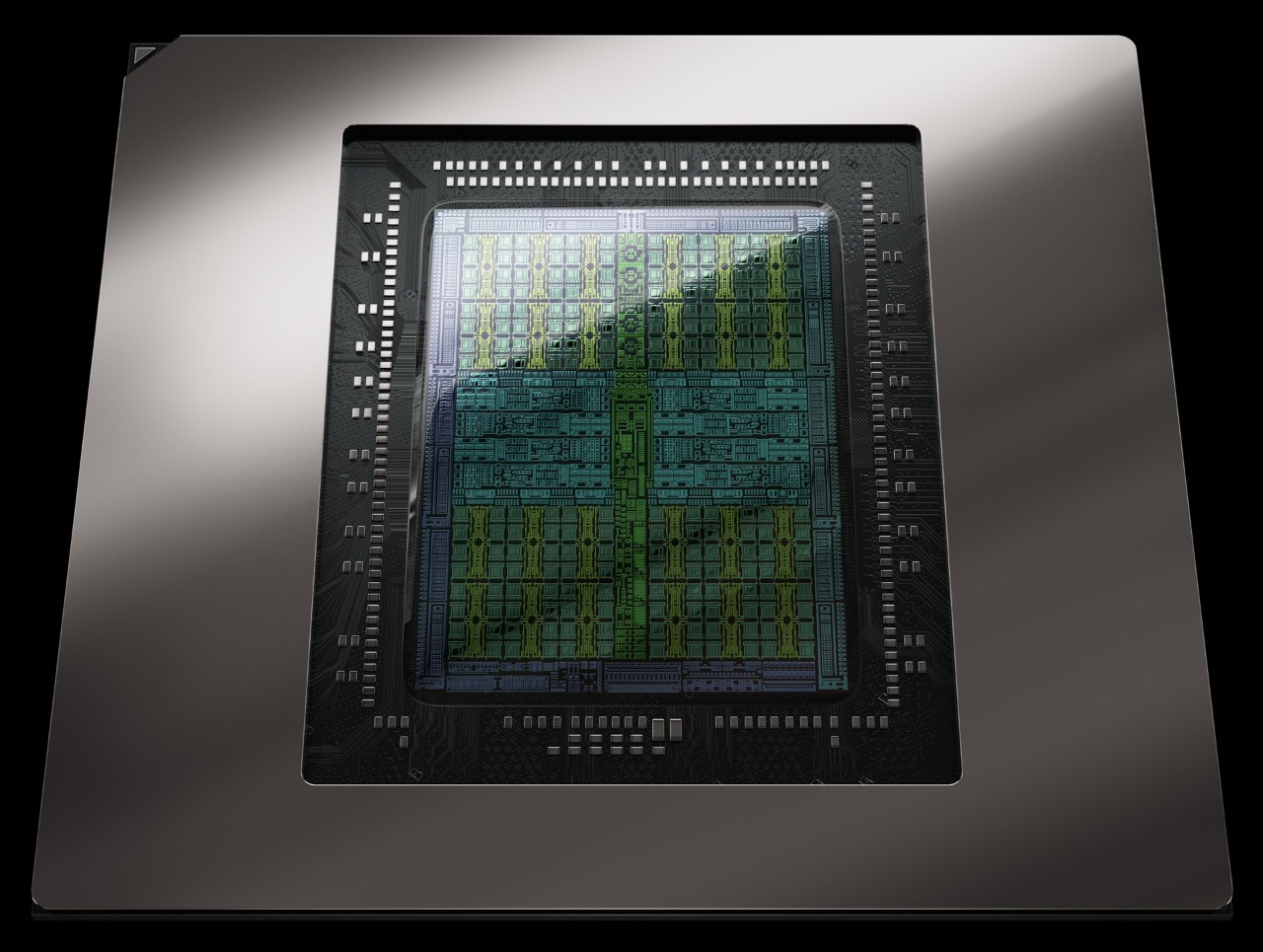
Image: NVIDIA
Other things that push prices up
Memory is the big one this year, but a few other forces stack on top:
- Tariffs and import duties. Cards are mostly assembled in Asia, so taxes at the border feed straight into the shelf price.
- Currency swings. Indian prices follow the dollar. When the rupee weakens, imported cards get dearer even if the US price doesn't move.
- Scalpers and resellers. When stock is short, third-party sellers on marketplaces list cards well above what the store itself charges.
- Retailer margin. Stores know a scarce card will still sell, so there's little reason to discount it.
What it means if you're buying in India
We couldn't find a confirmed current India price for the RTX 5070 Ti, so the rupee figures above are straight conversions from US prices, not Indian shelf prices. Indian prices usually sit higher than a direct conversion, once GST and import costs are added.
On paper, a few things are worth checking before you buy:
- Compare against MSRP, not last month's price. A "deal" on an inflated card can still be hundreds over launch price.
- Buy from the brand's authorised sellers. Third-party listings on big marketplaces are where scalper pricing shows up.
- Look at base models first. A Prime or Windforce card uses the same GPU and memory as the premium versions.
- Consider the tier below. If a 5070 Ti costs what a 5080 should, a regular RTX 5070 or an AMD card might fit your budget better.
What to watch
Watch the cheapest RTX 5070 Ti listing in the US over the next few weeks; if it keeps climbing past $1,339.99, Indian prices will follow. Also keep an eye on Nvidia's rumoured RTX 5080 with 24GB. A new model needing even more memory during a shortage won't be cheap.