The short version
- Supply-chain account ChannelGate says AMD will raise the price of its GPU + GDDR6 memory bundle for board partners in November 2026. This is a report, not an AMD announcement.
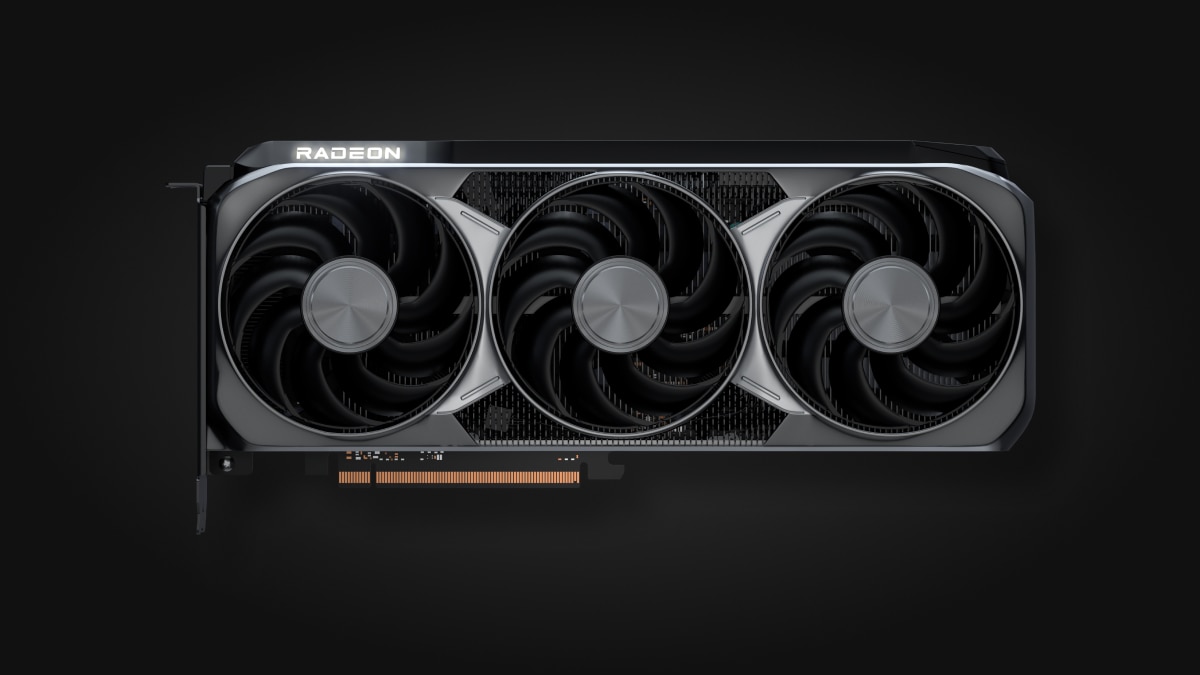
- No size has been given and no models are named, but the Radeon RX 9000 series (RX 9070 XT, RX 9070, RX 9060 XT) is the most likely to be affected.
- It would be AMD's third hike this year, after an August increase of at least 10% and China guide prices that rose by up to 20%.
- In India, an RX 9070 XT currently starts around ₹1,09,220 and an RX 9060 XT 16GB around ₹71,920 at one big retailer. If you're about to buy, prices are more likely to go up than down.
What's being reported
On October 30, 2026, Wccftech relayed a post from ChannelGate, an account that shares news from Chinese graphics card makers. Its claim: AMD "may implement another cost increase" for GPUs and video memory in November.
The same source says GDDR6 memory prices rose about 8-10% in the July to September quarter. GDDR6 is the memory every RX 9000 card uses. It's not clear whether AMD will pass on a similar 8-10%, more, or less.
How credible is this? ChannelGate's earlier AMD claim, in July, was followed by a higher China price list a couple of weeks later, so it has a decent record on this topic. Still, AMD hasn't confirmed anything, and the post doesn't give numbers.
How a "bundle" hike reaches your shop
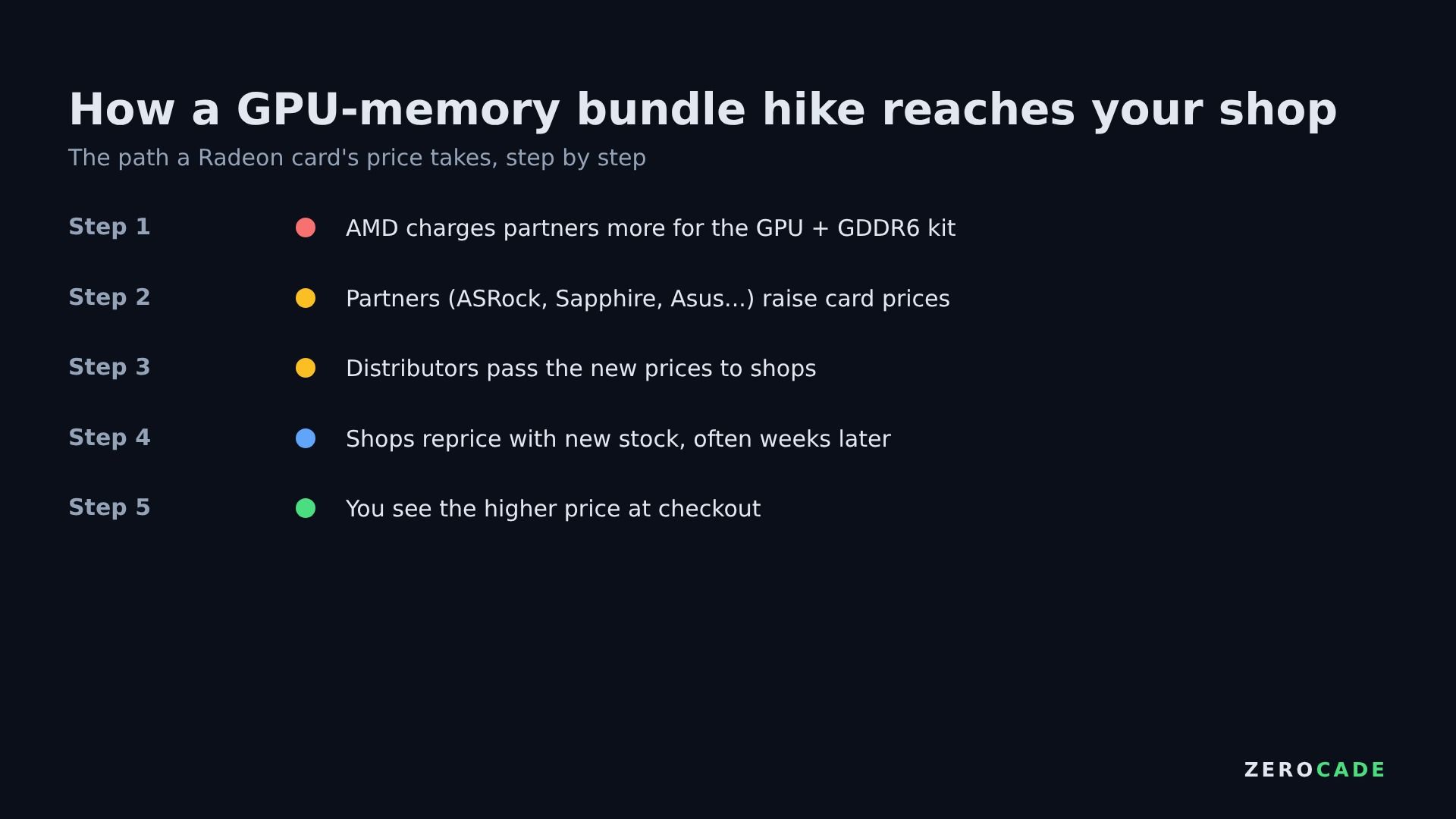
Image: Zerocade
AMD doesn't make most of the Radeon cards you buy. Companies like Sapphire, PowerColor, ASRock, XFX, Gigabyte and Asus (called board partners or AIBs) do. AMD sells them a kit: the GPU chip plus the matching GDDR6 memory chips. The partner adds the circuit board, power parts, cooler and box.
So when AMD charges more for that kit, the partner's cost goes up on every card. The partner then raises its price to distributors, who raise it to shops. Wccftech's estimate is that it can take a few weeks before you notice it at the checkout.
The memory part matters most right now. AI data centres are buying up huge amounts of memory, and chipmakers are shifting production to the expensive kinds AI servers use. That leaves less for everything else, from RAM sticks to graphics card memory. We covered this squeeze in our SK hynix shortage report.
This would be the third hike in 2026
Image: AMD
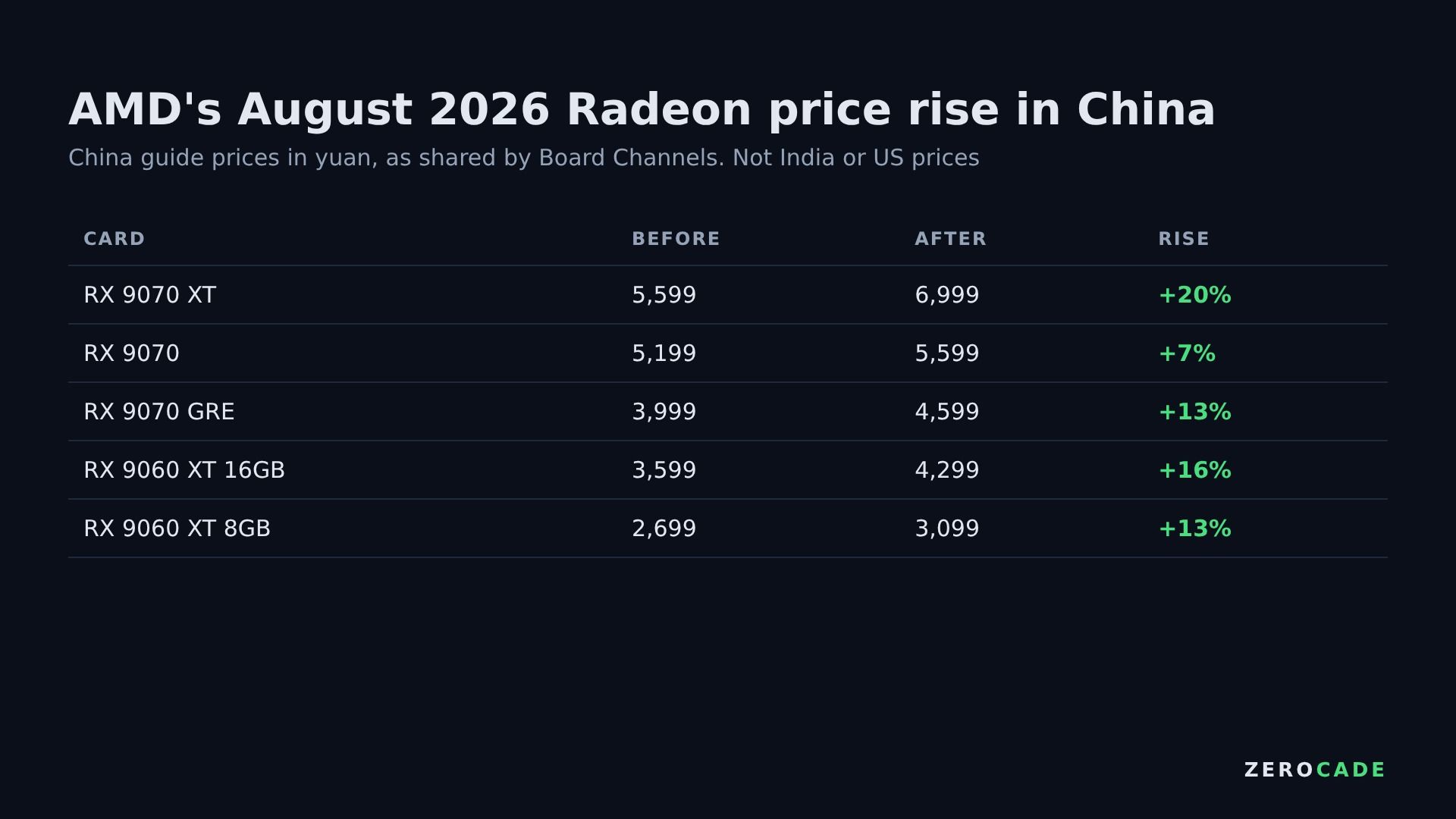
Image: Zerocade
- July 31: ChannelGate reported AMD had told partners its GPU-memory kits would cost at least 10% more, starting in August. This followed a similar rise from Nvidia.
- August 12: Board Channels, another partner-sourced account, shared AMD's new Q3 guide prices in China. The RX 9070 XT went from 5,599 to 6,999 yuan, up 20%. The RX 9060 XT 16GB rose about 16%, and the RX 9070 about 7%.
- November (reported): another bundle increase, size unknown.
For context, AMD's US launch prices in 2025 were $599 for the RX 9070 XT (about ₹57,000), $549 for the RX 9070, $349 for the RX 9060 XT 16GB and $299 for the 8GB model. Most cards have sold above those numbers for much of 2026.
What cards cost in India right now
Prices at PrimeABGB, checked on October 31, 2026:
| Card | Model | Price |
|---|---|---|
| RX 9070 XT 16GB | ASRock Challenger | ₹1,09,220 |
| RX 9070 XT 16GB | ASRock Steel Legend Dark | ₹1,11,675 |
| RX 9070 16GB | ASRock Challenger | ₹90,199 |
| RX 9060 XT 16GB | Asus Prime OC | ₹71,920 |
| RX 9060 XT 16GB | ASRock Challenger OC | ₹74,859 |
That's roughly double the US launch prices converted to rupees, after import duty, GST and this year's increases. We couldn't find an RX 9060 XT 8GB in stock at the stores we checked.
How does Nvidia compare? Its cards are under the same pressure. The cheapest in-stock RTX 5080 in India was about ₹2,02,000 last week, and there are reports of a 24GB RTX 5080 on the way.
Should you buy now or wait?
We can't tell you what prices will do, but on paper the signals all point one way. Memory makers expect the shortage to last into 2027, both GPU makers have raised kit prices this year, and no new mid-range Radeon cards have been announced.
If you've already picked a card and found it at a fair price, waiting for prices to fall looks like a gamble. If you're flexible, compare the same card across a few Indian stores, since listings for one chip can differ by several thousand rupees.
What to watch for
The first sign will be partner price lists in China in November, followed by US and European listings a week or two later. Indian stores usually move after their next stock shipment, so watch your shortlisted card's price through November.