The short version
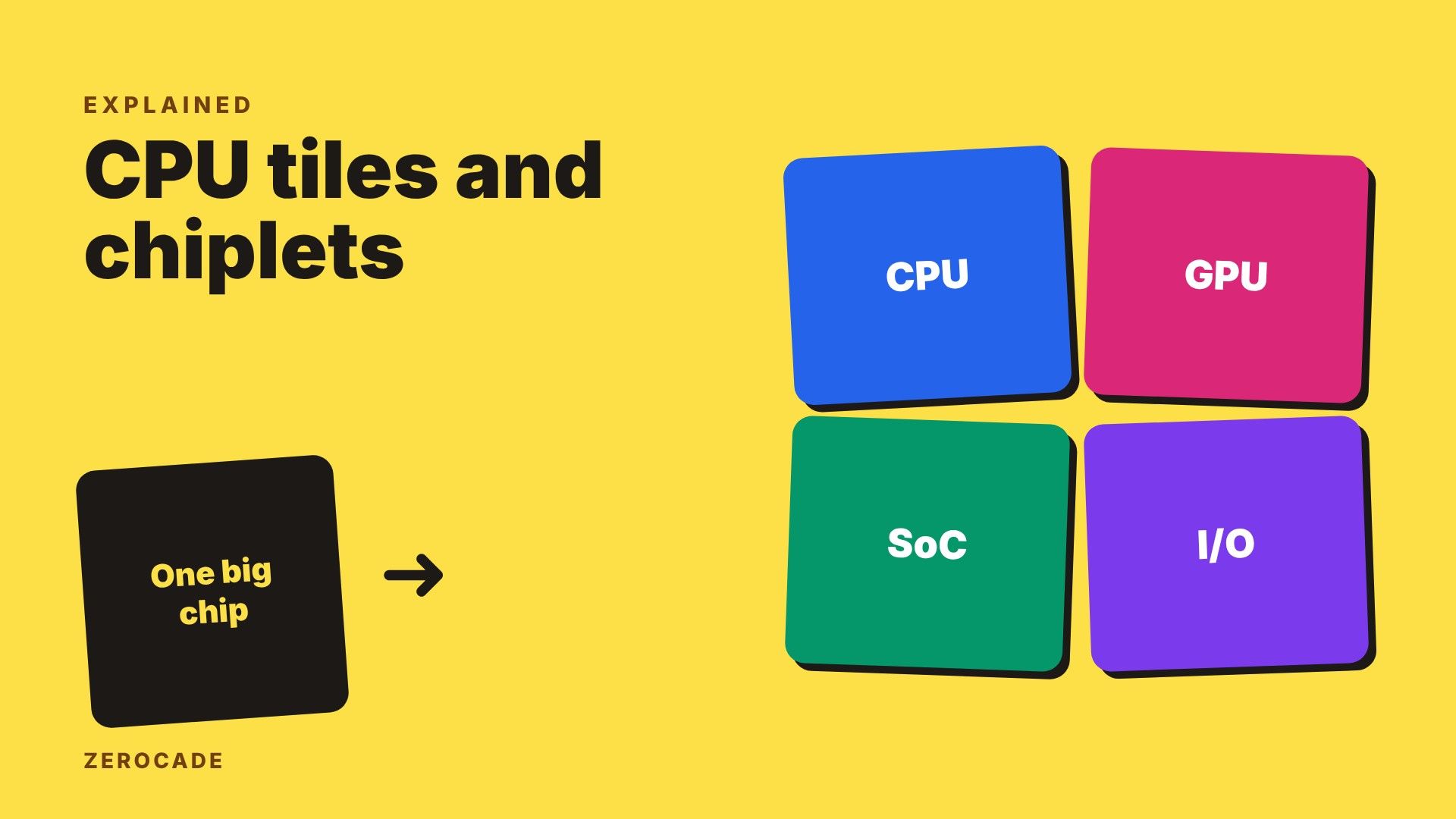
- A monolithic chip puts the CPU cores, graphics and everything else on one piece of silicon. A tiled or chiplet design splits them into several smaller pieces in one package.
- Intel calls these pieces tiles. AMD calls them chiplets. They're the same idea.
- Splitting a chip lets each part be made on the process that suits it, and it means fewer chips are thrown away because of manufacturing defects.
- The trade-off is that the pieces have to talk to each other quickly, which takes special packaging such as Intel's Foveros and EMIB.
One big chip versus several small ones
A processor starts life on a silicon wafer, a thin disc about 30cm across. Hundreds of chips are printed on each wafer at once and then cut apart. Each cut-out piece is a die.
For decades, a PC processor was one die. The CPU cores, the cache, the memory controller and later the graphics all sat on the same slab of silicon. That's called a monolithic design.
Tiles and chiplets break that one die into several. Each piece does one job, and they're mounted together in a single package, the part you see as a processor. From the outside it still looks like one chip, and Windows sees one CPU.
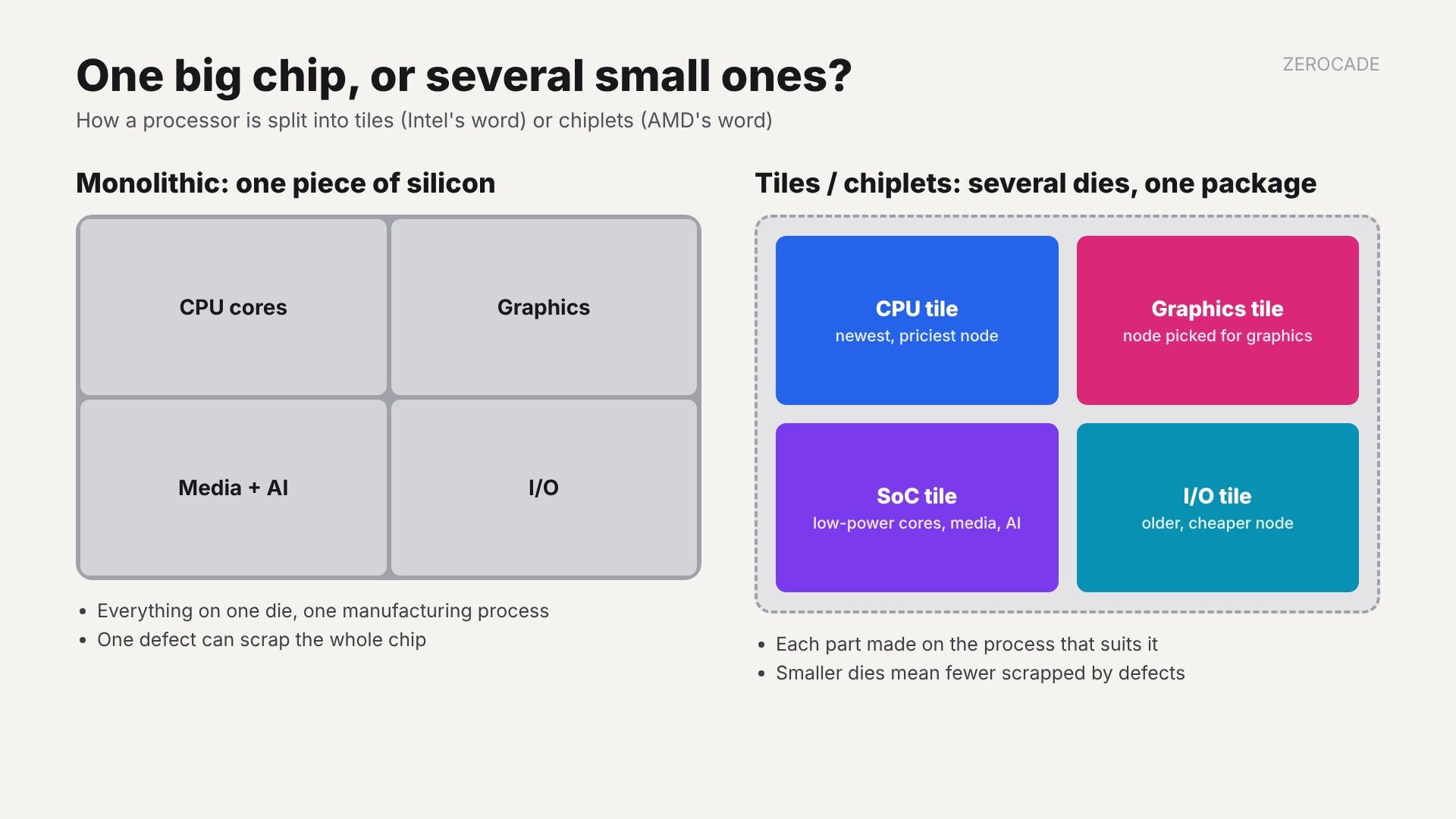
Image: Zerocade
Why chipmakers split their chips
Defects cost less. Every wafer has a few tiny flaws scattered across it. On a big monolithic die, one flaw in the wrong place can ruin the whole chip. With smaller dies, a flaw only ruins one small piece, and more of the wafer ends up usable. Intel's own foundry pages stress testing for "known good die" before assembly for this reason.
Each part gets the right process. The newest manufacturing processes are very expensive. CPU cores benefit most from them, but parts like USB, display outputs and PCIe controllers don't gain much. With tiles, a chipmaker can put the cores on the newest node and the input/output parts on an older, cheaper one.
Designs can be mixed and matched. The same CPU tile can be paired with a small or large graphics tile to make different models. AMD reuses the same CPU chiplet across many desktop chips, from mid-range Ryzen to its biggest models.
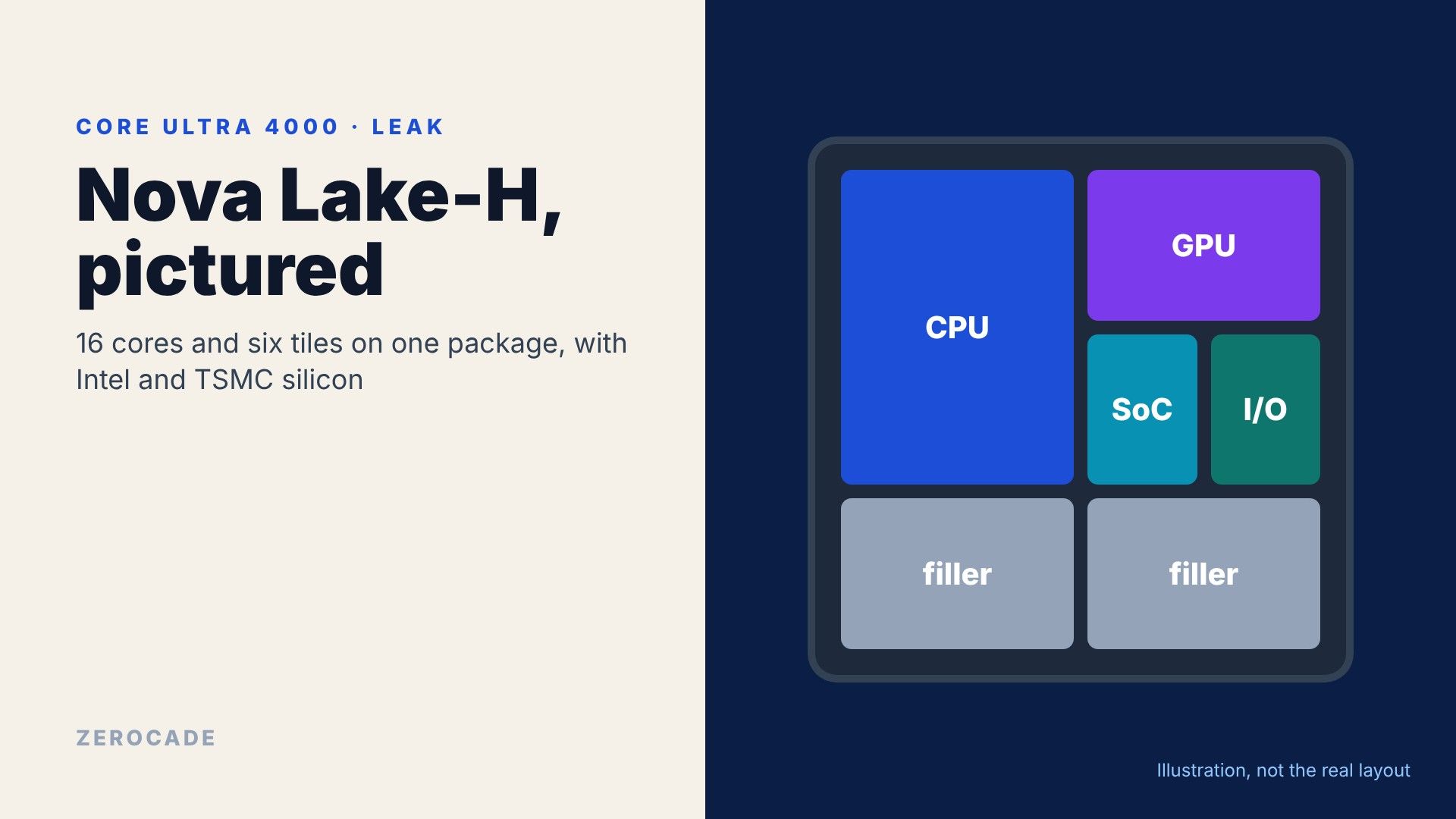
Two factories can work on one chip. Because tiles are separate, Intel can have some made in its own factories and others by TSMC. The leaked Nova Lake-H laptop chip reportedly does exactly that.
How the pieces talk to each other
Splitting a chip only works if the pieces can share data almost as fast as if they were one. That's where packaging comes in.
- EMIB (Intel): a small bridge of silicon embedded under the edges of two neighbouring dies, carrying thousands of fine connections between them. Intel says it has been in mass production since 2017.
- Foveros (Intel): stacks tiles on top of an active base die, which connects them from below. Intel says Foveros has been in mass production since 2019. Newer versions, like Foveros Direct, bond copper directly to copper for even denser connections.
- Infinity Fabric (AMD): AMD's connection between its CPU chiplets and the central I/O die, which runs over the package.
- UCIe: an industry standard for chiplet connections, so that pieces from different companies could one day be combined.
These links are fast, but not free. Data moving between tiles uses slightly more power and takes slightly longer than data moving within one die. Chip designers place the parts that talk most on the same tile for that reason.
Real chips, piece by piece
AMD Ryzen (since 2019): Ryzen 3000 desktop chips split the CPU cores into one or two CCDs (core complex dies) and added a separate I/O die for memory and connections. A 16-core Ryzen 9 uses two 8-core CCDs, while an 8-core Ryzen 7 uses one. Ryzen still works this way today.
Intel Meteor Lake (late 2023): Intel's first big tiled laptop chip, sold as Core Ultra Series 1. It had four tiles, for compute, graphics, SoC and I/O, sitting on a Foveros base. Intel made the compute tile and the base die itself, while TSMC made the graphics, SoC and I/O tiles.
Intel Panther Lake (2026): sold as Core Ultra Series 3, with its main CPU tile on Intel's own 18A process.
Intel Nova Lake-H (rumoured, 2027): reportedly six tiles, including two filler tiles, with the CPU cores made by TSMC. See our leak coverage for the details, which Intel hasn't confirmed.
What it means for you
You don't choose tiles or chiplets when buying a laptop. But the design explains a few things you'll notice:
- More models from one design. Chipmakers can offer many core and graphics combinations at different prices.
- Performance quirks. Some chiplet designs, like AMD's two-CCD Ryzen 9 chips, can be slightly slower in games if a game's threads spread across both CCDs. That's why many gamers prefer single-CCD X3D chips.
- Codenames matter more. Two chips with similar names can be built very differently. Our guide to Intel's codenames helps sort them out.
The big trend is clear: almost every high-end PC chip is now built from pieces. The real competition is now in how well those pieces are stitched together.