The short version
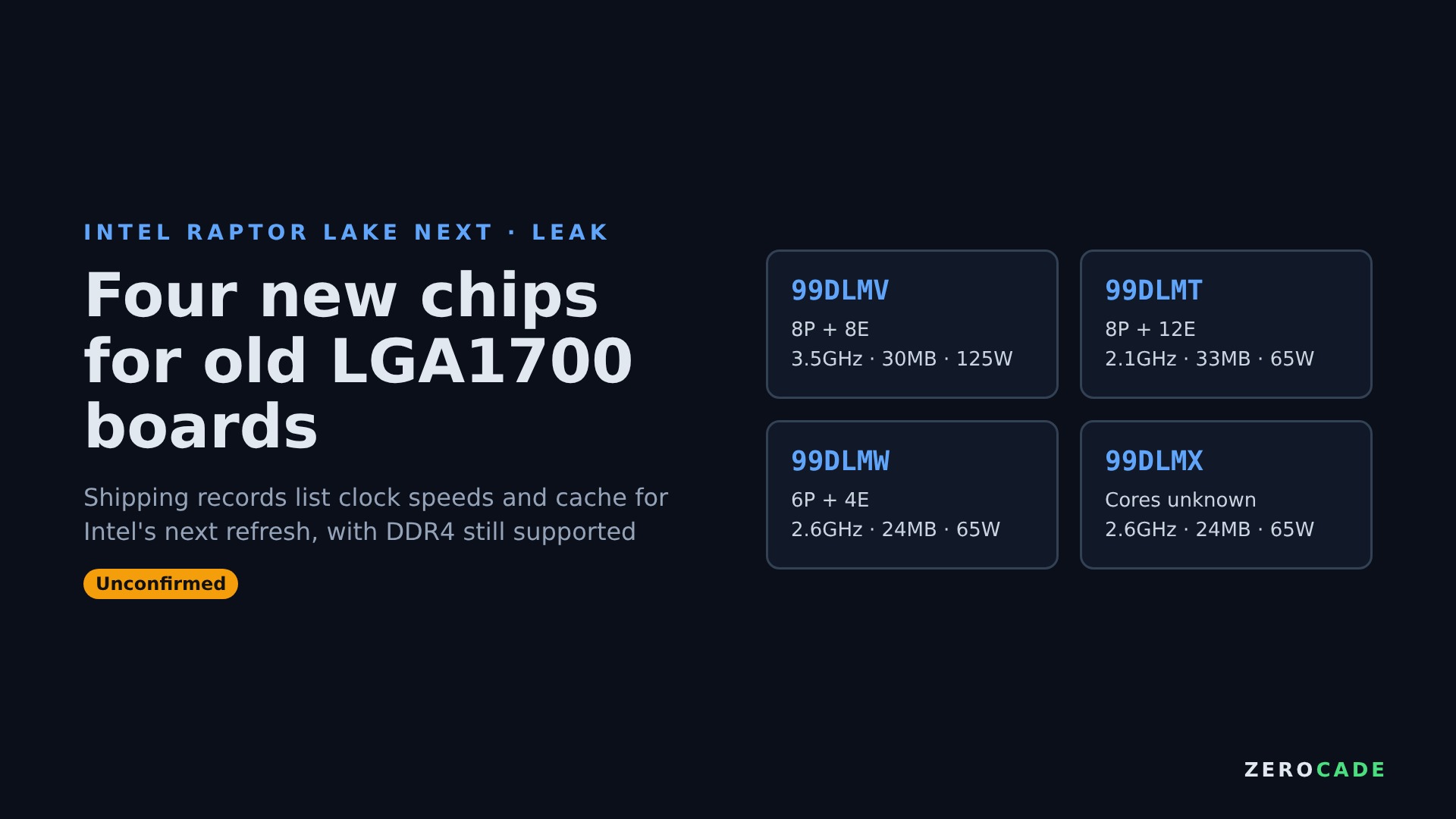
- Four unreleased Intel desktop chips labelled Raptor Lake Next have turned up in shipping records from Vietnam, with cache sizes, clock speeds and power ratings.
- Intel has also posted an internal "RPL-NEXT" test driver, which makes the chips' existence close to certain.
- They use the existing LGA1700 socket and support DDR4, so a ₹16,950 Core i5-14400 owner could, on paper, upgrade without a new board or RAM.
- Intel hasn't announced them. Gigabyte expects them in early 2027, and there are no prices yet.
What leaked
Two things surfaced within a day of each other.
First, on October 26, X user @momomo_us spotted a driver in Intel's software database labelled "RPL-NEXT". Tom's Hardware reports it's a test build for Smart Sound Technology, the audio processor built into Intel chips since Alder Lake. The download is locked behind an Intel login, so nobody outside can see what's in it. But companies don't usually write drivers for chips that don't exist.
Second, Club386 dug through global trade data and found CPUs labelled "Raptor Lake Next" being exported from Vietnam since August 2026. Intel has a big chip assembly and test plant there. The records list four part numbers, all marked FCLGA, which points to desktop chips rather than laptop ones.
We first covered this platform when Gigabyte said new LGA1700 chips were coming in early 2027. Back then there were no specs at all. Now there are.
The four chips
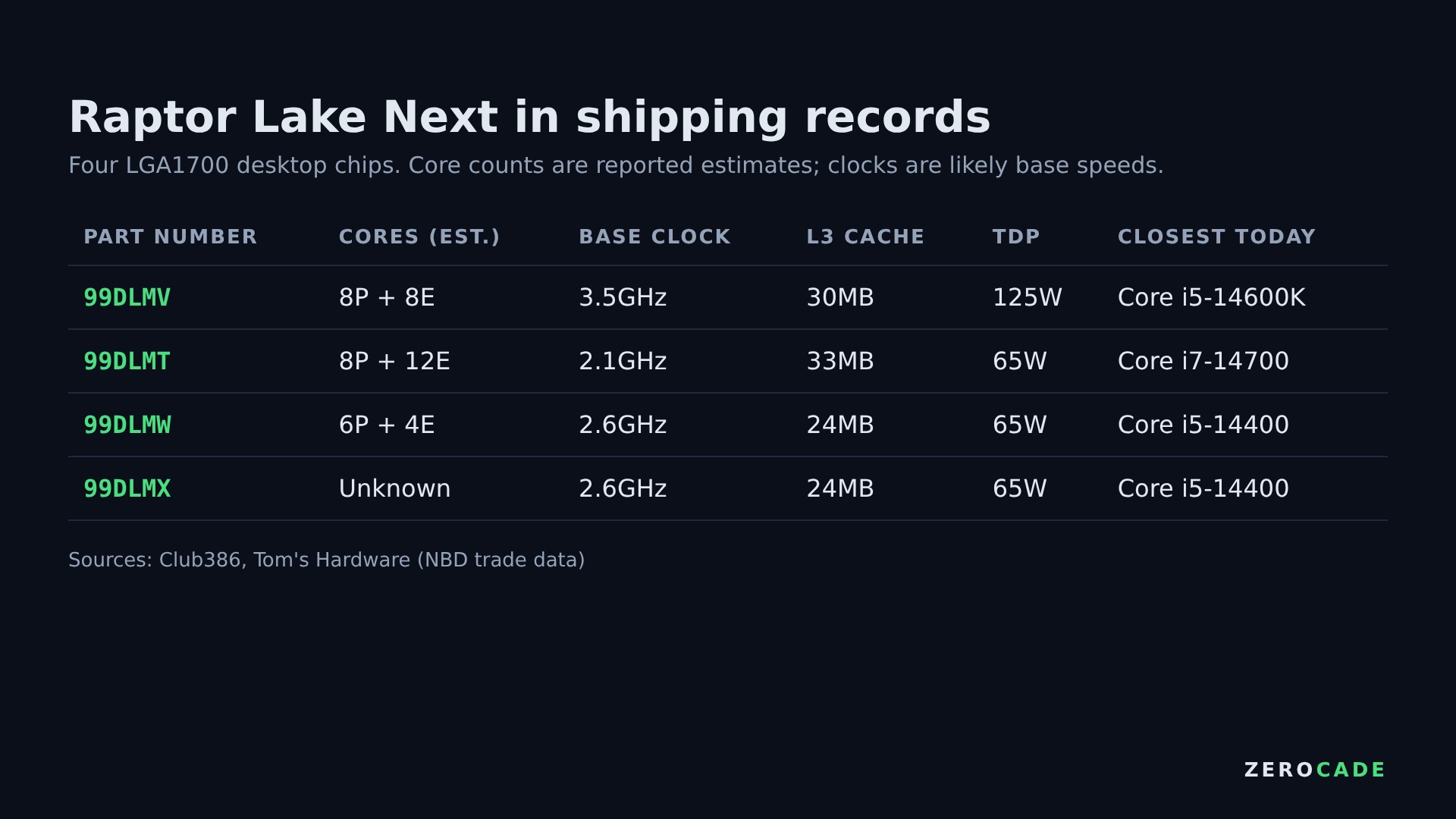
Image: Zerocade
| Part number | Cores (estimated) | Clock | L3 cache | Power |
|---|---|---|---|---|
| 99DLMV | 8 P-cores + 8 E-cores | 3.5GHz | 30MB | 125W |
| 99DLMT | 8 P-cores + 12 E-cores | 2.1GHz | 33MB | 65W |
| 99DLMW | 6 P-cores + 4 E-cores | 2.6GHz | 24MB | 65W |
| 99DLMX | Not known | 2.6GHz | 24MB | 65W |
A few things to know about that table:
- The core counts aren't in the records. Club386 and Tom's Hardware estimated them by matching the cache sizes to existing chips.
- The clocks are most likely base speeds, not the boost speeds printed on the box. A 2.1GHz base is normal for a 65W chip with 20 cores.
- 99DLMW and 99DLMX look identical on paper. One may lack integrated graphics, like Intel's "F" models, but that's a guess.
Where they'd slot in
The interesting one is 99DLMV. It has 16 cores, a 125W rating and 30MB of cache, the same cache as a Core i7-13700K, with a slightly higher base clock (3.5GHz vs 3.4GHz). Club386 thinks it's the replacement for the Core i5-14600K, which sells for about ₹31,399 at Indian retailer Computech right now. Tom's Hardware places it between the 14600K and the Core i7-14700K (about ₹43,699). On paper, that's a lot of chip for an i5.
The 99DLMT looks like a 65W Core i7, with the same 33MB of cache as today's 14700 series. The two 24MB chips sit where the Core i5-14400 does now (about ₹16,950), but with a bit more cache than its 20MB.
What's missing is a Core i9. Earlier leaks also suggested Intel won't refresh the 14900K this time, and these records fit that.
Image: Intel Corporation
Why Intel is going back to an old socket
LGA1700 first launched with the 12th Gen Core chips in late 2021. Intel's newer desktop chips moved to LGA1851, and Nova Lake will move again to LGA1954. So why bring new chips to the old one?
Memory. LGA1700 is Intel's last desktop platform that can use DDR4, and Gigabyte's recent BIOS updates appear to confirm Raptor Lake Next keeps that support. DDR5 prices have shot up in 2026 as memory makers chase AI demand. Our DDR4 vs DDR5 explainer covers how big that gap has become.
That makes this a cheap-upgrade play. Someone on an i5-12400 or 13400 could, on paper, drop in a faster chip with more cache after a BIOS update, and keep their board and RAM. Those are the parts that cost the most to replace right now. AMD is doing something similar on its side with new chips for AM4, like the Ryzen 5 5500F.
Our CPU socket explainer covers why sockets decide your upgrade path in the first place.
What it means for gamers
It's still Raptor Lake underneath. That's the same design as 13th and 14th Gen, so don't expect a big jump in speed per clock like the one Nova Lake's early benchmark hinted at. The gains would come from more cores and cache at a given price.
There's also the matter of trust. 13th and 14th Gen chips had well-publicised instability problems in 2024, which Intel traced to voltage issues and patched with microcode updates. Any refresh of that design will face questions about it, and Intel will need to address them at launch.
How much to trust it
Shipping records are one of the more reliable kinds of leak. They're customs paperwork, not a leaker's claim. Add Intel's own driver and Gigabyte's public statement, and the existence of Raptor Lake Next is about as solid as an unannounced product gets.
The details are softer. The core counts and the model each chip replaces are informed guesses, and the clocks may change before launch.
What to watch next
Watch for model names in motherboard BIOS notes, and for retail listings. Gigabyte expects launch in early 2027, possibly around CES in January. The key question for Indian buyers is price: if a 16-core 99DLMV lands near the 14600K's ₹31,399, it would be a strong pick for anyone already on an LGA1700 board.