The short version
- An unreleased 28-core Intel Nova Lake desktop chip has appeared in the PassMark benchmark database, first spotted by ComputerBase and VideoCardz.
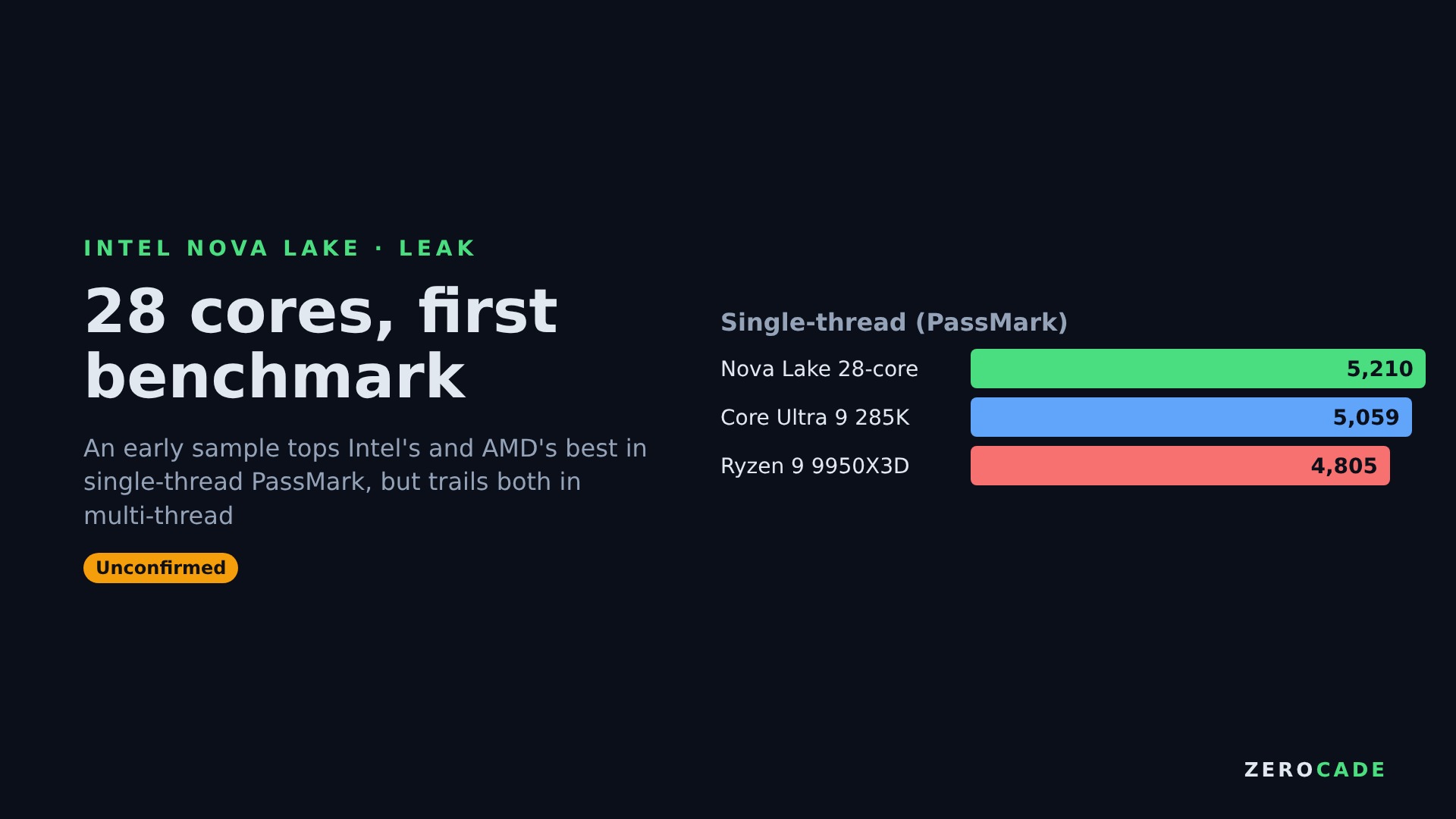
- In single-thread, it scored 5,210, ahead of the Core Ultra 9 285K (5,059) and Ryzen 9 9950X3D (4,805). Those two sell for about ₹67,500 and ₹80,900 on Amazon India right now.
- In multi-thread, it scored 61,509, behind both. An 8-core sample also showed up.
- These are pre-production chips running unfinished software. Nova Lake is expected in early 2027, and Intel hasn't confirmed any of it.
What leaked
On October 27, entries for two Nova Lake-S desktop chips turned up in PassMark PerformanceTest 11.1, a benchmark that many people run at home and upload to a public database. Neither has a real model name. The 28-core chip is listed simply as "Genuine Intel(R) 0000", which is typical for an engineering sample.
Based on the core count, it lines up with the leaked Core Ultra 9 4970K. Earlier leaks put that chip at 8 performance cores, 16 efficient cores and 4 low-power cores, rated at 125W. Our Core Ultra 4000 naming leak covers where that name comes from.
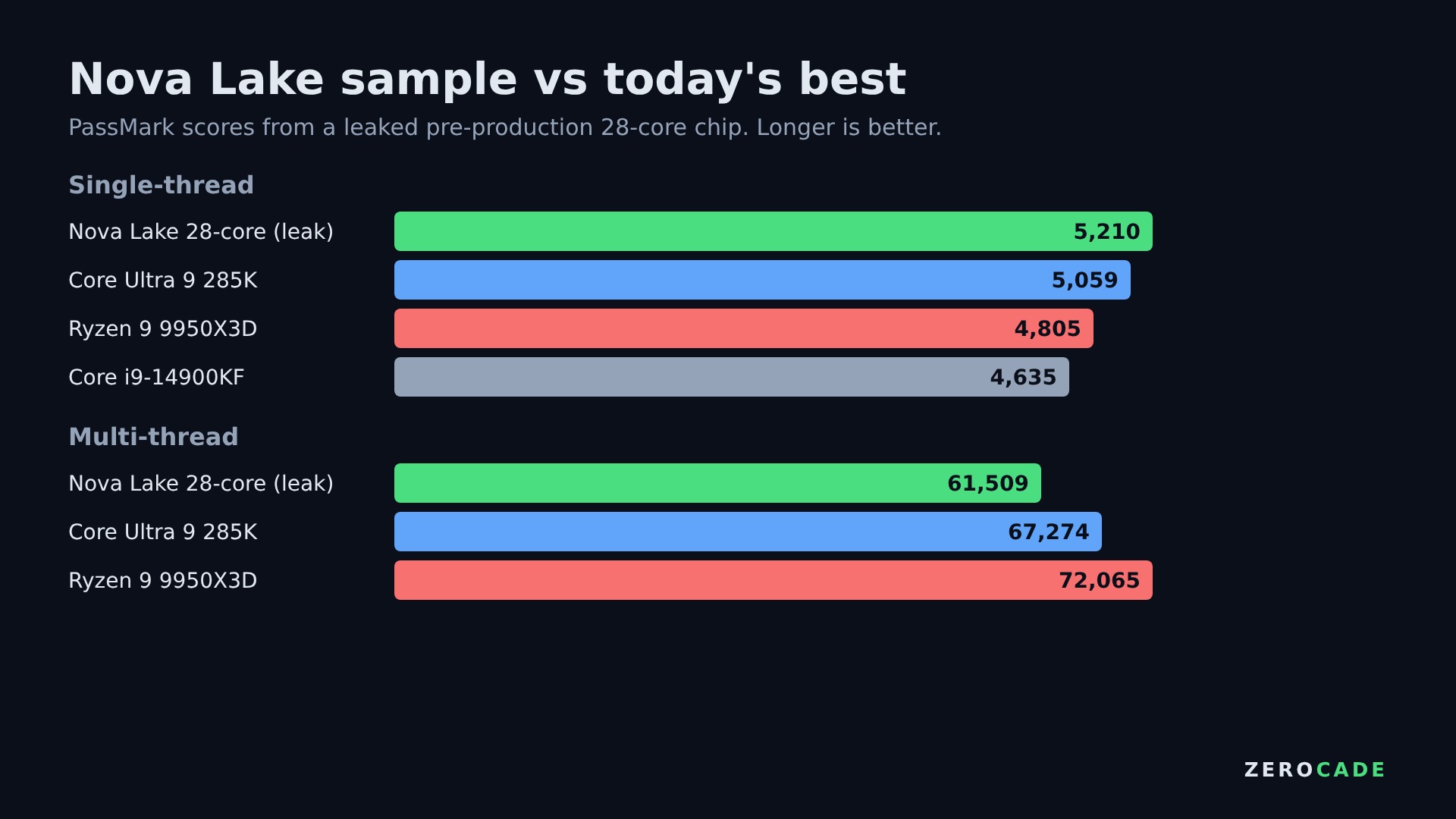
Image: Zerocade
The numbers
| Chip | Single-thread | Multi-thread |
|---|---|---|
| Nova Lake 28-core (sample) | 5,210 | 61,509 |
| Core Ultra 9 285K | 5,059 | 67,274 |
| Ryzen 9 9950X3D | 4,805 | 72,065 |
| Core i9-14900KF | 4,635 | Slightly below the Nova Lake sample |
That puts the sample about 3% ahead of the 285K and 8% ahead of the 9950X3D in single-thread. In multi-thread, it's about 9% behind the 285K and 15% behind the 9950X3D.
The 8-core sample is interesting too. It scored 5,085 in single-thread, also narrowly ahead of the 285K. Its multi-thread score of 23,478 is much weaker, barely half of what AMD's 8-core Ryzen 7 9850X3D manages.
The clock speed angle
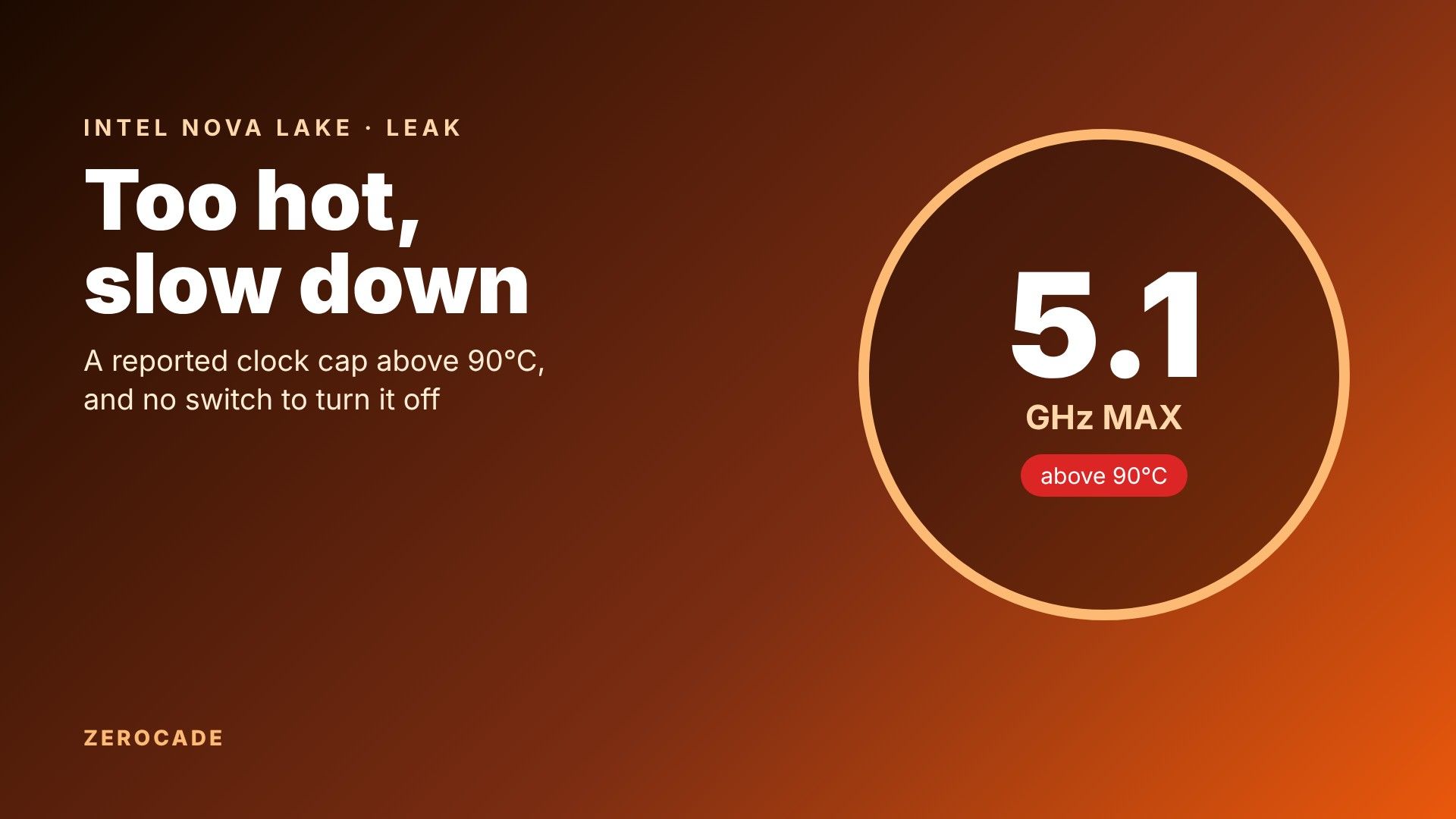
Here's the part that's caught the most attention. The 28-core sample reportedly ran at up to 4.8GHz. The 285K boosts to 5.7GHz. So Nova Lake beat it while running almost 1GHz slower.
Notebookcheck worked that out to about 1,085 points per GHz, roughly 15% more work per clock than the 285K. Against the 9950X3D it estimated 29%, though that compares against AMD's official top clock rather than what the chip actually ran at during the test.
On paper, that's a big jump in what engineers call IPC, or instructions per clock. If the final chips run at 5.5GHz or more, the single-thread lead could grow a lot. That's a big "if", though.
Why multi-thread looks weak
Two likely reasons, both common with early samples:
- Low clocks under load. Engineering samples often run well below their final speeds, especially with all cores busy.
- Unfinished software. Intel's newer chips mix three kinds of cores. Windows needs to know which jobs to send where, and that tuning usually isn't done this early.
There's also simple maths. The 285K has 24 cores and 24 threads, and the 9950X3D has 16 cores with two threads each, so 32 threads. A 28-core chip with 4 of them being low-power cores isn't guaranteed to win a test that rewards raw thread count. Our single-thread vs multi-thread explainer breaks down what each score measures, and why games lean on the first one.
How much to trust it
The scores themselves are probably real. PassMark's database is public, and several outlets reported the same entries. What they say about the final product is a different matter. Notebookcheck put it bluntly: these results are "not a reliable indication" of retail performance.
A few things to keep in mind:
- One run each. One upload can be affected by cooling, memory, Windows settings and background apps.
- Unknown settings. We don't know the memory speed, board or power limits used.
- PassMark isn't a game. It's a synthetic test. Our guide on how to read a benchmark leak has more on why early numbers swing.
Image: AMD
What it means for gamers
AMD's X3D chips are the ones to beat for gaming, mostly because of their extra stacked cache. Intel's answer is reportedly a big cache of its own, called bLLC, on some Nova Lake models. The leaked chips here aren't confirmed to have it.
Strong single-thread speed plus a big cache is, on paper, exactly the combination that helps in games. But nobody has tested a Nova Lake chip in a game yet. It also needs a new LGA 1954 socket, so a new motherboard is part of the upgrade cost.
What to watch next
Nova Lake-S is expected in Q1 2027, starting with the top 28-core model. Watch for more database entries with real model names and higher clocks, and for any sign of the big-cache bLLC versions. Intel hasn't announced prices, in India or anywhere else.