The short version
- QD-OLED is Samsung Display's OLED panel type. Blue OLED material makes the light, and a quantum dot layer turns some of it into red and green.
- Tandem means stacking several light-emitting layers on top of each other, so each one works less hard for the same brightness.
- Penta Tandem uses five layers instead of four. Samsung says that gives 1.3 times the efficiency and twice the lifespan of its previous panels.
- It's now turning up in gaming monitors like AOC's new U32G5D, a 31.5-inch 4K 180Hz screen launched in China on November 5 for about ₹49,800.
First, how OLED works
In an LCD monitor, a backlight shines through the whole screen and the pixels block or let through that light. In an OLED screen, every pixel makes its own light from organic material. That's why OLED can show true black: a pixel that's off gives off no light at all.
The weakness is wear. The organic material slowly gets dimmer the more it's used, and the harder it's driven, the faster it wears. When one part of the screen ages faster than the rest, for example under a game's health bar or a taskbar shown for hours, you get burn-in, a faint permanent shadow. Our guide to OLED, Mini-LED and LCD screens covers the basics.
What makes QD-OLED different
Samsung Display's QD-OLED has been in mass production since 2021. Instead of separate red, green and blue OLED material in each pixel, it uses blue OLED as the light source for the whole panel. A layer of quantum dots, tiny particles that glow a precise colour when light hits them, sits on top and converts blue light into red and green where needed.
This gives very pure, saturated colours, and it's why QD-OLED monitors often cover around 99% of the DCI-P3 colour range used for films and HDR games.
LG Display's rival technology, WOLED, works differently. It uses white OLED light and colour filters to make each colour. Both companies now stack layers to get more out of their OLED material, and LG markets its own panels as Tandem OLED.
What "tandem" means
A tandem OLED stacks several light-emitting layers on top of each other, all driven by the same electrical current. Each layer adds its own light.
Here's why that helps. If one layer has to produce all the brightness, it has to be pushed hard, which wears it out faster. Split the job across several layers and each one can run more gently for the same brightness. Samsung describes it as spreading the energy across the organic material. You can use that headroom in two ways: more brightness at the same power, or the same brightness with less power and less wear.
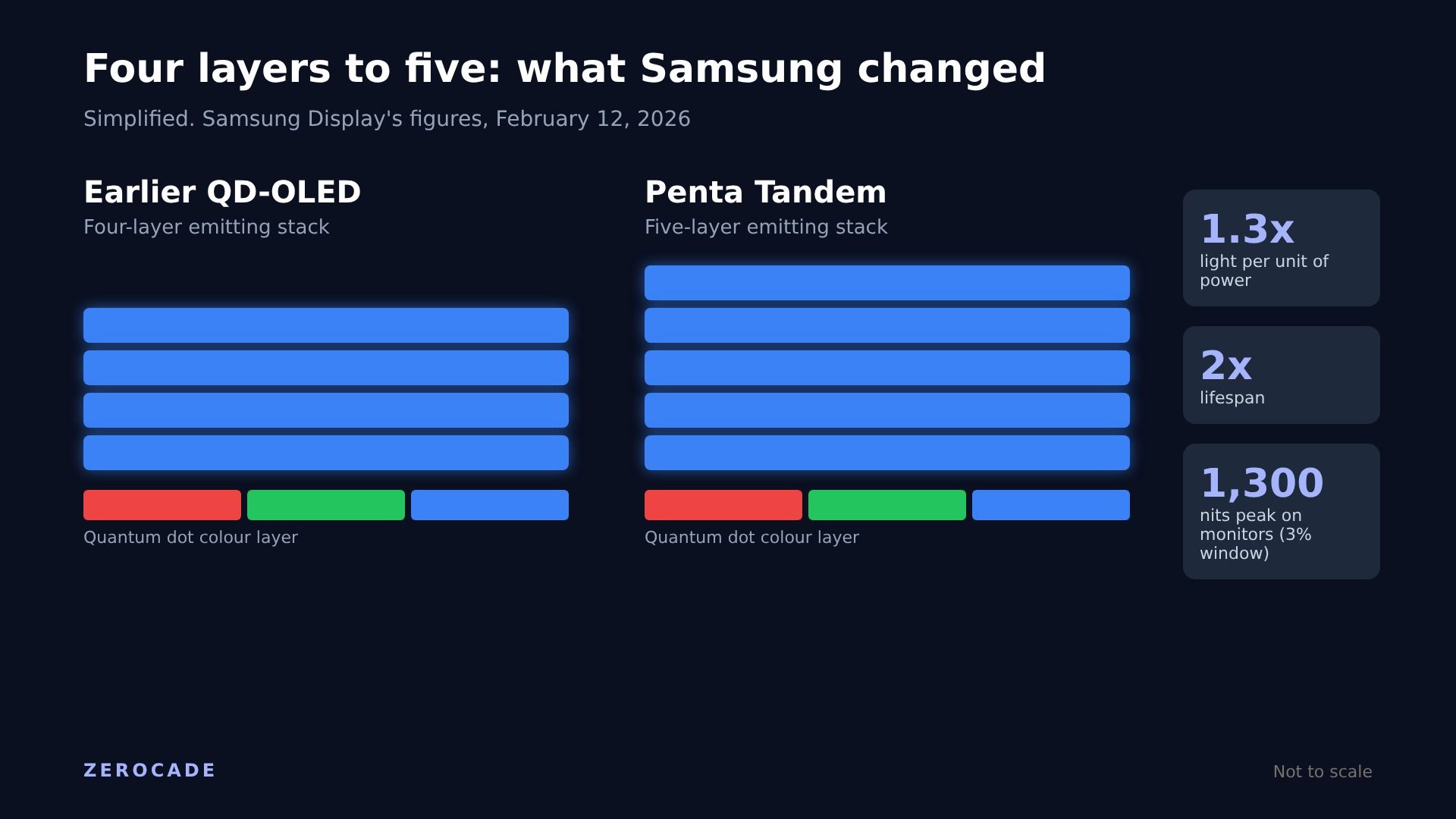
Image: Zerocade
What Penta Tandem changes
Samsung Display announced QD-OLED Penta Tandem as a brand on February 12, 2026. It says it moved its blue emitting stack from four layers to five starting in 2025, in TVs and a 27-inch 4K monitor panel, before expanding to more monitor sizes in 2026.
Compared with the previous four-layer panels, Samsung claims:
| Claim | Samsung's figure |
|---|---|
| Light efficiency | 1.3 times higher |
| Lifespan | 2 times longer |
| Peak brightness, monitors | 1,300 nits (3% of the screen lit) |
| Peak brightness, TVs | 4,500 nits (3% of the screen lit) |
| Monitor certification | DisplayHDR True Black 500 possible |
Two notes on those numbers. "3% of the screen lit" means a small bright highlight, like the sun or an explosion, not a full white screen, which is always much dimmer on OLED. And "lifespan" is about how long the organic material keeps its brightness. Samsung hasn't published a burn-in figure, but material that wears half as fast should, on paper, be more resistant to it.

Image: Samsung Display
The monitors using it
The panel is showing up across brands. Notebookcheck lists Penta Tandem panels in Asus's ROG Swift PG27UCDM, PG32UCDM3 and PG34WCDN, and MSI's MPG 272URX and MPG 341CQR X36. Two recent examples show the range:

Image: Samsung Display
| Monitor | Size and resolution | Refresh rate | Peak brightness | HDR certification |
|---|---|---|---|---|
| AOC U32G5D | 31.5-inch 4K | 180Hz | 450 nits | True Black 400 |
| Asus ROG Strix XG27ACDMSR | 27-inch 1440p | 320Hz | 1,300 nits | True Black 500 |
The AOC costs CNY 3,498 (about ₹49,800, or $524) as a launch price in China, with no global release announced. Asus hasn't priced its model yet.
That table makes an important point. The same panel family doesn't guarantee the same results. The AOC is rated far dimmer than Samsung's headline figure, because each monitor maker decides how hard to drive the panel. Our guide to dual-mode gaming monitors covers another spec that varies between models built on similar panels.
What to check before you buy
- The HDR rating, not just the panel name. True Black 500 means a brighter monitor than True Black 400.
- The warranty. Some makers cover burn-in, some don't. That matters more than any lifespan claim.
- India availability. Most of these monitors launch in the US, Europe or China first. Check whether there's an official Indian price and local warranty before importing.
On paper, Penta Tandem chips away at OLED's two old weaknesses, brightness and burn-in. Real-world burn-in results will take years of use to judge.