The short version
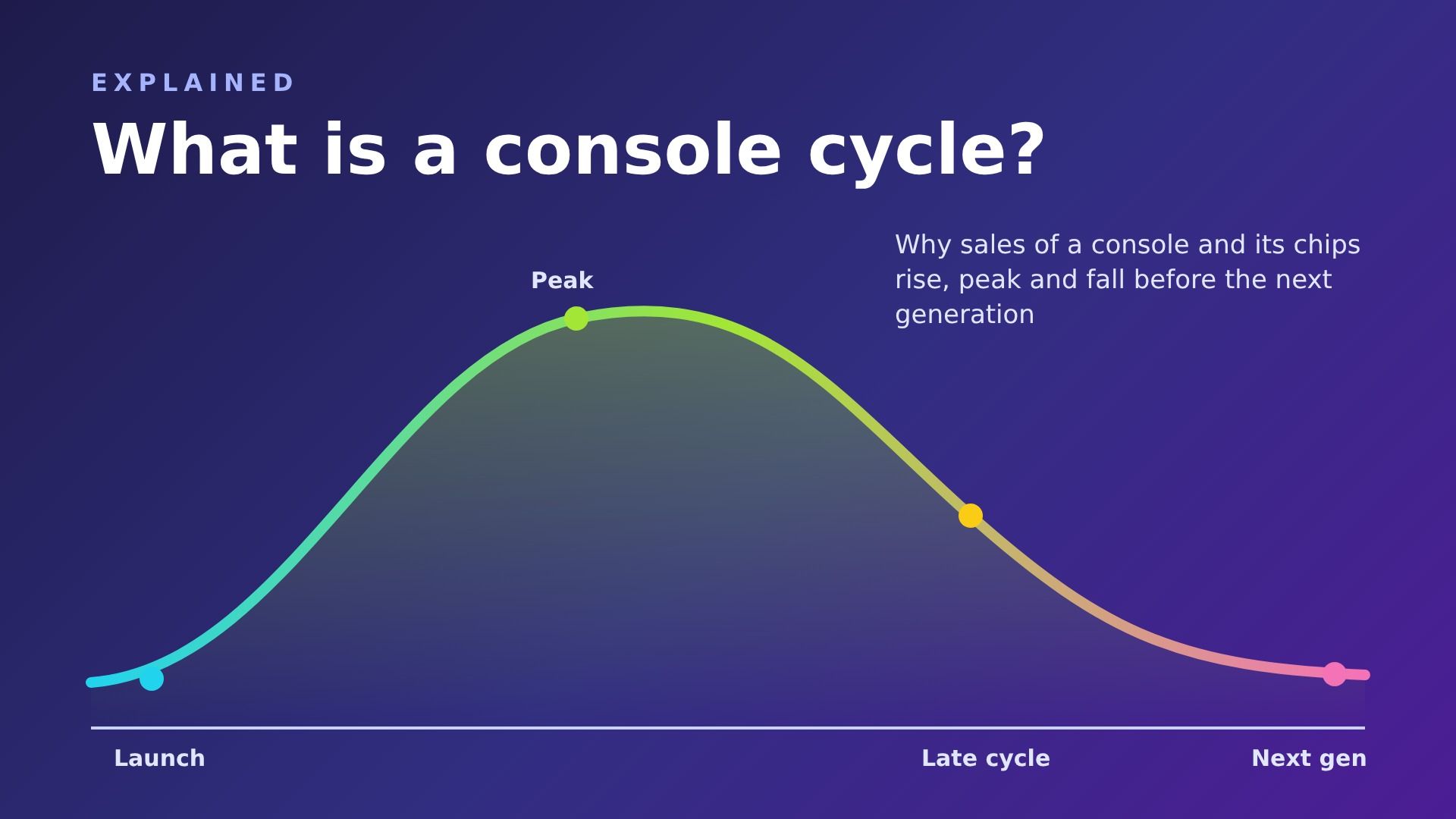
- A console cycle is the life of a console generation, usually around seven years, from launch to the arrival of its successor.
- Sales follow a curve: slow at launch, a peak a few years in, then a steady decline as everyone who wants one already has one.
- The PS5 is in its sixth year. Sony shipped 16.0 million in its last financial year, down from 18.5 million the year before.
- The chipmaker feels it too. AMD, which makes the PS5 and Xbox Series chips, just reported gaming revenue down 40%, to $773 million (about ₹7,340 crore).
Why it's in the news
On November 3, AMD reported its Q3 2026 results. CEO Lisa Su put the gaming drop down to lower semi-custom sales, "as expected at this stage of the console cycle." It's a phrase you'll hear a lot over the next year, so here's what it means.
The four stages of a generation
1. Launch. A new console arrives, usually in November, and demand outstrips supply. The chips are new and expensive to make, so companies often sell the hardware at a thin margin or even a loss. Sony said in 2020 that the cheapest PS5 was being sold at a loss at first. The game library is small, so early buyers are mostly enthusiasts.
2. Growth and peak. Over the next two to four years, the library fills out, supply catches up and sales climb. This is also when companies used to cut costs. Chips get die-shrunk, meaning moved to a newer manufacturing process so they're smaller, cheaper and cooler. The PS4 got a slimmer redesign in 2016, launched at $299 against the original's $399. The PS5 got a revised chip in 2022 and a slim model in 2023.
3. Mid-generation refresh. Around year three or four, a more powerful version often appears for people who want better graphics: the PS4 Pro in November 2016, the PS5 Pro in November 2024 at $699.99 (about ₹66,500).
4. Late cycle. By year five or six, most people who want the console already own one. Hardware sales fall year after year, even though people keep buying games and subscriptions. The next generation is being built, and developers start getting early hardware.
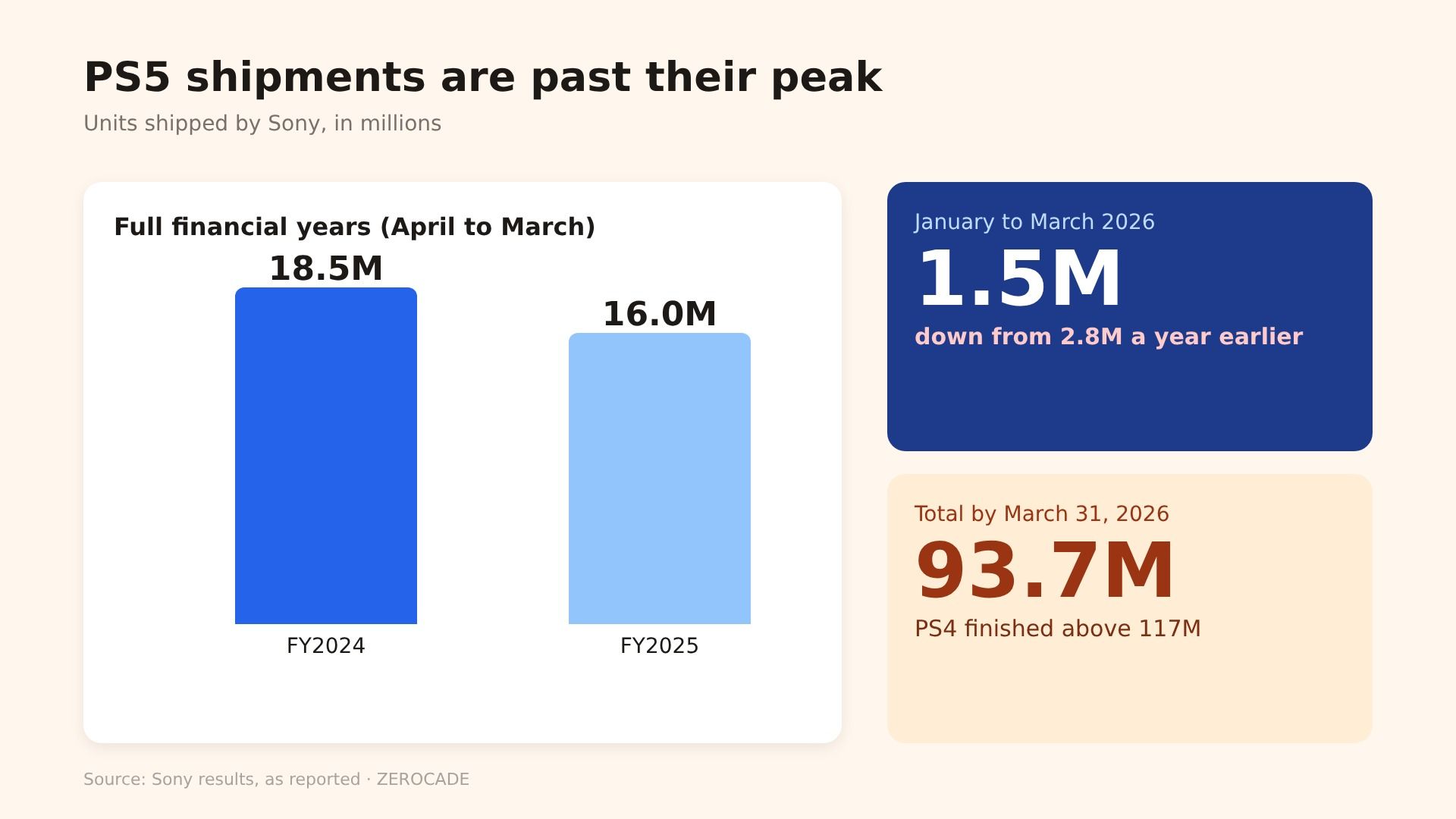
Image: Zerocade
Where the PS5 is now
The PS5 launched on November 12, 2020, so it's now six years old. Sony's numbers show the slowdown clearly:
| Period | PS5 units shipped |
|---|---|
| FY2024 (April 2024 to March 2025) | 18.5 million |
| FY2025 (April 2025 to March 2026) | 16.0 million |
| January to March 2025 | 2.8 million |
| January to March 2026 | 1.5 million |
| Total by March 31, 2026 | 93.7 million |
For comparison, the PS4 finished its life at more than 117 million. The PS5 is still selling, but each quarter adds less than the same quarter a year before.
That doesn't mean PlayStation is struggling. Sony reported 125 million monthly active users on PSN, and most of a console maker's profit comes from games, subscriptions and its store cut, not the box itself.

Image: Sony Interactive Entertainment
Why the chipmaker feels it first
Sony and Microsoft don't buy chips off a shelf. AMD designs a semi-custom chip for each of them, and they order them in huge batches. We cover how that works in our semi-custom chip explainer.
When console production slows, those orders shrink, and AMD sees it straight away. A year ago its gaming revenue was about $1.3 billion for the quarter. This year it was $773 million. When the next generation starts, the curve flips: AMD gets big orders for the new chips months before the consoles reach shops.
What's different this time
In earlier generations, the late cycle was when prices fell. That isn't happening now.
- The PS5 went up in the US, from $499.99 to $549.99, in August 2025.
- Microsoft raised Xbox Series X|S prices more than once in 2025.
- Nintendo raised the Switch 2 from $449.99 to $499.99 on September 1, 2026.
The main reason is the memory shortage. AI data centres are buying up RAM and storage, and consoles need both. Sony even told investors it would plan PS5 production around "the volume of memory we can procure at reasonable prices." A shortage like that can make a late-cycle console both pricier and harder to build, which drags sales down further.
What comes next
The next generation is already on its way, though nothing has a firm date:
- PlayStation 6: Sony hasn't announced it. A report says a reveal is planned for early March 2027.
- Next Xbox (Project Helix): Microsoft has confirmed a custom AMD chip and said developers will start getting early hardware in 2027.
If those consoles launch in late 2027 or 2028, the PS5 generation will have lasted about seven or eight years, right in line with the PS4.
For you, the late cycle has an upside: the PS5 library is huge and mature. The thing to watch is AMD's gaming revenue. When it starts climbing again, the next generation is being built.