The short version
- OnePlus announced the Ace 7 and Ace 7 Pro in China on October 29, 2026. Both have a built-in cooling fan, something usually only seen on dedicated gaming phones like RedMagic.
- Most phones cool passively: heat spreads through a vapour chamber and graphite sheets, then leaves through the body. A fan actively pushes air through, so the chip can stay fast for longer.
- The trade-offs are real: dust, noise, a bit of battery drain, and a design that has to keep water out. OnePlus says both phones are still rated IP68/IP69K.
- The Ace 7 Pro costs CNY 4,799 in China. There's no India launch or price, though the series is rumoured to come out globally as the OnePlus 16R.
Why phones get hot
A phone's processor works by switching billions of tiny transistors on and off. Every switch wastes a little energy as heat. A chip like the Snapdragon 8 Elite Gen 5 can draw well over 10 watts when a game pushes it hard, and almost all of that ends up as heat.
That heat has to go somewhere. In a laptop, a fan blows it out. In a phone, it normally spreads through the frame and glass into your hands and the air. If heat comes in faster than it leaves, the chip gets too hot. It then protects itself by slowing down, which is called thermal throttling. Our thermal throttling guide explains it in detail. In a game, throttling shows up as a frame rate that starts smooth and drops after 15 or 20 minutes.
How most phones stay cool without a fan
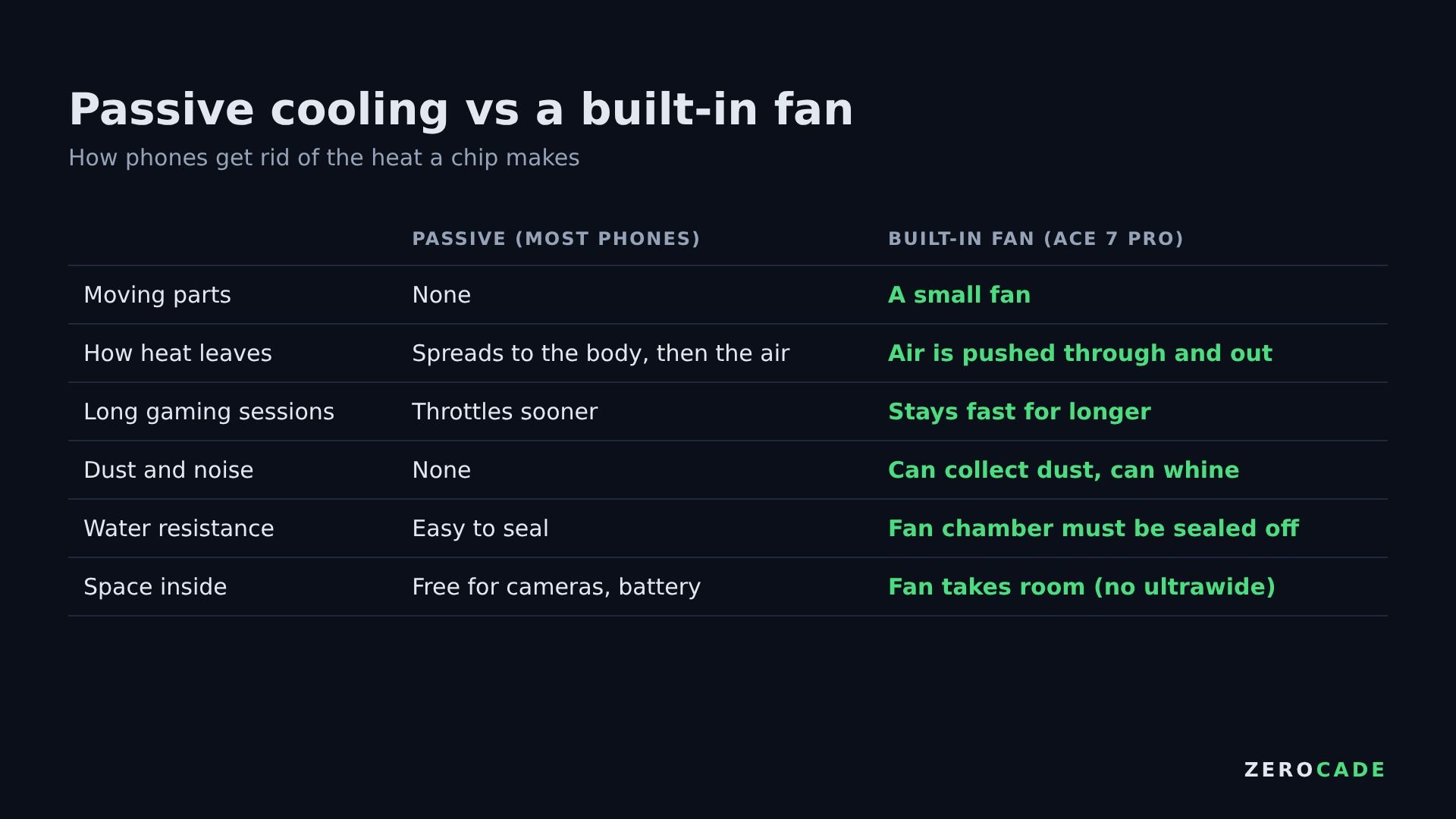 Image: Zerocade
Almost every phone uses passive cooling, meaning nothing moves. The main parts are:
- Vapour chamber: a thin, sealed copper plate with a little liquid inside. The liquid boils over the hot chip, the vapour spreads across the plate and condenses on cooler parts, then flows back. It moves heat away from the chip far better than solid metal.
- Graphite sheets: thin layers that spread heat sideways across the phone's body.
- Thermal gel or paste: fills the gaps between the chip and the cooling parts, so heat doesn't get stuck in tiny air pockets.
All of this only spreads heat around. In the end, the heat still has to leave through the phone's surface, and a slab of glass and metal can only shed so much. That's the ceiling a fan is designed to break.
What a fan adds
A fan pulls cool air in and pushes warm air out across a heatsink inside the phone. Moving air carries heat away much faster than still air, so the phone can sustain higher performance before throttling kicks in.
On the Ace 7 Pro, OnePlus uses a bi-directional fan with two air intakes and two exhaust grilles. Unusually, the vents sit on the camera island. RedMagic phones put their vents on the side frame instead. OnePlus dropped the ultrawide camera on the Pro to make room for the fan.
 Image: OnePlus
The cheaper Ace 7 also has a fan, but it isn't bi-directional. It uses a chip OnePlus calls the Snapdragon 8 Elite Gen 5 V Series, with a cut-down GPU. It's a lower-power chip, so it needs less help to stay cool.
The downsides of a phone fan
Fans aren't free. On paper, these are the costs:
- Dust and lint: any opening that lets air in also lets dirt in. Over time that can clog the fan and heatsink.
- Noise: small fans spin fast and can whine. OnePlus hasn't published a noise figure.
- Battery: the fan uses some power, though far less than a throttled chip wastes by running hot.
- Water: openings are the enemy of water resistance. OnePlus claims IP68/IP69K anyway, so the fan chamber must be sealed off from the rest of the phone.
- Space: the fan takes room that could hold a camera, battery or speaker, as the missing ultrawide shows.
Clip-on coolers are the other option. The Infinix GT 50 Pro ships with one in the box. They're often stronger, but you have to carry them.
OnePlus Ace 7 and Ace 7 Pro at a glance
 Image: OnePlus
Both phones share a 6.78-inch display that runs at 165Hz in daily use and 185Hz in supported games. Both have a 9,000mAh battery with 100W charging, and both are 8.5mm thick. The Ace 7 Pro costs CNY 4,799 (about ₹56,000 at current rates) and the Ace 7 costs CNY 4,399 (about ₹51,500). Those are straight conversions, not Indian prices.
The Pro's chip is the full Snapdragon 8 Elite Gen 5. If you're curious where Qualcomm goes next, our Snapdragon 8 Elite Gen 6 comparison covers the coming generation.
Will it come to India?
OnePlus Ace phones usually launch in China first and come to India under a different name. Reports say this series could arrive globally as the OnePlus 16R, but OnePlus hasn't confirmed that, or whether the fan would survive the rebrand.
If you game for long sessions on your phone, the thing to watch is whether a fan-cooled model actually reaches India. Until then, a clip-on cooler is the cheaper way to fight throttling.