
The short version
- Neural rendering means running small AI networks inside a game's rendering pipeline, on the GPU's AI cores, to do jobs that used to be calculated the slow way.
- You already use it if you've turned on DLSS, PSSR or FSR upscaling or frame generation. Newer forms rebuild lighting, materials and even textures.
- It saves memory. Nvidia showed a scene's textures shrinking from 6.5GB to 970MB with neural compression, about 85% less.
- Xbox's Jason Ronald said on November 16 that the RAM shortage makes neural rendering central to Project Helix. RAM prices are why consoles cost more this year.
Why this came up now
Jason Ronald leads development of Project Helix, Xbox's next console. In an interview with GamesRadar published on November 16, he called this a "challenging time" for hardware because of the global RAM shortage. He also called it one of the most exciting, because "we have to invent entirely new technology".
The technology he pointed to is neural rendering, which he called "an entirely new way to generate a frame". GamesRadar summarised his view as producing frames without needing much more raw power or memory. That matters when memory is the expensive part.

Image: Nvidia
Step 1: the old way
A traditional renderer calculates everything. For each pixel, it works out which surface is visible, what texture sits on it, how light hits it and how that light bounces. More pixels, more frames or more realistic lighting all mean more calculation and more memory for textures and buffers.
That's why games run at lower resolutions or 30fps on consoles. Our CPU-bound vs GPU-bound guide covers where those limits come from.
Step 2: let a network guess the rest
A neural network is a set of maths trained on huge amounts of example data until it can predict an answer. Neural rendering puts small ones at specific steps inside the frame. Microsoft's DirectX team defines it as the suite of techniques that use AI and machine learning in rendering. Its "cooperative vectors" feature, in DirectX Shader Model 6.9, lets a small network run inside a pixel shader without taking over the whole GPU.
The jobs those networks do so far:
| Technique | What the network does | Examples |
|---|---|---|
| Upscaling | Turns a low-resolution frame into a sharp high-resolution one | DLSS, PSSR, FSR Upscaling |
| Frame generation | Creates extra frames between real ones | DLSS 4 adds up to three per rendered frame |
| Ray reconstruction | Rebuilds clean ray-traced lighting from a few noisy samples | DLSS Ray Reconstruction, AMD's ML ray regeneration |
| Radiance cache | Learns how light bounces around a scene and predicts it | Nvidia Neural Radiance Cache, AMD FSR Radiance Caching |
| Neural materials | Replaces complex material maths with a small network | Nvidia claims up to 5x faster |
| Neural textures | Stores textures as a compact network instead of an image | Nvidia RTX Neural Texture Compression |
| Neural lighting | Adds photoreal lighting and materials to the finished frame | DLSS 5 |
Each one swaps expensive, exact calculation for a fast, trained guess. The GPU's tensor or matrix cores, built for AI maths, do the guessing.
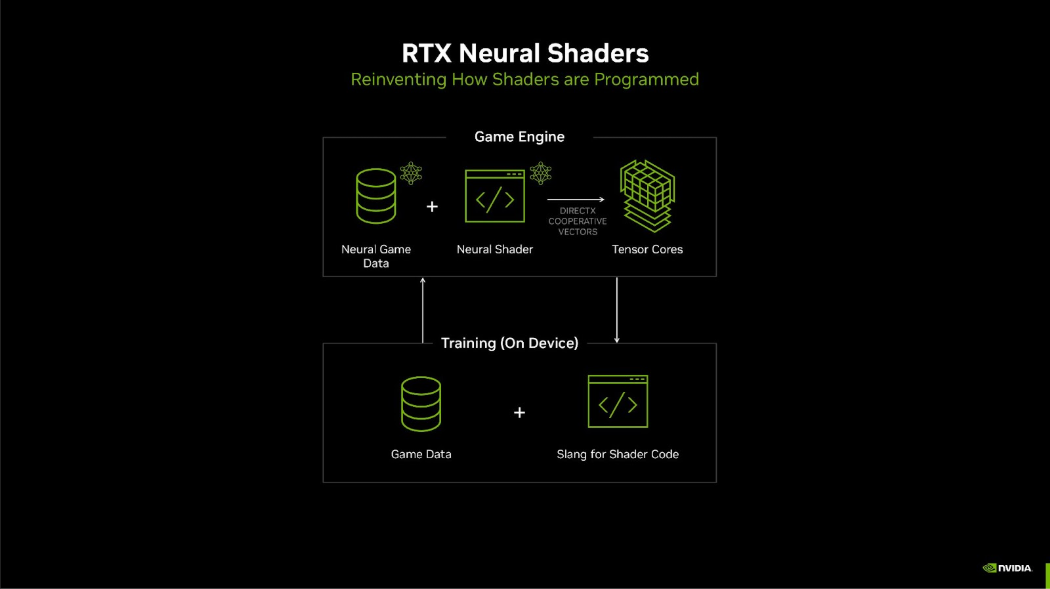
Image: Nvidia
Step 3: why it saves memory
Textures are one of the biggest users of graphics memory in a game. Today they're stored with block compression, which shrinks them by a fixed amount. Neural texture compression instead trains a tiny network per material to rebuild the texture when it's needed.
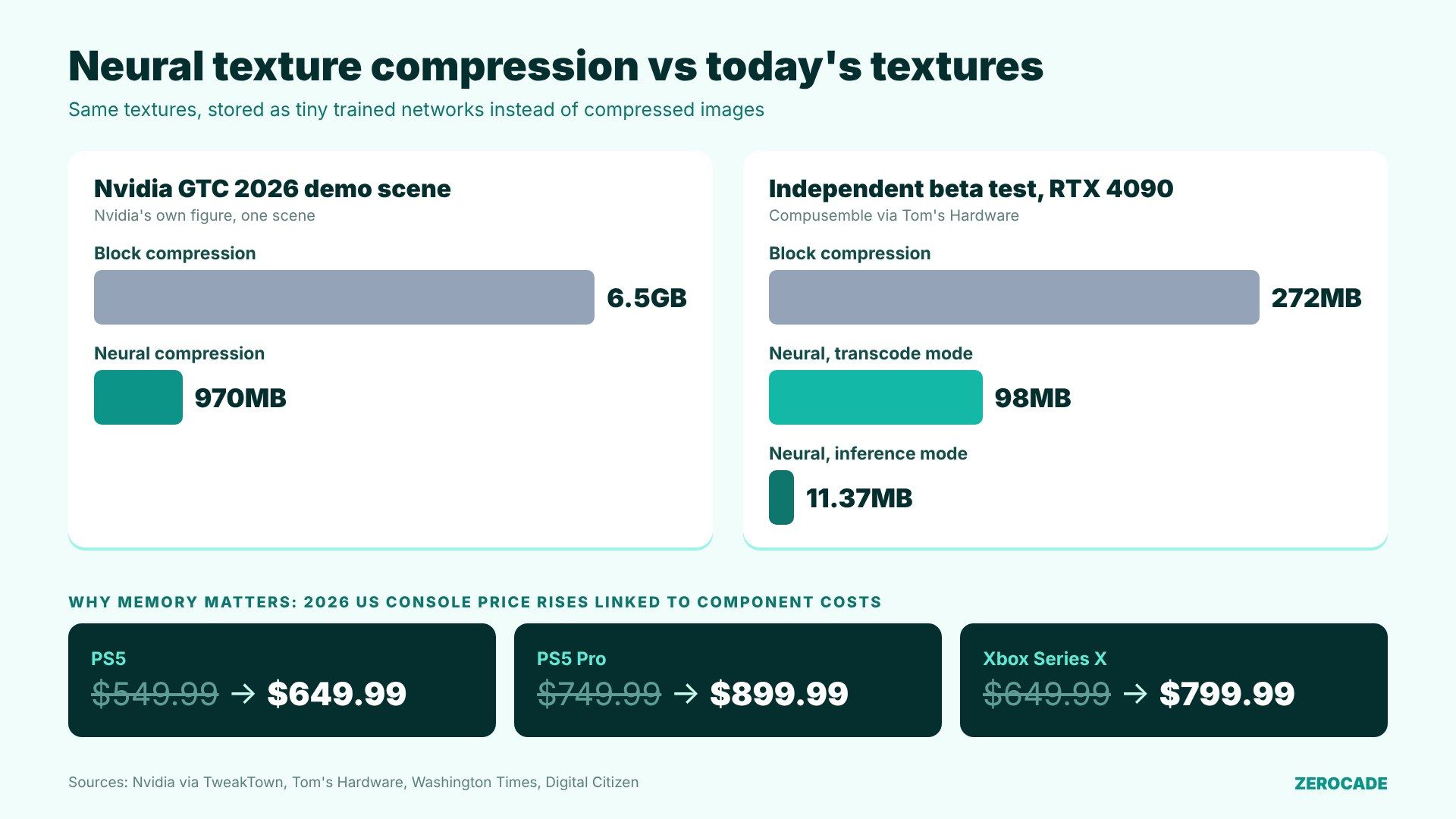
Image: Zerocade
- Nvidia's own demo at GTC 2026 cut a scene's textures from 6.5GB to 970MB. That's one scene, chosen by Nvidia.
- An independent test of the beta SDK on an RTX 4090 cut 272MB of textures to 98MB in its safer mode, which turns them back into normal compressed textures on load. Its full mode, which rebuilds texture data as it's drawn, got it down to 11.37MB, at some cost in frame rate.
- Microsoft says Helix supports neural texture compression, according to Tom's Hardware's report on its March slides.
Upscaling saves memory too. A game rendering at 1080p and upscaling to 4K needs smaller buffers than one rendering at native 4K.
Why RAM prices make it urgent
Memory makers have moved factory capacity to AI servers. TrendForce expects regular DRAM contract prices to rise another 10-15% this quarter, with graphics memory prices still climbing. Sony and Microsoft have both raised console prices this year and pointed to component costs. In the US:
- PS5 went from $549.99 to $649.99 in April, and the PS5 Pro from $749.99 to $899.99.
- Xbox Series X went from $649.99 to $799.99 in August.
Sony CEO Hiroki Totoki said in May that memory costs will be "very high" in its next financial year, and that Sony hasn't decided when to launch its next console. We covered how this hits PC builders in our DDR4 vs DDR5 guide. On paper, a console that needs less memory per frame is cheaper to build, which is the bet Ronald is describing.
Where PlayStation stands
Sony is on the same path. The PS5 Pro's upgraded PSSR, which launched with Resident Evil Requiem in February, uses a network from Project Amethyst, Sony's partnership with AMD. Mark Cerny has described Amethyst hardware for a "future console", including Neural Arrays for AI work and Universal Compression to save bandwidth. That's widely assumed to mean PS6, but Sony hasn't confirmed it.
For Helix, Microsoft has confirmed a custom AMD chip built for next-gen DirectX and FSR, with ML upscaling, ML ray regeneration and multi-frame generation. Developers are due to get early hardware in 2027. A $1,800 price and a late-2028 launch have been reported, but both are rumours. We covered the earlier Helix price report in October.

Image: Nvidia
The catches
- It's a guess. Networks can smear fine detail, ghost behind moving objects or invent things that weren't there.
- Frame generation adds lag. Made-up frames look smooth, but your inputs only register on real ones.
- Art direction. When DLSS 5 was shown in March, one developer called it "just a garbage AI filter", and others said it airbrushed faces. Nvidia says studios can tune the effect. Our Hogwarts Legacy DLSS 5 report covers how it landed.
- It needs support. Each game has to build these features in, and neural texture compression is still a beta SDK.
What to watch
Watch for the first games to ship neural texture compression, and for Microsoft's next Helix details. In India, the easiest way to see neural rendering today is DLSS 5 in Hogwarts Legacy or NBA 2K27, which needs an RTX 50 card. Price trackers put the RTX 5060 Ti 16GB at around ₹45,000 to ₹46,500.