The short version
- BGMI Air launches in India on December 10, with a closed beta running from November 20 to 24. It's about a 1GB download on Android and is reported to need just 1.5GB of RAM and an Adreno 306 GPU, the graphics in 2014's Snapdragon 410.
- Unlike PUBG Mobile Lite in 2019, it keeps the full match: 100 players on Erangel, with your BGMI account and items carried over.
- Lite games get small by cutting what each phone has to load, draw and remember: lighter textures, simpler models at a distance, baked lighting, lower resolution and optional download packs.
- It matters more in 2026. Memory prices have pushed up the cost of budget phones in India, and people are keeping their old phones longer.
What BGMI Air is
Krafton India first announced it in August as "BGMI Lite", then renamed it BGMI Air in October after it passed 10 million pre-registrations. It has since passed 14 million on Google Play. We covered the original announcement in October.
| BGMI Air | BGMI | |
|---|---|---|
| Android download | About 1GB | 412MB to 850MB, plus about 1.2GB of game files |
| iPhone download | About 1.8GB | About 4GB |
| Minimum RAM | 1.5GB (reported) | 2GB recommended at launch |
| Map and players | Erangel, 100 players | Several maps, 100 players |
| Account | Uses your BGMI account and items | – |
The Play Store listing promises "no extra mandatory package before your first match" and lets you pick which extra modules to download. The closed beta is invite-only in Mumbai, Delhi and Kolkata for players aged 18 and over. Some reports say an open beta starts on November 25, but Krafton hasn't confirmed that publicly.
Digit reports two optional monthly plans on the App Store: Prime at ₹89 and Prime Plus at ₹449.

Why a budget phone struggles in the first place
Three limits matter most on a cheap phone: memory, graphics power and heat.
Memory is the hard wall. Android's own game guidance says games typically get between a quarter and half of a phone's physical RAM. On a 2GB phone that's roughly 0.5GB to 1GB, because Android, the launcher and background apps need the rest. If a game asks for more, Android kills it, which is the crash-to-home-screen many budget phone owners know well. Before that, the phone starts juggling memory, which Google says can cause frame times of "a second or more".
The GPU is the second limit. An Adreno 306 is a 28nm chip from 2014. It supports OpenGL ES 3.0, but it has a fraction of the power of a modern mid-range chip.
Heat is the third. Google's thermal documentation notes that phones can only hold high performance for a limited time before throttling. A game that runs well for five minutes can stutter in minute fifteen, right when the final circle closes.
The tricks lite games use
1. Shrink the textures
Textures are the images wrapped around every model, and they take up most of a game's memory. Phones use compressed formats like ETC2, which works on any OpenGL ES 3.0 device, and ASTC. Google says compressed textures can use up to 36x less space than uncompressed ones. Google Play can also send each phone only the format it supports, so nobody downloads both.
Lite versions go further by shipping lower-resolution textures. A wall that's a 2048-pixel image on a flagship can be a 512-pixel one on a budget phone, which takes about one-sixteenth of the memory.
2. Draw less at a distance
Level of detail (LOD) swaps distant objects for simpler versions with fewer polygons. A house 300 metres away might be a box with a painted texture. Lite games push those switches closer to the camera and cut how far you can see, so there's less on screen at any moment.
3. Bake the lighting
Real-time shadows are expensive. Epic's mobile guidelines for Unreal Engine, which BGMI uses, tell developers to use "static (baked) lights wherever possible", meaning lighting is calculated once during development and painted into the scene. One analysis of Free Fire found that on 1GB phones it drops shadows and most light effects.
4. Render fewer pixels
Many phones render the game at a lower internal resolution and scale it up to the screen. In Unreal Engine, the default mobile render scale works out to 720p on Android. Capping the frame rate at 30fps also gives each frame twice the time to finish than at 60fps.
5. Download only what you need
BGMI already offers optional Low and HD resource packs (about 230MB and 1.68GB) and lets players remove maps. Google's Play Asset Delivery lets games ship packs at install time, right after install or only on demand. BGMI Air's "choose your modules" approach is built on that idea.
6. Different settings for different phones
PUBG Mobile's engine lead said at GDC 2023 that the game runs on more than 22,000 phone models, over 55% of them low-end, and that the team has "different strategies for lower and higher level devices". Unreal sorts Android phones into Low, Mid and High profiles based on their GPU, and each profile gets its own settings automatically.
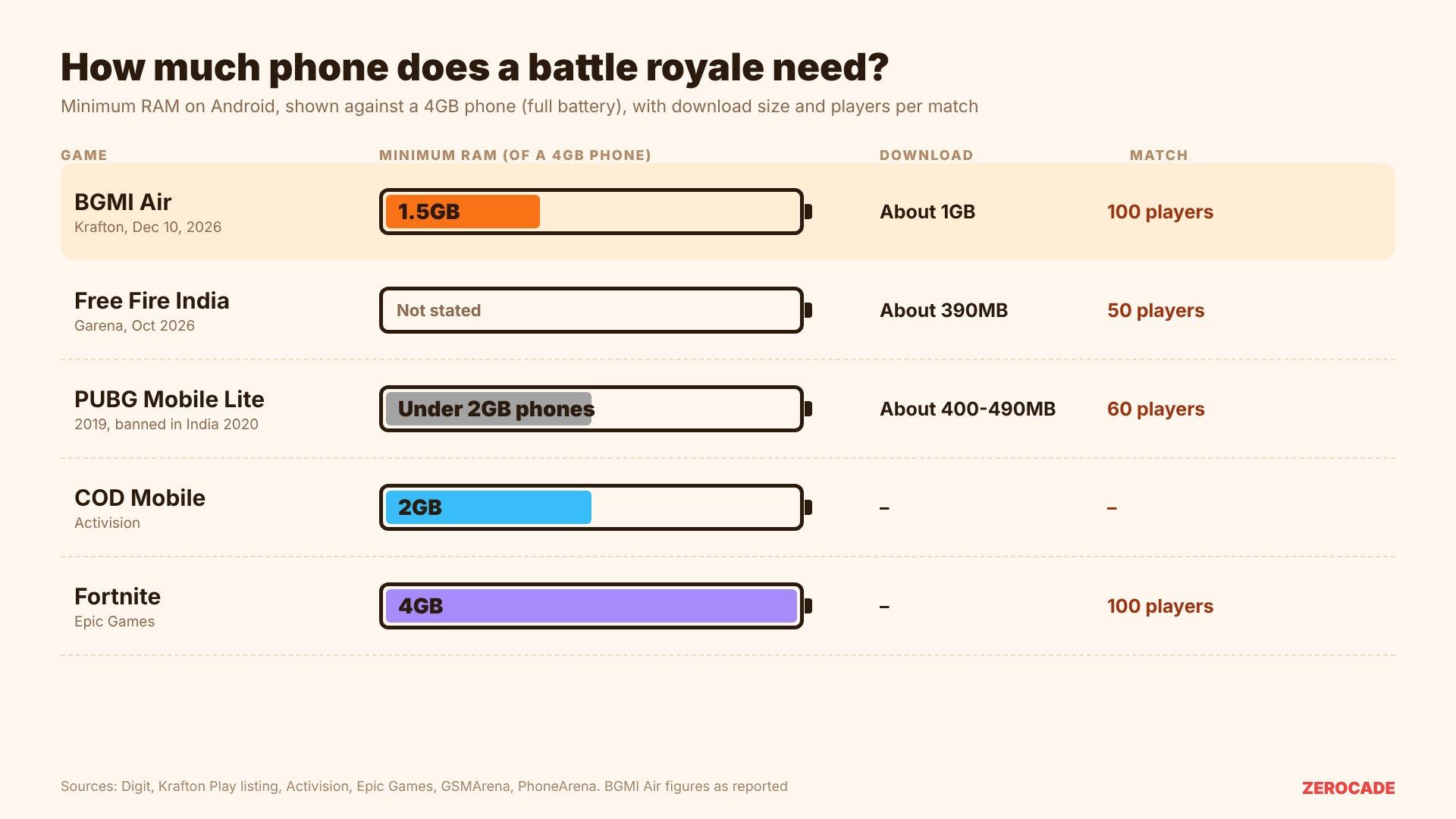 Image: Zerocade
The other way: shrink the match
BGMI Air keeps the full 100-player Erangel match, which is ambitious for 1.5GB of RAM. Earlier lite games cut the match itself:
- PUBG Mobile Lite launched in India in July 2019 with 60 players on a 2km x 2km map instead of 8km x 8km, and a download of roughly 400MB to 490MB. It was banned in India in September 2020 along with PUBG Mobile.
- Free Fire was built small from the start: 50 players, matches of around 10 minutes, and early versions playable on 1GB of RAM. The new Free Fire India, launched on October 28, is about a 390MB download on Android. We covered its launch and playtime limits last month.
Fewer players means fewer characters to draw, animate and send over the network, and a smaller map means less to load. It's the easiest saving there is, but it changes the game.
For comparison, the bigger shooters need much more: COD Mobile officially needs 2GB of RAM and Android 6.0, while Fortnite needs 4GB, Android 10 and an Adreno 530-class GPU.
 Image: Garena
Why this matters more in India now
India's phone market is shifting in a way that makes lite games more important. Counterpoint reported that shipments of phones under ₹15,000 fell 45% in the second quarter of 2026 as memory prices nearly quadrupled since September 2025. Memory now makes up more than 45% of the parts cost of those phones. TechCrunch reported people are now keeping phones for about four years.
Today's ₹6,000 to ₹8,000 phones show the squeeze. Models like the Redmi A5 (₹6,499 at launch for 3GB), itel A100 (from ₹6,799) and Lava Bold N4 Lite (₹7,999 with 3GB) use entry-level Unisoc chips and often run Android Go, Google's lighter Android for low-RAM phones. That's the audience BGMI Air is chasing.
What to watch on December 10
On paper, BGMI Air's pitch is the full Erangel experience on hardware that BGMI itself has outgrown. The real test is the final circle: whether a 1.5GB phone can hold a steady frame rate with dozens of players nearby, and how hot it gets doing it. If you're on a low-end phone, watch for Krafton's official device list at launch, and check how much free storage you have before the update modules start downloading.