The short version
- Every frame needs two jobs done. The CPU works out what happens: physics, AI, traffic, what to draw. The GPU then draws it.
- Whichever chip takes longer sets the frame rate. If it's the CPU, a game is CPU-bound. If it's the GPU, it's GPU-bound.
- Lowering the resolution only makes the GPU's job easier. In a CPU-bound game, it adds no frames at all.
- That's why GTA 6 targets 30fps even on the PS5 Pro: the Pro has a much bigger GPU, but essentially the same CPU as the PS5.
Two chips, one frame
Think of every frame as a relay. The CPU runs first, the GPU second.
The CPU handles the world. It moves every pedestrian and car, decides what the AI does next, runs the physics, streams new parts of the map from the SSD, and builds the list of things the GPU needs to draw (each request is called a draw call).
The GPU handles the picture. It turns that list into pixels: geometry, textures, lighting, shadows, ray tracing, effects. The more pixels and the fancier the lighting, the longer it takes.
In a real game the two work at the same time on different frames, so the slower one decides how often a new frame comes out. To hit 30fps, both need to finish their part in 33.3ms. For 60fps, it's 16.7ms. Our 1% lows guide covers how frame times work in more detail.
Why lowering the resolution sometimes does nothing
This is where the difference shows up.
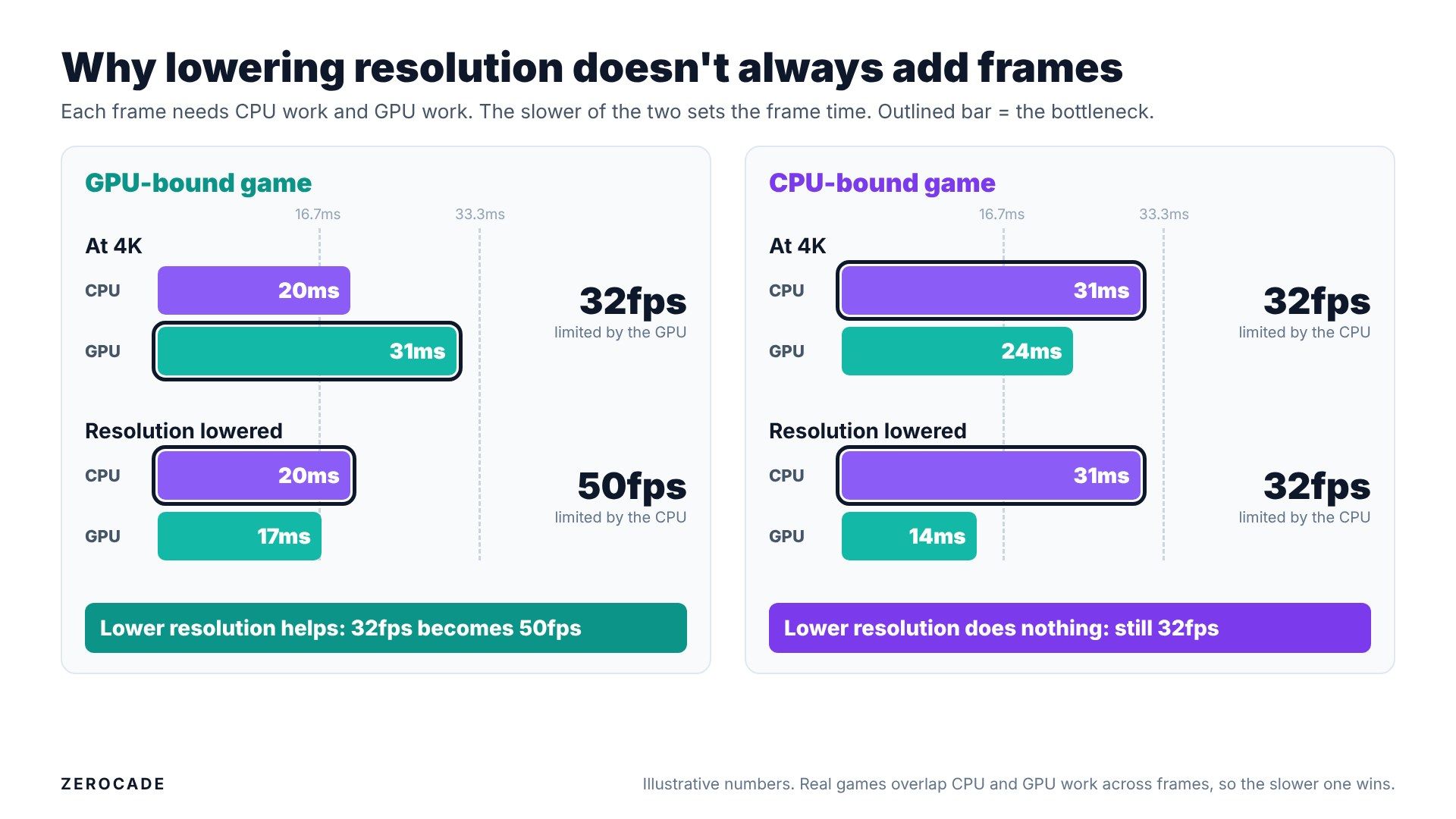
Image: Zerocade
In the made-up example on the left, the GPU takes 31ms and the CPU 20ms. Drop the resolution, the GPU's time falls to 17ms, and the CPU becomes the limit at 20ms: the game jumps from about 32fps to 50fps.
On the right, the CPU is already the slow one at 31ms. Lowering the resolution cuts the GPU's time to 14ms, but the frame still has to wait for the CPU. You're stuck at 32fps with a blurrier picture.
Capcom ran into exactly this with Dragon's Dogma 2. Its developers told Famitsu that CPU power goes to processing "the thoughts of each NPC", and that because the CPU was the bottleneck, GPU fixes like lowering the resolution "had little effect." The slowdowns were worst in busy towns. An October 2024 patch reworked how NPC thinking is processed instead.
What makes a game CPU-heavy
- Crowds and traffic. Every person and car needs AI and pathfinding.
- Physics. Collisions, ragdolls, debris and vehicle handling.
- Simulation. Anything that keeps running when you're not looking, like day-night routines or a living economy.
- Streaming a big world. Loading and unloading parts of the map as you move.
- Lots of draw calls. A dense city with thousands of separate objects.
GTA 6 has all five, in a city packed with people. That's why the CPU, not the GPU, is the likely limit.
What's inside today's consoles
| Console | CPU | GPU |
|---|---|---|
| PS5 | 8 Zen 2 cores, up to 3.5GHz | 36 compute units, 10.28 teraflops |
| Xbox Series X | 8 Zen 2 cores, 3.8GHz (3.6GHz with SMT) | 52 compute units, 12.15 teraflops |
| Xbox Series S | 8 Zen 2 cores, 3.6GHz (3.4GHz with SMT) | 20 compute units, 4 teraflops |
| PS5 Pro | Same 8-core Zen 2 design, reportedly up to 3.85GHz | 67% more compute units than PS5, 2-3x faster ray tracing, PSSR |
The pattern is clear. All four use the same family of CPU, from consoles that launched in 2020. The GPUs vary much more.
So when a developer makes a game that pushes the CPU to its limit on a base PS5, the PS5 Pro has very little extra CPU to spare. That matters if you're weighing an import, since the Pro isn't officially sold in India and grey-market units have been reported at around ₹85,000. Digital Foundry said as much: the Pro's new features don't really ease the CPU burden. Its GPU can make the image sharper with PSSR and add effects like ray-traced shadows, but it can't make the world simulation finish faster.
Image: Microsoft
Why 30, and not 45?
A TV refreshes at a fixed rate, usually 60Hz. To look smooth, each new frame has to land on a refresh.
- 30fps shows each frame for exactly two refreshes on a 60Hz TV. Even.
- 45fps would mean some frames stay for one refresh and some for two. That uneven rhythm is called judder, and it can feel worse than a steady 30.
That's why many console games lock to 30 instead of letting the frame rate float. Bethesda's Todd Howard said exactly this about Starfield in 2023: the game was locked to 30fps on Xbox because the team preferred "the consistency". A 60fps option arrived on Series X in May 2024.
Where 40fps modes come from
There's a middle ground, but it needs the right screen. On a 120Hz TV or monitor, 40fps divides evenly: each frame stays for exactly three refreshes, or 25ms. That's much closer to 60fps's 16.7ms than 30fps's 33.3ms, while needing far less power than 60.
Insomniac's Ratchet & Clank: Rift Apart made this popular in 2021, and A Plague Tale: Requiem ran at about 40fps on PS5 when 120Hz was turned on. On a 60Hz TV, 40fps can't divide evenly, so these modes only appear when the console is outputting 120Hz. Our HDMI 2.1 guide covers which TVs can do that.
Unofficial preload files for GTA 6 mention a 120Hz high framerate setting. Rockstar hasn't announced any mode beyond its 30fps target.
Why PC is different
On PC you can pick your own CPU. A modern desktop chip is far faster than a console's Zen 2 cores, which is why CPU-heavy console games often run at much higher frame rates on PC. It's also why benchmark charts often test games at 1080p: a low resolution takes the GPU out of the picture and shows what the CPU alone can do.
If your PC game doesn't speed up when you lower the resolution, check your CPU usage. You've probably hit the CPU limit.
What to look for
When a console game is announced at 30fps, check what's pushing the hardware. A huge, busy open world is a CPU problem, and a Pro console won't fix it. Ray tracing and resolution are GPU problems, which is exactly where the PS5 Pro helps. And if your TV supports 120Hz, keep an eye out for 40fps modes: they're often the best balance on hardware that can't quite reach 60.