The short version
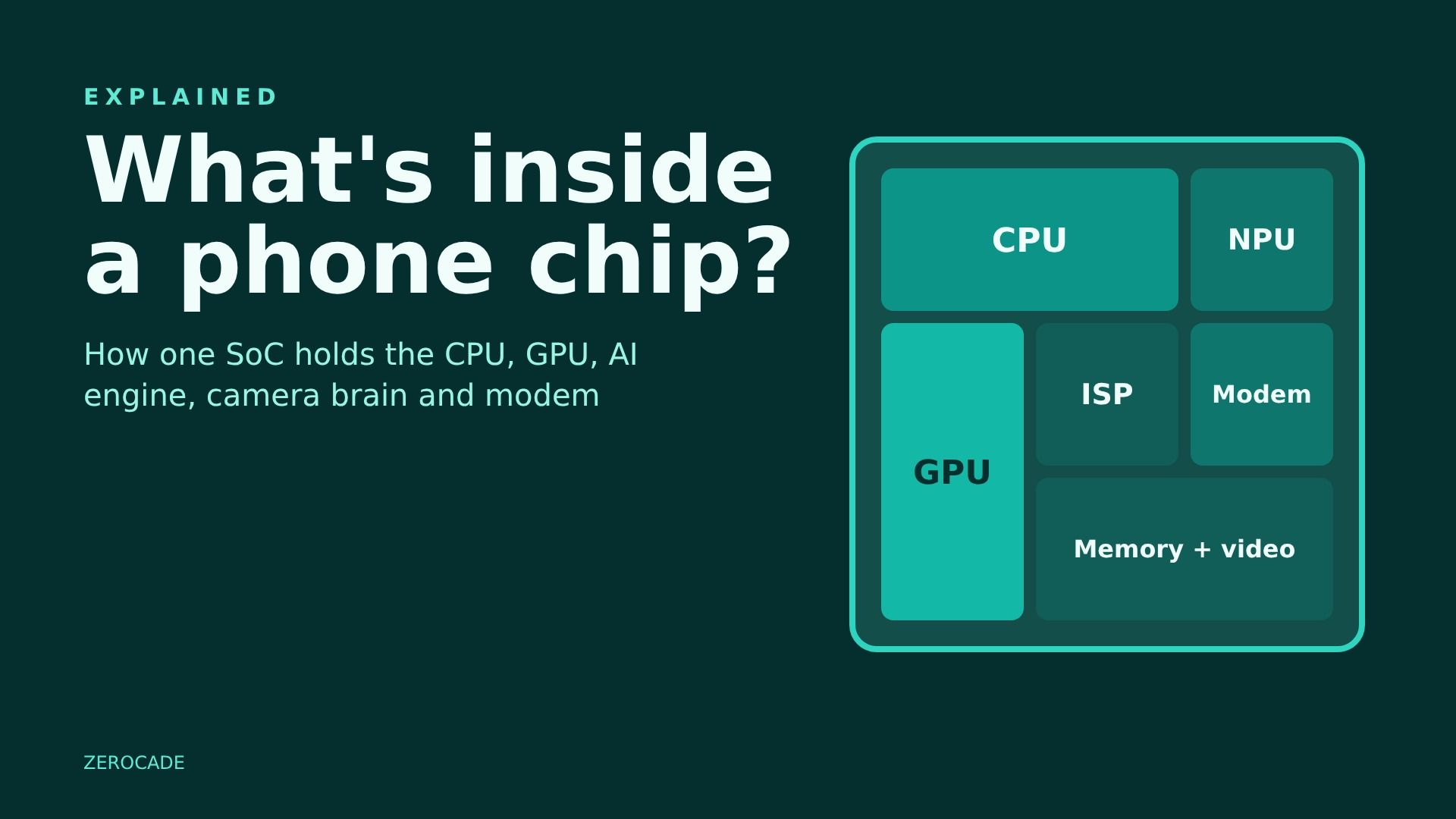
- An SoC (system on a chip) is the one main chip in your phone. It combines the parts that would be separate chips in a PC.
- The big pieces are the CPU, GPU, NPU (for AI), ISP (for the camera) and, on Android chips, the modem.
- Qualcomm's Snapdragon, MediaTek's Dimensity, Apple's A-series, Samsung's Exynos and Google's Tensor are all SoCs.
- When you game, take a photo or use AI features, different parts of the SoC do the work, which is why two phones with similar CPUs can feel very different.
Why it's in the news
Counterpoint Research says smartphone chip shipments fell 21% worldwide in July to September, and Qualcomm's phone chip sales dropped 26%, as we covered in our Qualcomm results story. Those reports count SoCs, the single chip at the heart of every phone. Here's what that chip actually is.
One chip instead of many
In a desktop PC, the main parts are separate. The CPU sits in a socket, the graphics card plugs into a slot, and the Wi-Fi and memory are on their own chips. That's fine when you have a big box, a fan and a wall socket.
A phone has none of that. It needs everything to fit in a few square centimetres and run on a small battery. So chipmakers put most of the important parts on one piece of silicon. That's a system on a chip.
Putting everything together has two big advantages. Data travels short distances between parts, which is faster and uses less power. And each part can be switched off when it isn't needed, which saves battery.
The main parts, one by one
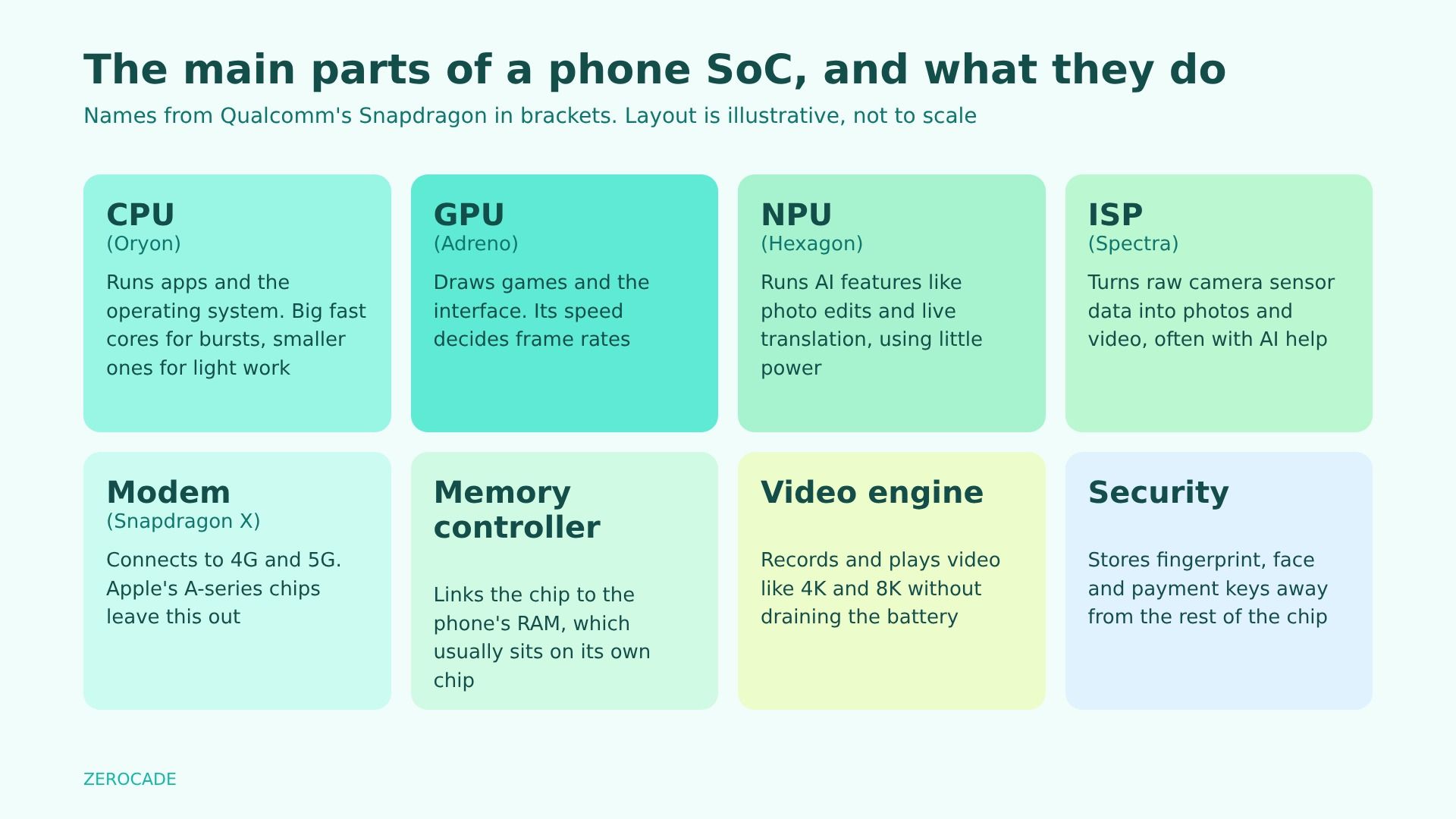
Image: Zerocade
CPU. The general-purpose brain that runs Android or iOS and your apps. Modern phone CPUs mix core sizes. The Snapdragon 8 Elite Gen 6, for example, has two prime cores at up to 5GHz for heavy bursts and six performance cores at up to 4GHz, as our Gen 6 vs Extreme guide explains. Light jobs run on slower cores to save power.
GPU. The graphics processor. It draws everything you see, from the home screen to a game's 3D world. In gaming phones, the GPU matters more than the CPU for frame rates. Qualcomm calls its GPU Adreno, MediaTek uses Arm's Mali or Immortalis, and Apple designs its own.
NPU. The neural processing unit, built for AI maths. It runs features like photo object removal, live translation and on-device assistants much more efficiently than the CPU could. Our NPU explainer covers how its TOPS rating works.
ISP. The image signal processor turns raw data from the camera sensor into a photo or video. It handles noise reduction, HDR merging and colour, often with help from the NPU. A lot of the difference between phone cameras comes from here, not just the lens.
Modem. The part that connects to 4G and 5G networks. Snapdragon and Dimensity chips build it in. Apple's A-series chips don't, so iPhones use a separate modem chip, which used to come from Qualcomm and is now increasingly Apple's own.
The rest. A memory controller links the SoC to the phone's RAM, which usually sits on its own chip stacked on top or right beside it. A video engine records and plays 4K or 8K video without waking the GPU. A secure area stores fingerprint, face and payment keys.
How the parts share the work
The clever part is that each job goes to the piece built for it.
- Playing a game: the GPU draws the frames, the CPU runs the game logic and physics, and features like frame generation or upscaling may lean on the GPU or NPU.
- Taking a photo: the ISP processes the sensor data, the NPU recognises the scene and faces, and the CPU coordinates everything.
- Watching a video: the video engine decodes it while the CPU and GPU mostly rest, which is why video playback barely touches the battery.
That's also why spec sheets can mislead. Two phones with similar CPU scores can perform very differently in games if one has a much stronger GPU or keeps cool for longer.
Why the process node matters
All the major flagship chips this year, Apple's A20, MediaTek's Dimensity 9600 Pro and Qualcomm's Snapdragon 8 Elite Gen 6, are made on TSMC's 2nm process. A smaller process lets chipmakers fit more transistors in the same space and use less power. Our process node explainer covers what "2nm" really means.
Not every chip from a production run is equal, either. Qualcomm sorts chips by how well they perform in testing, and the best become the Extreme version. That's called chip binning.
What to look for when buying
- For gaming: look at GPU benchmarks and sustained performance tests, not just CPU scores.
- For cameras: the ISP and NPU matter as much as megapixels. Check camera reviews with real samples.
- For battery life: a newer process node usually helps, but phone design and cooling count too.
Next time a phone launch slide says "Snapdragon" or "Dimensity", you'll know it's describing one chip doing almost everything.