The short version
- India blocks apps under Section 69A of the Information Technology Act, 2000. It lets the central government order any website or app blocked for reasons including national security and public order.
- The orders are confidential. That's why players usually learn about a ban from the Play Store, not an official notice.
- PUBG Mobile (2020), Free Fire (2022) and BGMI (2022) were all blocked this way.
- Games come back as new India versions: a new app, data stored in India, cut ties with the worrying owner, and limits on playtime. Free Fire India, out today, follows that pattern.
What Section 69A says
The IT Act is India's main law for anything online. Section 69A gives the central government the power to direct any government agency or "intermediary", which includes app stores and internet providers, to block public access to information. It can do this when it believes it's necessary for:
- the sovereignty and integrity of India
- defence
- the security of the State
- friendly relations with foreign countries
- public order, or to stop incitement to related offences
The reasons must be recorded in writing. A company that refuses to comply can face up to seven years in jail and a fine. The Supreme Court upheld the section in the landmark Shreya Singhal case in 2015, partly because the blocking process has safeguards built in.
How a block works, step by step
The details are in the IT (Blocking) Rules, 2009. In plain terms:
- A request. A ministry or agency, such as the home ministry, sends a request to a designated officer at the IT ministry (MeitY).
- A committee review. A committee of officials from several ministries examines it. The app's owner is normally given notice and a chance to respond.
- The order. If the committee agrees, the IT secretary approves and the order goes out to Google, Apple and internet providers.
- The emergency route. In urgent cases, the IT secretary can issue an interim order straight away, without a hearing. The committee must review it within 48 hours. Most of the big app bans have used this route.
- Review. A separate review committee meets every two months to check that orders follow the law.
Then the part players notice: the orders are secret. Rule 16 requires confidentiality, so the government doesn't publish which apps were blocked or the full reasons. News of a ban usually comes from a short press release, leaks, or apps vanishing from the store.
What happens to the app you already have? Google and Apple remove it from their Indian stores. Copies already on phones may keep working for a while, until the developer shuts off service in India, which most do to comply.
The games that were blocked
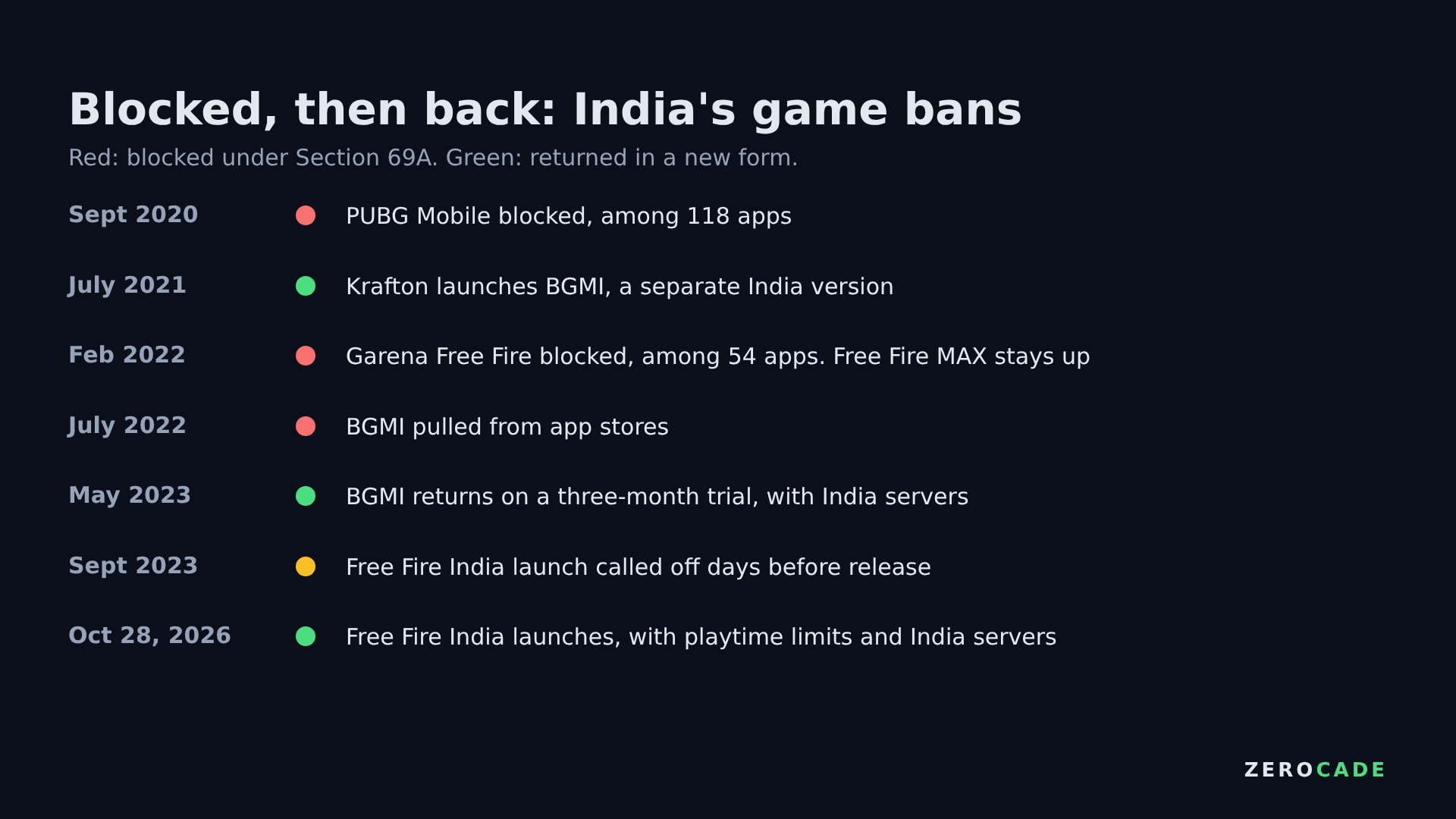
Image: Zerocade
| Date | What happened |
|---|---|
| June to Nov 2020 | 267 apps blocked in four orders after the India-China border clash, including TikTok (June) and PUBG Mobile (September, among 118 apps) |
| July 2021 | Krafton launches BGMI, an India-only version of PUBG Mobile |
| Feb 2022 | Garena Free Fire blocked among 54 apps. Free Fire MAX isn't on the list and stays available |
| July 2022 | BGMI removed from app stores |
| May 2023 | BGMI allowed back on a three-month trial |
| Sept 2023 | Free Fire India's planned launch called off days before release |
| Oct 28, 2026 | Free Fire India launches |
The 2020 orders mentioned data being sent to servers outside India. The February 2022 order cited risks to Indians' privacy and security, and an official said many of the apps had changed owners to hide links to China while data still ended up there.
How games come back
There's no formal "unban" process in the law. In practice, a returning game has to answer the concerns that got it blocked. BGMI set the template:
- A new app and a new name. BGMI was a separate game from PUBG Mobile, with its own Play Store listing.
- Cutting the worrying link. Krafton ended its publishing ties with Tencent in India and ran the game itself.
- Data in India. BGMI moved to Microsoft Azure servers in India.
- A trial. When BGMI returned in May 2023, then IT minister of state Rajeev Chandrasekhar said the government would watch for "user harm, addiction etc." during the three-month trial.
- Player protections. BGMI added playtime limits for younger players.
Free Fire India ticks the same boxes: a separate app, servers in India, parental consent for under-18s, daily playtime limits of reportedly 6 hours for adults and 3 hours for minors, and spending caps. Garena says it took feedback from government stakeholders before launch.
What 69A doesn't cover
Section 69A is about blocking access. It isn't the law behind India's 2025 crackdown on real-money games like fantasy sports and online rummy. That came from a separate law passed in August 2025, which bans real-money online games while backing esports and regular social games. Free Fire and BGMI are free-to-play games with optional purchases, so they fall on the allowed side.
Why it matters for players
On paper, a block can come at any time and with no public explanation. That's a risk for anyone spending money on a game. The comebacks show the path back is real but slow: BGMI took ten months, and Free Fire took more than four and a half years.
If you're buying in-game currency in an India version, the safeguards that brought it back, like playtime caps and spending limits, are part of the deal. Expect more games entering India to launch this way from day one.