The short version
- XRing O3 is Xiaomi's own phone and tablet chip, built by TSMC on its 3nm-class N3P process. It powers the Xiaomi 18 Fold and the Pad 9 Pro Max, both on sale in China since September.
- In Notebookcheck's review of the Pad 9 Pro Max, published November 1, the chip scored 85 fps in GFXBench's 4K Aztec Ruins test. Apple's M5 iPad Pro managed 49.6 fps.
- On the CPU it sits behind the M5 (12,976 vs 16,544 in Geekbench 6 multi-core) and ahead of the Snapdragon 8 Elite Gen 5 in the OnePlus Pad 4.
- Its AI chip is the weak spot: 1,761 in Geekbench AI against the M5's 57,388. Neither device has been announced for India.
A phone chip with no small cores
Most phone chips mix a few fast cores with a group of small, frugal ones. The XRing O3 doesn't. All 10 CPU cores are big Arm designs, in three tiers:
- 2 × C1-Ultra at up to 4.35GHz, for the heaviest single tasks
- 4 × C1-Premium at up to 3.68GHz
- 4 × C1-Pro at up to 3.15GHz
That's the same "all big cores" idea Qualcomm and MediaTek use in their 2026 flagships. Xiaomi pairs it with 44MB of on-chip cache, which is a lot for a phone chip, and claims up to 25% lower power at light-to-medium loads than its first chip, the XRing O1. If the P-core and E-core talk is new to you, our P-cores vs E-cores guide covers it.
The rest of the spec sheet, from Xiaomi's August 24 announcement:
| Part | XRing O3 |
|---|---|
| Process | TSMC N3P, about 133 mm², about 24 billion transistors |
| GPU | Arm Mali-G2 Ultra NX, 16 cores |
| NPU (AI) | 200 TOPS (Xiaomi's figure) |
| Memory | LPDDR6 at 10,667 MT/s, the first chip to support it |
| Modem | MediaTek T900 5G, per Shattered |
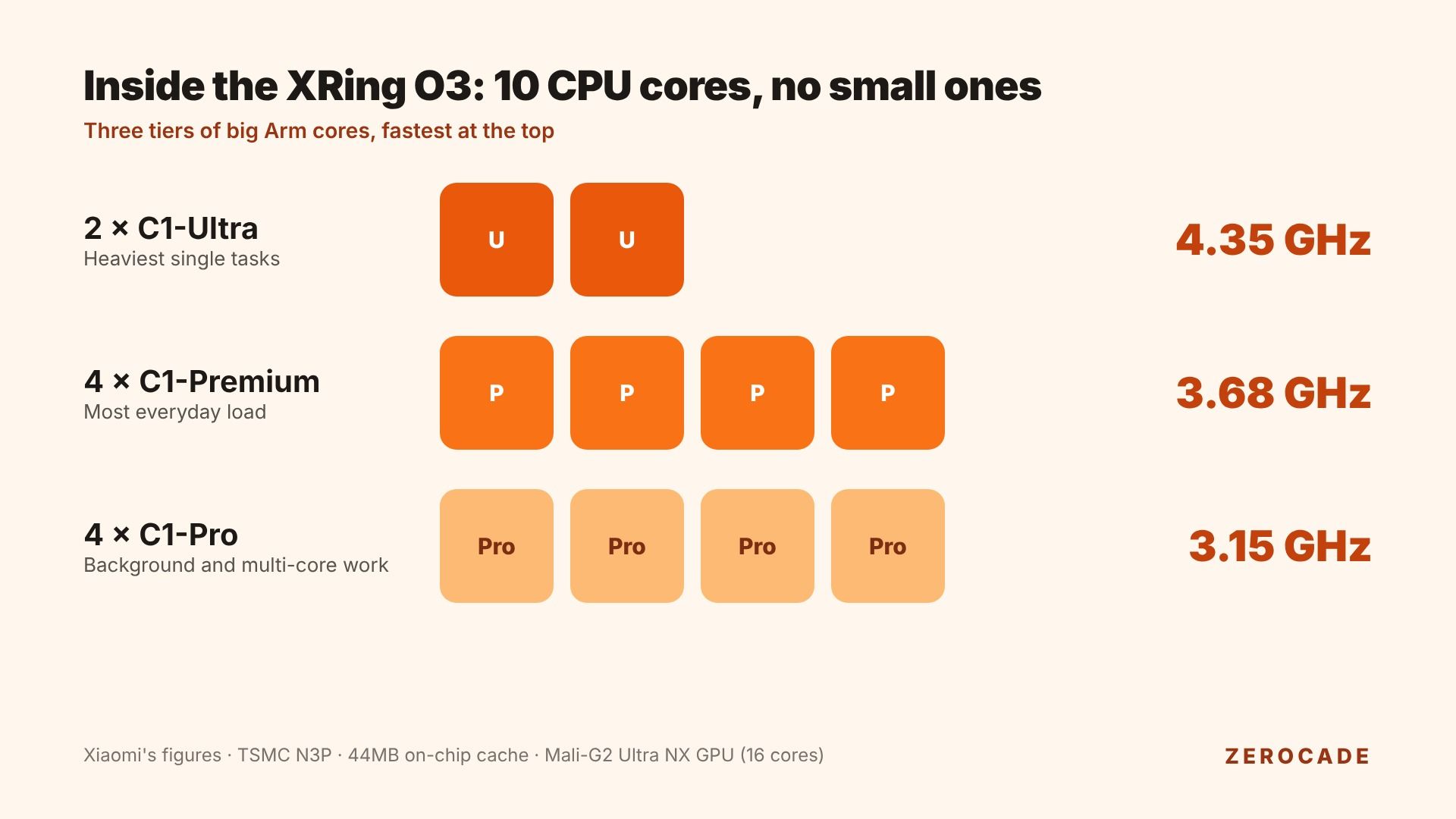
Image: Zerocade
What Notebookcheck measured
Xiaomi's own launch figures were 3,945 single-core and 15,221 multi-core in Geekbench 6.5, plus 5,228,014 in AnTuTu. Those are the maker's numbers. Notebookcheck's review is the first big independent look, and its scores come in lower, as retail tests usually do:
| Test | Xiaomi Pad 9 Pro Max (XRing O3) | iPad Pro 11 (M5) | OnePlus Pad 4 (8 Elite Gen 5) | Pixel 10 Pro (Tensor G5) |
|---|---|---|---|---|
| Geekbench 6 single-core | 3,522 | 4,128 | 3,506 | 2,308 |
| Geekbench 6 multi-core | 12,976 | 16,544 | 10,703 | 6,314 |
| GFXBench 4K Aztec High (offscreen) | 85 fps | 49.6 fps | 57 fps | 25 fps |
| 3DMark Solar Bay | 16,999 | 17,650 | Not listed | Not listed |
| Geekbench AI (quantized) | 1,761 | 57,388 | Not listed | 3,792 |
Notebookcheck's testing, Geekbench 6.7. Xiaomi's launch figures used Geekbench 6.5, so the two sets aren't directly comparable.
Three things stand out.
The graphics result is the real headline. In the 4K Aztec test the Pad is more than 70% ahead of the M5 iPad Pro. That's a sustained, high-resolution GPU load, the closest thing in this list to a demanding game.
Solar Bay tells a more modest story. In 3DMark's ray-tracing test the M5 edges ahead, 17,650 to 16,999. So "beats the M5 at graphics" holds in one test and is roughly a tie in another.
The AI number is a different planet. The M5 scores more than 30 times higher in Geekbench AI, and even Google's Pixel 10 Pro doubles the Pad. Xiaomi's 200 TOPS NPU claim hasn't shown up in this test at all. Our NPU and TOPS explainer covers why a TOPS figure on a slide doesn't always turn into a benchmark score.
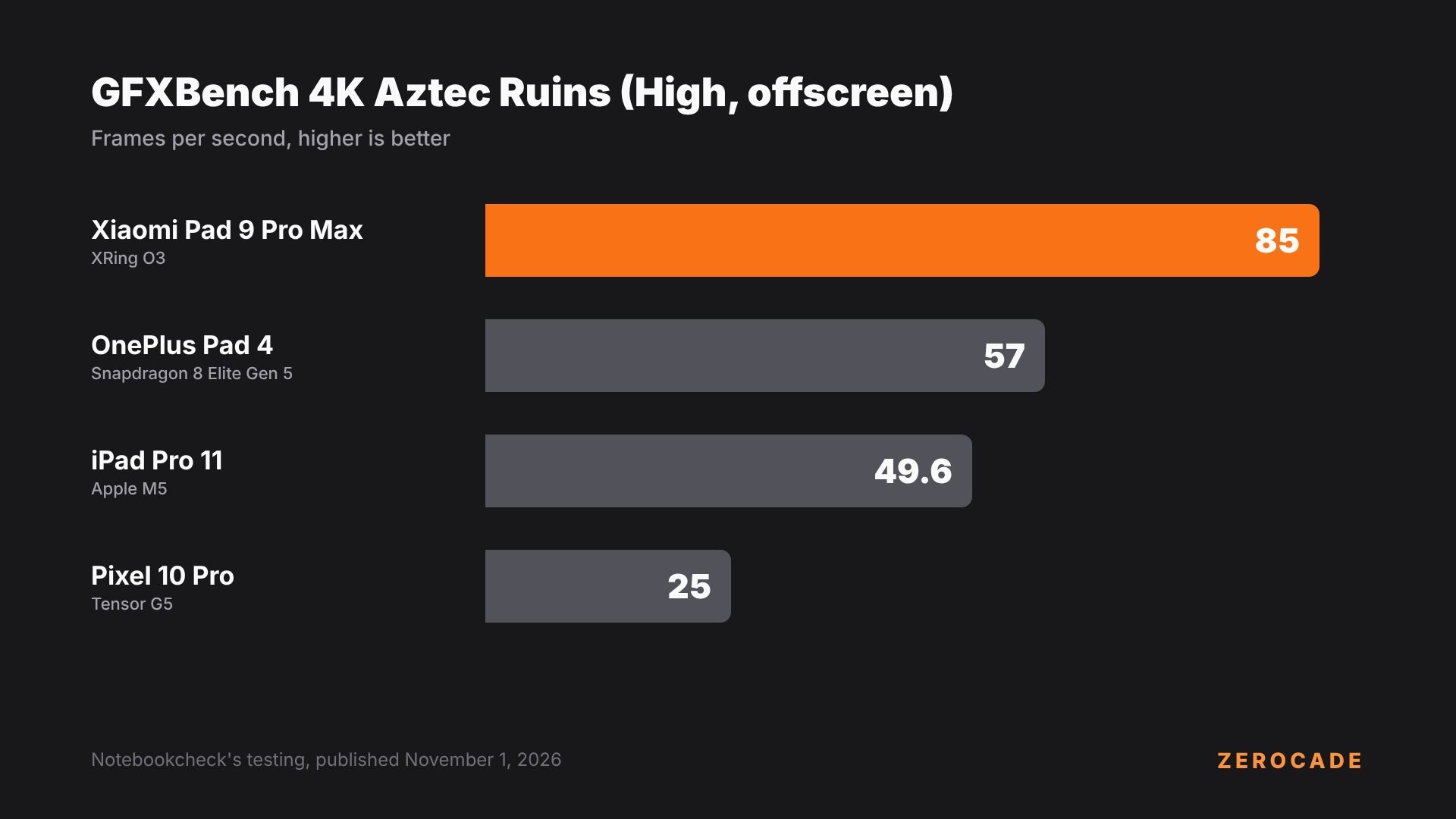
Image: Zerocade
What about that "1,000 FPS" headline?
Notebookcheck's story ran with a headline about passing 1,000 fps. The highest figure in the review's own results is 387 fps, in the 1080p Normal Tier GFXBench test, where the M5 scored 317.5. We couldn't find where the 1,000 figure comes from in the review, so treat it as a headline rather than a measured result. If you've seen it shared around, that's the context. Our benchmark leak guide has more on reading numbers like these.
The devices, and what they cost in China
Xiaomi Pad 9 Pro Max. A 13.3-inch, 3.4K, 144Hz tablet with a 12,000mAh battery and 120W charging, weighing 645g. China prices run from CNY 4,799 (8GB/256GB, about ₹68,600) to CNY 6,599 (16GB/512GB, about ₹94,400).
Xiaomi 18 Fold. A book-style foldable with a 5.38-inch outer screen and a 7.58-inch inner one, launched in China on September 7. It costs CNY 10,999 (about ₹1.57 lakh) for 12GB/256GB, up to CNY 15,999 (about ₹2.29 lakh) for the 16GB/1TB ceramic model.
Rupee figures are straight currency conversions, without import duty or GST, so treat them as a floor rather than a likely India price.
Will this chip reach India?
No device with the XRing O3 has been announced for India, and Xiaomi hasn't said whether it plans to sell its in-house chips here. The Xiaomi phone that is confirmed for an Indian launch this month, the Xiaomi 18 Pro, uses Qualcomm silicon. Our November phone launches roundup has the details.
On paper, the XRing O3 shows Xiaomi can now design a chip that trades blows with Apple and Qualcomm on CPU and graphics. AI is where it's clearly a generation behind. Watch for Notebookcheck's thermal and battery results, which this review didn't include, and for any sign of an XRing device on Xiaomi India's site.