The short version
- A leaked Geekbench 6.5 result shows Samsung's Exynos 2700 scoring about 13,000 in multi-core. The test phone is unconfirmed but looks like a Galaxy S27 Pro.
- That would put it ahead of Qualcomm's Snapdragon 8 Elite Gen 6 and its faster Extreme version, which scored close to 11,000.
- The Galaxy S27, S27+ and S27 Pro are expected to use the Exynos 2700 in most countries, though Samsung says that isn't final. The series is tipped for January or February 2027.
- Unconfirmed. It's one benchmark post plus unnamed sources. There's no India price or launch date yet.
Where this comes from
Sammy Fans reported the claim on October 25, citing "industry sources" and a Geekbench score posted on X by the leaker SemiconductorsX. The same day, Korea's Chosun Biz published what it said were Samsung's internal test results, which GSMArena summarised. The headline claim from both: the Exynos 2700 beats Snapdragon by about 20%.
The details are messier:
- Against the standard Snapdragon 8 Elite Gen 6 (in a Xiaomi 18 Pro), the Exynos is said to be 44% ahead on Geekbench 6.5 and 36% ahead on Geekbench 7.
- Against the 8 Elite Extreme Gen 6 (in a Xiaomi 18 Pro Max), the gap shrinks to about 20% on Geekbench 6.5 and 15% on Geekbench 7.
- For graphics, Chosun Biz reported about 20% higher peak performance in demanding games, but only about 5% higher baseline. No GPU benchmark scores were shared.
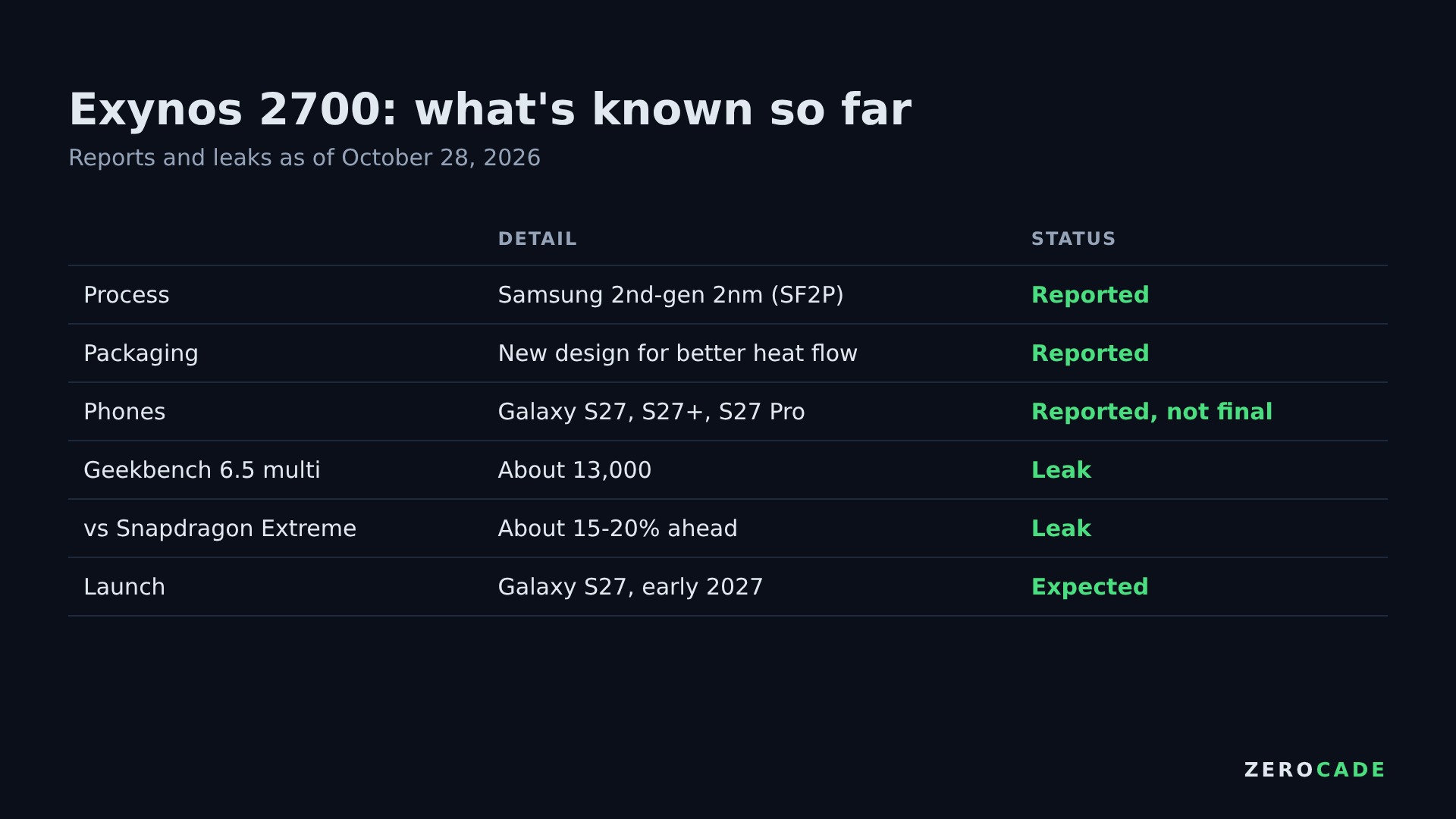
Image: Zerocade
What we know about the chip
Samsung hasn't announced the Exynos 2700. Reports say it's made on Samsung Foundry's second-generation 2nm process, called SF2P, with a new packaging design to move heat away from the chip. Earlier Korean reports said Samsung would decide which S27 models get it based on "the performance and yield stability" of its 2nm production.
For context, its predecessor is official. Samsung says the Exynos 2600, used in this year's Galaxy S26 and S26+ in some countries, was the industry's first 2nm GAA chip. It has a 10-core CPU on Arm's v9.3 design, led by an Arm C1-Ultra core, and an Xclipse 960 GPU based on AMD graphics. Samsung claims up to 39% better CPU performance than the chip before it, more than double the GPU compute, and 113% faster on-device AI.

Image: Samsung Semiconductor
How much to trust it
Treat it as a weak to medium leak:
- Single scores can be faked, and Geekbench results are easy to edit before posting.
- Mixing Geekbench versions (6.5 and 7) makes the percentages hard to compare.
- Different phones. Samsung's chip in its own test phone is compared against Xiaomi phones with their own cooling and tuning.
- The source is Samsung's side. Internal results leaked through Korean media are hard to check.
Our guide to reading benchmark leaks explains why one score is never the full story.
What fits: Samsung said in June that the Exynos 2700 was "on track" for flagship phones. It's also the backup option in the Galaxy S27 Ultra overheating report, which Qualcomm has denied.
Why it matters
Exynos phones have a history of running hotter and slower than their Snapdragon twins. That's why buyers often care which chip their country gets. Indian Galaxy S models have used both over the years. A strong Exynos 2700 would make that much less of a worry, on paper at least.
Samsung has a lot riding on it. A competitive 2nm chip in its own phones would also help its foundry business win orders from other chip designers.

Image: Samsung Semiconductor
What to watch next
Peak multi-core numbers don't tell you much about heat or sustained gaming. Watch for longer stress tests and GPU results closer to the S27 launch, Samsung's official Exynos 2700 announcement, and which chip the Indian Galaxy S27 models use.