The short version
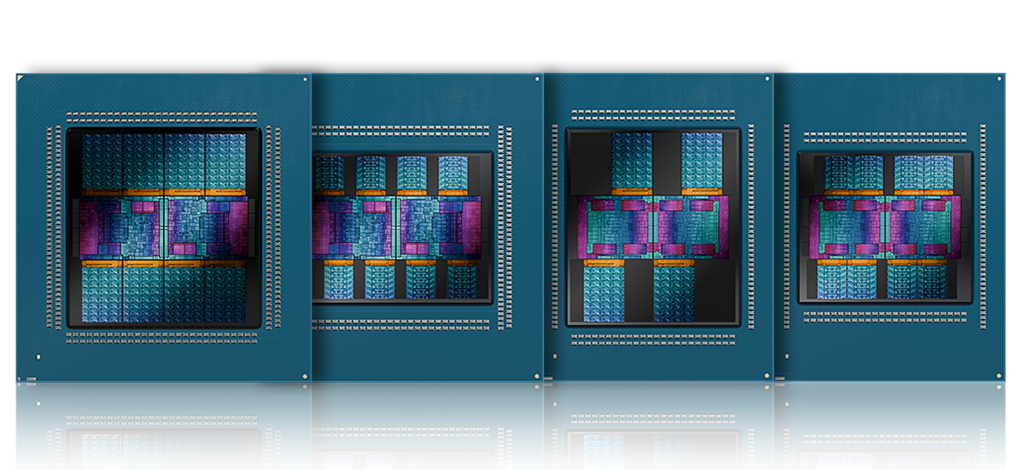
- AMD's 6th Gen EPYC "Venice" server CPUs, the first chips with Zen 6 cores, are now shipping from server makers. AMD announced general availability on November 10.
- The top model, the EPYC 9996, has 256 cores and lists at $14,904 (about ₹13.2 lakh). Chips are made on TSMC's 2nm process.
- Each standard Zen 6 chiplet has 12 cores and 48MB of L3 cache, up from 8 cores and 32MB on Zen 5. That's the part gamers should watch.
- AMD hasn't announced Zen 6 Ryzen yet. Analysts read the server chips as pointing to 24-core desktop Ryzens and much bigger X3D gaming chips, probably in 2027.
What launched
AMD first showed Venice in July and published the full lineup in September. On November 10 it said the SP7 versions are shipping now from the major server makers, with Meta named as a lead customer. Cloud versions on Microsoft Azure and Oracle are coming soon.
Dan McNamara, AMD's senior vice president for compute and enterprise AI, said AI is "significantly expanding the role of the CPU" across data centres. That's the pitch: AI agents need lots of general-purpose CPU work alongside GPUs.
The headline numbers for the SP7 platform:
- Up to 256 Zen 6c cores and 512 threads per socket.
- 16 memory channels of DDR5, with MRDIMM memory up to 12,800 MT/s, about 1.6TB/s per socket.
- PCIe 6.0 and CXL 3.1. AMD and reviewers call it the first server CPU with PCIe 6.
- AMD quotes boosts of "up to 5.3GHz" for high-frequency models, though the highest boost on the published SKU list is 5.0GHz.
The SP7 lineup and prices
These are AMD's 1,000-unit prices, as listed in September.
| Model | Cores | Base / boost | L3 cache | Power | Price |
|---|---|---|---|---|---|
| EPYC 9996 | 256 | 2.55 / 4.10GHz | 1,024MB | 600W | $14,904 |
| EPYC 9966 | 192 | 2.90 / 4.00GHz | 768MB | 600W | $14,079 |
| EPYC 9846 | 168 | 2.85 / 3.70GHz | 768MB | 500W | $13,114 |
| EPYC 9756 | 128 | 3.15 / 4.00GHz | 512MB | 500W | $12,498 |
| EPYC 9G76 | 96 | 3.40 / 4.80GHz | 384MB | 500W | $11,622 |
| EPYC 9686F | 96 | 3.40 / 5.00GHz | 384MB | 500W | $11,434 |
| EPYC 9656 | 96 | 3.05 / 3.70GHz | 512MB | 400W | $9,713 |
| EPYC 9586F | 64 | 3.75 / 5.00GHz | 384MB | 500W | $9,701 |
| EPYC 9556 | 64 | 2.75 / 4.30GHz | 384MB | 300W | $8,008 |
A cheaper SP8 platform with half the memory channels comes in the first half of 2027, starting at an 8-core model for about $700. AMD also confirmed Venice-X, a version with stacked 3D V-Cache, for the second half of 2027.
Zen 6 vs Zen 6c
Venice uses two kinds of chiplet:
- Zen 6: 12 cores and 48MB of L3 per chiplet, built for high clock speeds. Up to 96 cores per socket.
- Zen 6c: a dense version with 32 cores and 128MB of L3 per chiplet, at lower clocks. Up to 256 cores per socket.
Both keep 4MB of L3 per core. AMD's briefing, as reported by Wccftech and Notebookcheck, claimed about 27% higher IPC for Zen 6c over Zen 5. IPC is how much work a core does per clock tick. That figure is an average across server and AI tests, about 20% in enterprise work and 31% in AI, and it isn't a gaming number.
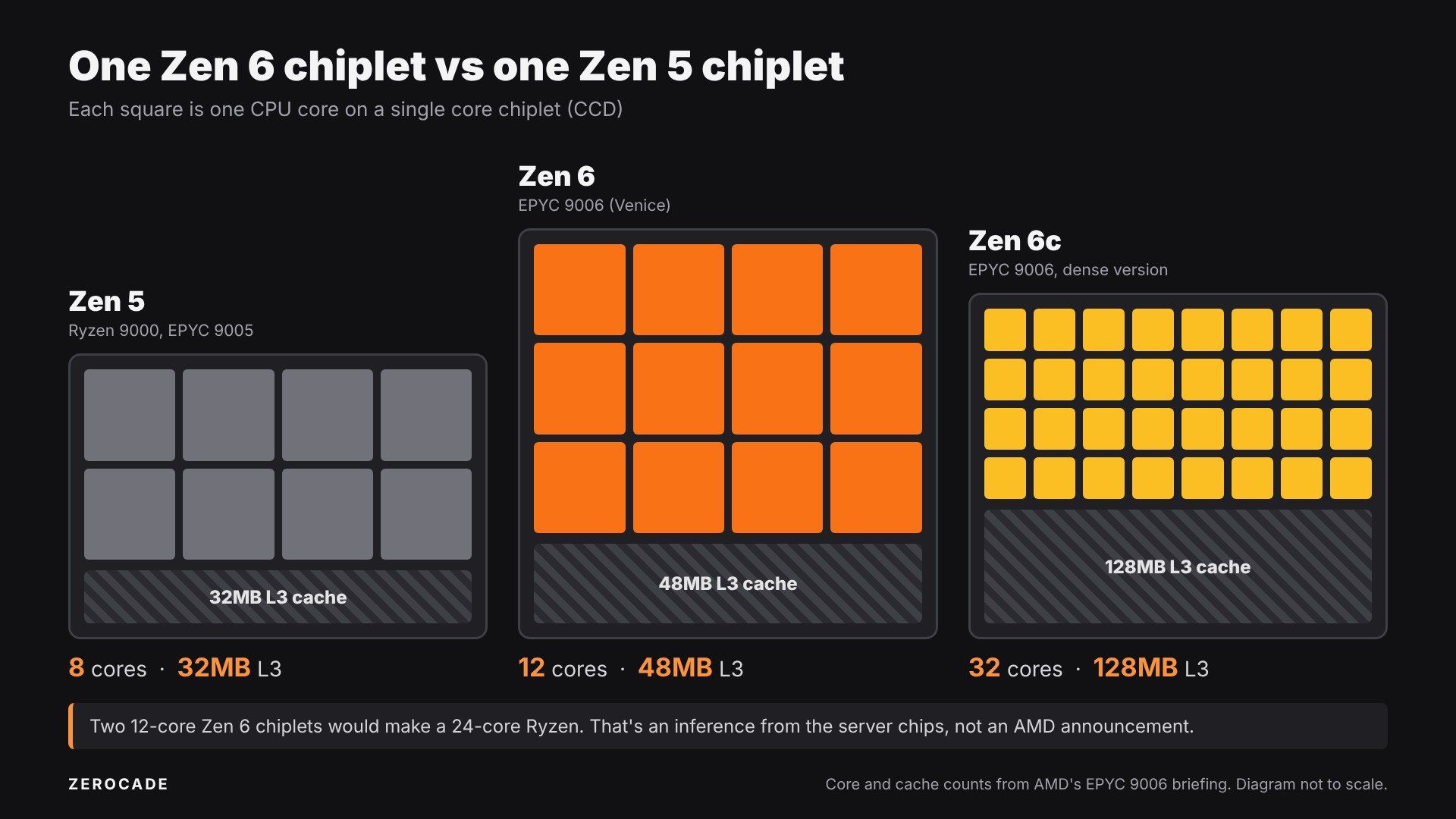
Image: Zerocade
What it hints at for Ryzen
AMD builds its desktop Ryzen chips from the same core chiplets as its servers. Our chiplets explainer covers how that works. So the 12-core, 48MB Zen 6 chiplet is the strongest clue yet about the next Ryzen.
What's confirmed and what isn't:
- Confirmed: AMD's own technical portal lists Zen 6 desktop chips codenamed Olympic Ridge for the AM5 socket, plus Medusa laptop chips. AMD has said AM5 is supported through 2027.
- Inferred: two 12-core chiplets would make a 24-core Ryzen, up from 16 on today's Ryzen 9 9950X. Notebookcheck worked out that a Zen 6 X3D chiplet could carry 48MB plus 96MB of stacked cache, or 144MB, against 96MB on today's Ryzen 7 9800X3D. That's maths on the server design, not an AMD announcement.
- Rumoured: leaks have pointed to a 2027 launch and very high boost clocks. Treat those as unconfirmed.
There's a gaming upside even before counting cores. With 12 cores on one chiplet, an eight-core game thread pool can stay on one piece of silicon, avoiding the slower hop between chiplets. Our 3D V-Cache explainer explains why that extra cache matters so much for games.
The laptop side has already leaked: Geekbench listings of six- and eight-core Zen 6 Medusa Point samples appeared last week.
What today's Ryzen chips cost
If you're building a gaming PC now, Zen 5 X3D is still AMD's best. PrimeABGB lists the Ryzen 7 9800X3D at ₹48,360 and the Ryzen 9 9950X3D at ₹73,018, both in limited stock as of November 11. Zen 6 desktop chips are likely a year or more away, so on paper there's no reason to wait if you need a PC now.
Also announced: SSDs that act like RAM
AMD also highlighted MEXT, memory software from a startup it bought in June. It moves rarely used data from expensive DRAM onto flash storage and brings it back before it's needed, so servers can get by with less RAM. It's a server feature for now, but with memory prices driving up the cost of everything from GPUs to consoles, it shows where the industry is heading.
What to watch
Watch for Zen 6 Ryzen news at CES in January, where AMD often announces desktop chips. And when independent server reviews arrive, look at single-thread results from the 12-core Zen 6 models: they're the closest preview of how a Zen 6 gaming chip might perform.