The short version
- SmileBASIC 4, a $24.99 programming app for the original Switch, is back on the eShop after being pulled in October for its role in ns2jb, the first public Switch 2 exploit. GamesRadar reported the return on November 20, and the app itself has been patched.
- Nintendo's system update 23.5.0, released on November 9 and 10, reportedly closed the system-level hole the exploit relied on. Nintendo's patch notes don't mention it.
- A second route through Civilization VII cartridges, called CivSwitch, gives more limited access. A physical cartridge can't be delisted.
- Neither Nintendo nor SmileBoom has commented publicly. The Switch 2 isn't officially sold in India, so most consoles here are grey imports with no local warranty.
What SmileBASIC 4 is
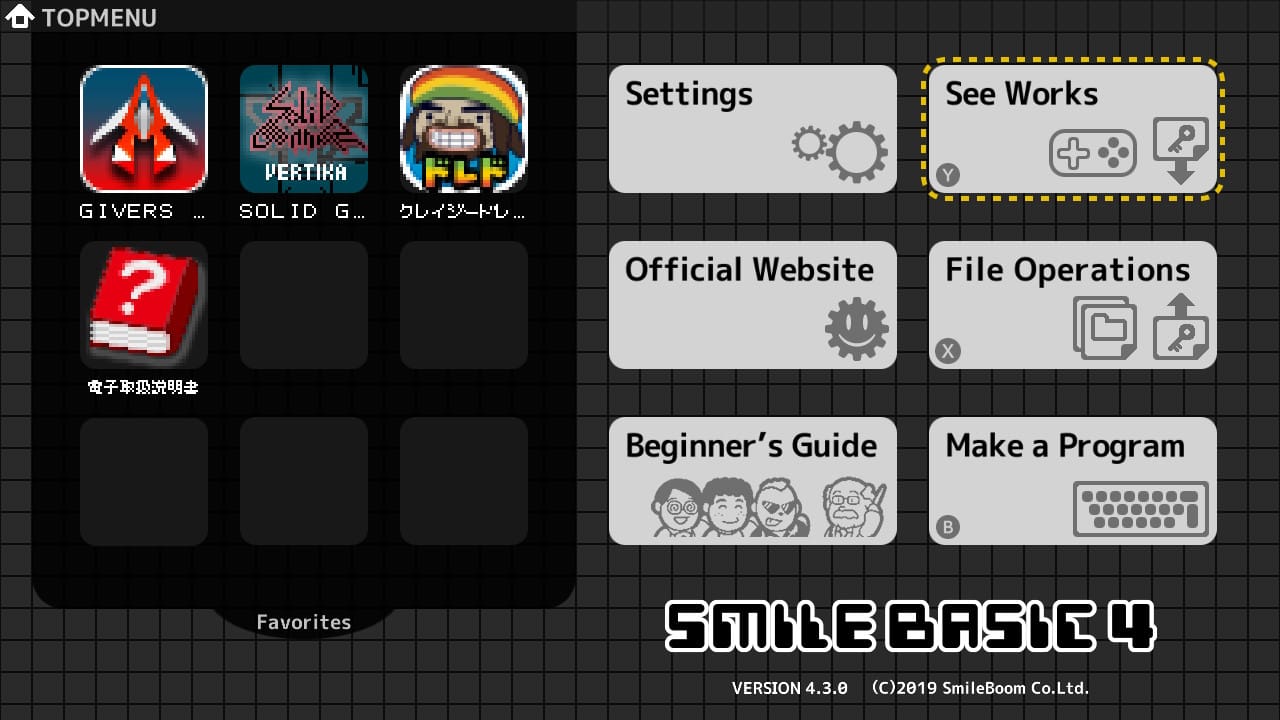
SmileBASIC 4, called Petit Computer 4 in Japan, is a programming tool from the Japanese developer SmileBoom. You write games in a version of the BASIC language, with built-in tools for drawing, sound and Joy-Con controls, and can share programs online with a separate server ticket. It launched in Japan in May 2019 and in the US in April 2020 for $24.99.
It's a Switch 1 app, and it runs on the Switch 2 through backward compatibility. That turned out to matter.
The timeline
| Date (2026) | What happened |
|---|---|
| October 1 | Switch 2 system update 23.0.1 released |
| October 21 | SmileBoom takes its program-sharing servers down for maintenance "to address a PHP vulnerability" |
| October 22 | Security researcher pepsipu publishes ns2jb, targeting firmware 23.0.1 |
| October 23 | SmileBASIC 4 disappears from the eShop in Japan and elsewhere, with no announcement |
| November 5 to 6 | Developer Gezine releases CivSwitch, using Civilization VII cartridges |
| November 9 to 10 | System update 23.5.0 released |
| Around November 18 to 20 | SmileBASIC 4 returns to the eShop, patched; SmileBoom restores program sharing |
Some sites report the fixed version as 4.4.10. We couldn't find an official source for that number.
How ns2jb worked
pepsipu's exploit started inside SmileBASIC 4 version 4.4.9. A bug in how the app handled large arrays, known as an integer overflow, let specially written code run outside SmileBASIC's normal limits. From there, the exploit reached the Switch 2's system through its file system service.
It was a limited jailbreak. It ran custom code, but it was tethered, needing a computer each time, and disappeared on reboot. It didn't give access to the console's deepest level or its encryption keys, and there was no custom firmware. pepsipu showed it off by modding Mario Kart World with new characters.
The unusual part was how it was built. pepsipu used OpenAI's Codex, an AI coding tool, to dig through bugs and write parts of the exploit, with AI agents connected to the consoles and reading their output. The work took about two weeks and still needed a lot of human effort. A first attempt through the console's web browser failed before the file system route worked.
Our explainer on what a console jailbreak is covers the difference between this kind of userland exploit and a full kernel or custom firmware hack.
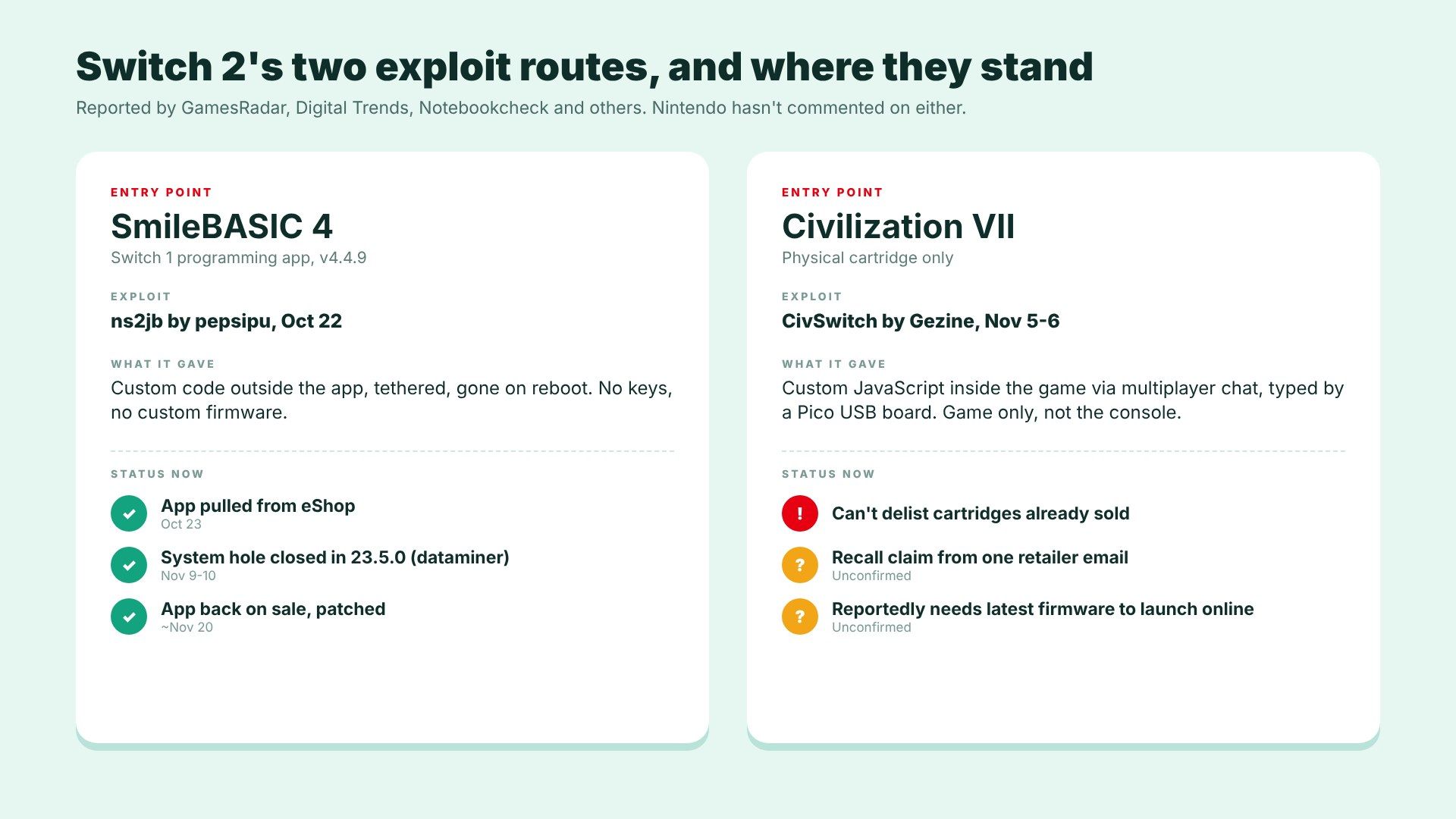 Image: Zerocade
What 23.5.0 changed
Nintendo's official notes for update 23.5.0 list accessibility options during setup, groundwork for eShop gifting in family groups and new Portuguese text-to-speech, plus "general adjustments and fixes". We covered those features when the update arrived.
The security side comes from dataminer OatmealDome, who said the system-level hole used by the jailbreak had been patched in 23.5.0, and that dumping and modding games would be "impossible again" with a few exceptions. Bugs inside individual games can still be found, but code can no longer escape from the game into the system.
Later reports say SmileBASIC 4 and Civilization VII now need the latest firmware to launch on a console that's online. Nintendo hasn't confirmed that.
The Civilization VII route
CivSwitch is a different kind of exploit. It sends custom JavaScript through Civilization VII's multiplayer chat, typed in by a small Raspberry Pi Pico board pretending to be a USB keyboard. It only works with a real game cartridge, not the code-in-a-box version.
It gives access inside the game, not a jailbreak of the console. Nintendo can patch software, but it can't take back cartridges already in people's homes. One Reddit user shared an email from a German Amazon seller saying the cartridge had been withdrawn for "technical and security-related" reasons. Neither 2K nor Nintendo has confirmed a recall.
Can old copies still be used?
According to reports, a console that's still on firmware 23.0.1 with SmileBASIC 4 version 4.4.9 is still exploitable. Pulling the app from the store only stopped new buyers. But going online or launching either game reportedly forces the update, and accounts on modified consoles risk being banned.
This has happened before
SmileBoom has been here once already. In July 2016, the 3DS version of SmileBASIC was pulled from the North American eShop over a homebrew exploit and returned about a month later as patched version 3.3.2.
Game-based exploits have a long history on Nintendo hardware. The Wii's Twilight Hack in 2008 used a modified Twilight Princess save file, and the 3DS's Ninjhax in 2014 used the level editor in a game called Cubic Ninja. The original Switch was different: its 2018 hack, Fusée Gelée, came from a flaw in Nvidia's Tegra X1 chip that no software update could fix. The Switch 2's exploits so far have all been software that Nintendo can patch.
Why it matters in India
Nintendo doesn't sell the Switch 2 officially in India, so consoles here come through grey imports, listed on Amazon India at launch for around ₹75,999, with no local warranty or support. There's no Indian eShop either, so owners buy games from other regions' stores.
None of this changes much for ordinary players. The practical advice is simple: keep the console updated, especially before going online, and don't install exploit tools on a console tied to the account holding your games. A banned account takes those purchases with it, and there's no Indian support line to appeal to.
What to watch next
Watch for whether Nintendo or 2K comments on the Civilization VII cartridges, and whether pepsipu releases the web browser version of the exploit that was mentioned. With 23.5.0 out, the next system update will show whether Nintendo has more to close.