The short version
- A Moore Threads product manager posted a teaser on November 18 saying its next desktop GPU, Lushan, will have the "largest video memory capacity in consumer GPU history".
- No number was given. The current consumer record is the 32GB on Nvidia's RTX 5090. The "64GB" figure doing the rounds is a press estimate, not a Moore Threads spec.
- Moore Threads' own claims for Lushan, made in December 2025, are 15x the gaming performance, 50x the ray tracing and 64x the AI compute of its current cards. None of that has been tested independently.
- The full reveal is planned for the company's MUSA developer conference on December 29. Moore Threads cards are effectively sold only in China, so don't expect Lushan in India.
What the teaser actually says
According to Wccftech, the post came from a user called "AIR_FORCE", described as a product manager for the company's MTT S80 card. Moore Threads itself hasn't published a spec sheet.
The teaser makes three points: hardware performance, "astonishing capacity" and a "record consumer-grade graphics card". The headline line is that Lushan will have the largest video memory, or VRAM, of any consumer GPU so far. It also mentions a 64x jump in AI computing performance, a new rendering architecture called UniTE, a new in-house hardware ray tracing engine and "AI generative rendering technology".
On November 19, Moore Threads' official news page posted a short title for its conference, roughly "climb to the summit of Lushan, see a new realm of compute". It's a pun on the chip's name, which comes from a famous mountain in China. That post has no specs either.
So, to be clear about what's confirmed: Moore Threads plans to show "major new products" at its conference on December 29 in Beijing, and an employee has hinted that Lushan's memory capacity will set a record. Everything else is a company claim or a guess.
Where 15x, 50x and 64x come from
Lushan isn't new. Moore Threads first showed it at the same conference in December 2025, as part of a new GPU architecture called Huagang. Lushan is the graphics chip. Its sibling, Huashan, is an AI chip for data centres.
Moore Threads' claims for Lushan, compared with its current cards:
| Claim vs MTT S80 | Moore Threads figure |
|---|---|
| AAA gaming performance | Up to 15x |
| Ray tracing | Up to 50x |
| AI compute | Up to 64x |
| Geometry processing | Up to 16x |
| Memory capacity | 4x |
| API support | Full DirectX 12 Ultimate |
These numbers are vendor claims with no benchmarks behind them. The Chinese site MyDrivers noted at the time that they are best-case figures that depend heavily on driver work. In September 2026, Moore Threads repeated the same claims on its earnings call and said Lushan was expected around the end of 2026.
Why "64GB" is only a guess
The MTT S80 has 16GB of memory. Moore Threads said Lushan has 4x the memory capacity, and some reports worked out that this means up to 64GB. That's arithmetic by the press, not a figure Moore Threads has given. In August the company would only say capacity was "significantly increased".
If 64GB turns out to be right, it would double the RTX 5090. Even a 48GB card would beat every single-GPU consumer card on sale. The size of that gap is why the teaser has drawn so much attention.
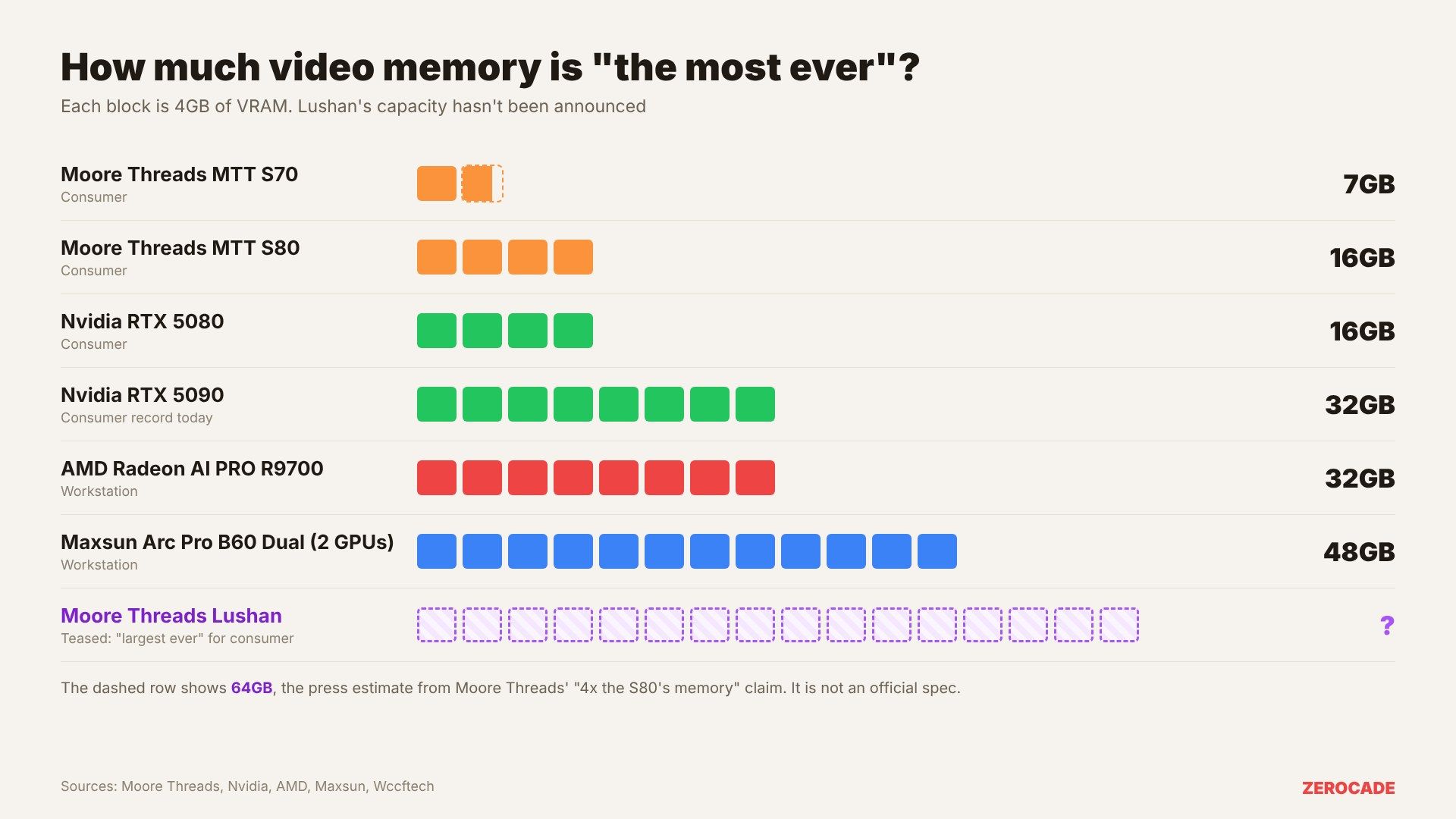 Image: Zerocade
Why a gaming card would need that much memory
For games alone, 64GB would be wildly more than needed. Most games today are comfortable with 12GB to 16GB, as our guide on how much VRAM you need explains.
Huge memory makes more sense for AI. Running large AI models on your own PC needs the whole model to fit in video memory, and that's exactly why people in China have been modding RTX 5090s up to 96GB. A consumer card with a big memory pool at a lower price than Nvidia's would appeal to those buyers, whatever its gaming speed. The teaser's focus on AI features points the same way.
Bigger memory also depends on chip choices. Our explainer on 2GB vs 3GB GDDR7 memory chips covers how card makers reach 24GB, 32GB and beyond.
Who Moore Threads is
 Image: Moore Threads
Moore Threads was founded in Beijing in 2020 by Zhang Jianzhong, a former global vice president at Nvidia and head of Nvidia China. In October 2023, the US added it to the Entity List, which restricts its access to American technology. It listed on Shanghai's STAR Market in December 2025, raising about ¥8 billion, and its shares rose more than 400% on the first day.
Its gaming cards so far:
| Card | Launched | Specs | Price in China |
|---|---|---|---|
| MTT S80 | Nov 2022 | 4,096 cores, 16GB GDDR6, 256-bit, 255W, PCIe 5.0 | ¥2,999, later cut to ¥1,199 |
| MTT S70 | May 2023 | 3,584 cores, 7GB GDDR6, 224-bit | ¥2,499, later cut to ¥899 |
On paper the S80 looked like a mid-range card. In practice, early drivers held it back badly. Tom's Hardware reported in October 2023 that, after 12 driver updates, it still couldn't consistently beat a GTX 1650. Moore Threads has kept releasing drivers since, claiming up to 120% higher frame rates in some games in early 2025, but those are its own figures.
A faster S90 was shown by influencers in 2025, claiming RTX 4060-level results. It still has no official product page, so treat it as unconfirmed.
Moore Threads isn't the only Chinese company trying. Lisuan launched its 6nm 7G100 card in China in May 2026 at ¥3,299, with performance reported around an RTX 3060 and no ray tracing.
What it means for buyers in India
Directly, very little for now. Moore Threads sells through China's JD.com and has no official distribution in India, and Lushan's price and launch markets are unknown.
The real interest is competition. High-end GPU prices in India are painful right now. On November 21, an MSI RTX 5090 Suprim SOC was listed at ₹4,07,300 at MDComputers, and an ASUS Prime RTX 5080 at ₹1,31,777 at PrimeABGB, with only a few units left. If Lushan lives up even partly to its claims, it adds pressure on Nvidia and AMD, especially in AI-focused cards.
The big caveat is Moore Threads' history. A huge memory number is easy to promise. Drivers that run games well are much harder, and the S80 showed that.
What to watch next
The Moore Threads keynote is on the morning of December 29 in Beijing (around 7:30 AM IST if it starts at 10 AM local time). Look for an actual VRAM number, the memory type, power draw, a price, and above all real game benchmarks rather than "up to" multiples. Until then, Lushan's record-breaking memory is a teaser, not a spec.