The short version
- A seller on Xianyu, Alibaba's second-hand marketplace, has listed an RTX 5090 modified to 96GB of GDDR7 memory, three times the stock 32GB.
- It's for businesses only: buyers must give a company name and sign an NDA. The listed price, about $900,000 (roughly ₹7.7 crore), is a placeholder.
- Nobody has tested it. There are no benchmarks, and the photos don't show the back of the board, where half the memory would have to be.
- 96GB is physically possible on the RTX 5090's chip. Nvidia's own RTX PRO 6000 does it, for about $16,000.
What the listing says
Hardware repair specialist VIK-on spotted the listing, and VideoCardz reported it on November 12, followed by Wccftech, Notebookcheck and others. The seller is based in Changsha. According to those reports, the listing offers:
- The card: an RTX 5090's GB202 graphics chip on a custom circuit board, with 96GB of Samsung GDDR7 memory.
- The extras: the full schematics for the custom board and a modified BIOS, the firmware that tells the card how much memory it has.
- The terms: businesses only, with individuals told not to get in touch. Buyers must share their company name and sign a confidentiality agreement, and testing is offered only through verified middlemen.
- The price: 6,488,888 yuan, about $900,000. Every outlet that covered it treats that as a placeholder, with the real price agreed privately.
There's no word on cooling or power draw, and no performance numbers.
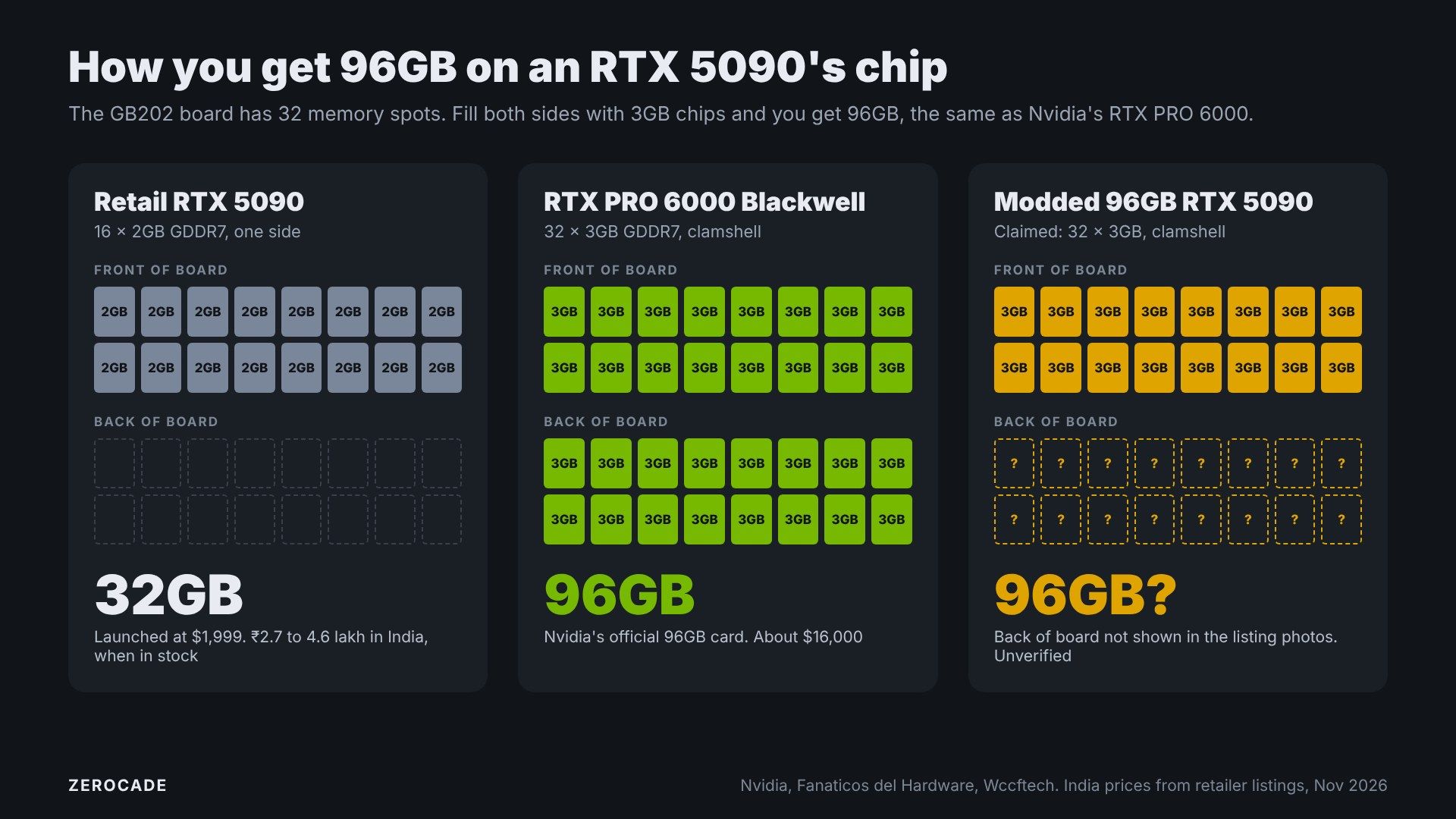
Image: Zerocade
Why it's still unverified
Spanish site Fanaticos del Hardware looked closely at the photos. It read the memory chips as Samsung 3GB GDDR7 modules, but only 16 of them are visible on the front of the board. That's 48GB. The other 16 needed for 96GB would sit on the back, which the listing doesn't show.
VIK-on suggested the custom board might be based on Nvidia's RTX PRO 6000 Max-Q design, but that's a guess. And there's a history of doubtful listings here. In September 2025, a "prototype" 128GB RTX 5090 turned out to be almost certainly fake, since it claimed a memory type that doesn't exist. In September 2026, a 96GB card on Alibaba listed GDDR6X memory, which can't reach 96GB on this card either. In late October, VideoCardz said there was still no publicly verified way to push an RTX 5090 past 32GB.
So treat this as a claim. A careful reading of the evidence says the seller has shown a card with 48GB of chips on one side, and asked buyers to trust the rest.
How 96GB would actually work
The stock RTX 5090 has 32GB of GDDR7: 16 chips of 2GB each on one side of the board, connected through a 512-bit memory bus at about 1.79TB/s. Our explainer on 2GB vs 3GB GDDR7 chips covers how chip size sets a card's VRAM.
There are two ways to add memory without changing the chip:
- Bigger chips. Swapping 2GB modules for 3GB ones takes 32GB to 48GB.
- Clamshell. Putting chips on both sides of the board, sharing the same connections, doubles it again.
Do both and you get 32 × 3GB = 96GB. That's exactly how Nvidia builds the RTX PRO 6000 Blackwell, a workstation card with the same GB202 chip and 96GB of memory. It launched at $8,565 in March 2025, and has since climbed to about $16,000. In India, listings currently range from about ₹15.9 lakh to ₹25 lakh.
The hard part isn't soldering. Nvidia digitally signs its BIOS files, so a card can't simply be told it has more memory. The modded firmware is the real secret in a listing like this.

Image: Nvidia
Why China keeps doing this
It's about AI, not games. Running large language models needs as much memory as possible on one card, and a 96GB card can hold much bigger models than a 32GB one.
US export rules have blocked China from Nvidia's top data-centre chips since 2022, and the newest Blackwell server chips are still barred. Nvidia made cut-down versions for China, including the RTX 5090D, and then a 5090D V2 with 24GB in August 2025, which Beijing itself banned from import in May 2026 to push buyers towards Chinese chips.
So Chinese workshops have spent years upgrading gaming cards instead. In 2024, RTX 4090D cards modded to 48GB appeared for rent on Chinese AI cloud services. In 2025, a Shenzhen production line was filmed moving RTX 5090 chips onto server-style boards with blower coolers. That pressure has also helped push retail RTX 5090s off shelves, as we covered when RTX 5090s were stripped for AI servers.
Image: Nvidia
What it means for gamers
Nothing directly: no game needs 96GB, and a card like this voids any warranty, runs non-standard firmware, and could be cut off by a future driver. But it's another sign of why the RTX 5090 is so hard to buy.
The card launched at $1,999, and in India at around ₹2,14,000. Today, Indian listings run from about ₹2.7 lakh to ₹4.6 lakh, and most show it out of stock. In the US, the cheapest cards have sold for over $6,000. We covered how bad it's got in our report on RTX 5090 shortages.
What to watch
Watch for independent photos of the back of the board, or any benchmark run through the seller's middlemen. Until then, the 96GB RTX 5090 is a listing, not a proven product.