The short version
- IJP OLED means the screen's light-emitting materials are printed, like ink from an inkjet printer, instead of evaporated through a metal stencil as most OLEDs are today.
- On November 13, TCL CSOT showed a Lenovo Legion laptop prototype with a 16-inch, 1440p, 360Hz IJP OLED. Laptop OLEDs on sale today top out at 240Hz.
- Analysts at Omdia estimate printed laptop panels could cost 30-35% less to make, which is the real reason this matters.
- 360Hz helps in esports games that can actually hit those frame rates. In big single-player games, laptops are nowhere near it.
What TCL CSOT showed
TCL CSOT, the display-making arm of China's TCL, held its DTC 2026 conference in Wuhan on November 13. Notebookcheck reported two inkjet-printed laptop panels from the show:
- A Lenovo Legion gaming laptop prototype with a 16-inch 2560x1440 IJP OLED at 360Hz, covering 100% of the DCI-P3 colour range at 500 nits. A TCL CSOT representative said mass production could start soon, without giving a date.
- A 16-inch 1440p panel with tiny bezels, 2mm on the sides and 1.6mm at the top, at 400 nits. TCL said it would reach consumer products soon, with mass production for partners expected in 2027.
Neither panel has a laptop, price or launch date attached yet. But it's not TCL's first laptop panel: in July 2026, Lenovo's China-only Legion R9000P became the first laptop with a printed OLED, at 240Hz. The R9000P is usually sold in other countries as part of the Legion Pro 5 family, but Lenovo hasn't announced it for India.
How OLED screens are made today
Every pixel on an OLED screen has red, green and blue subpixels made of organic materials that glow when electricity flows through them. The hard part is putting the right material in the right tiny spot.
Most laptop and phone OLEDs, from Samsung Display and BOE, use vacuum evaporation through a fine metal mask (FMM):
- The organic material is heated in a vacuum chamber until it turns to vapour.
- A thin metal stencil, the mask, sits over the glass so the vapour only lands where, say, the red subpixels go.
- The process repeats with a different mask for each colour. Much of the material ends up coating the mask instead of the screen.
- On the biggest glass sheets, large masks sag, so factories often cut the sheet in half first, which wastes glass and creates dust.
It works very well. Samsung Display and BOE are now ramping huge new "Gen 8.6" factories to make laptop OLEDs this way. But it's expensive, which is a big part of why OLED laptops cost more than LCD ones.
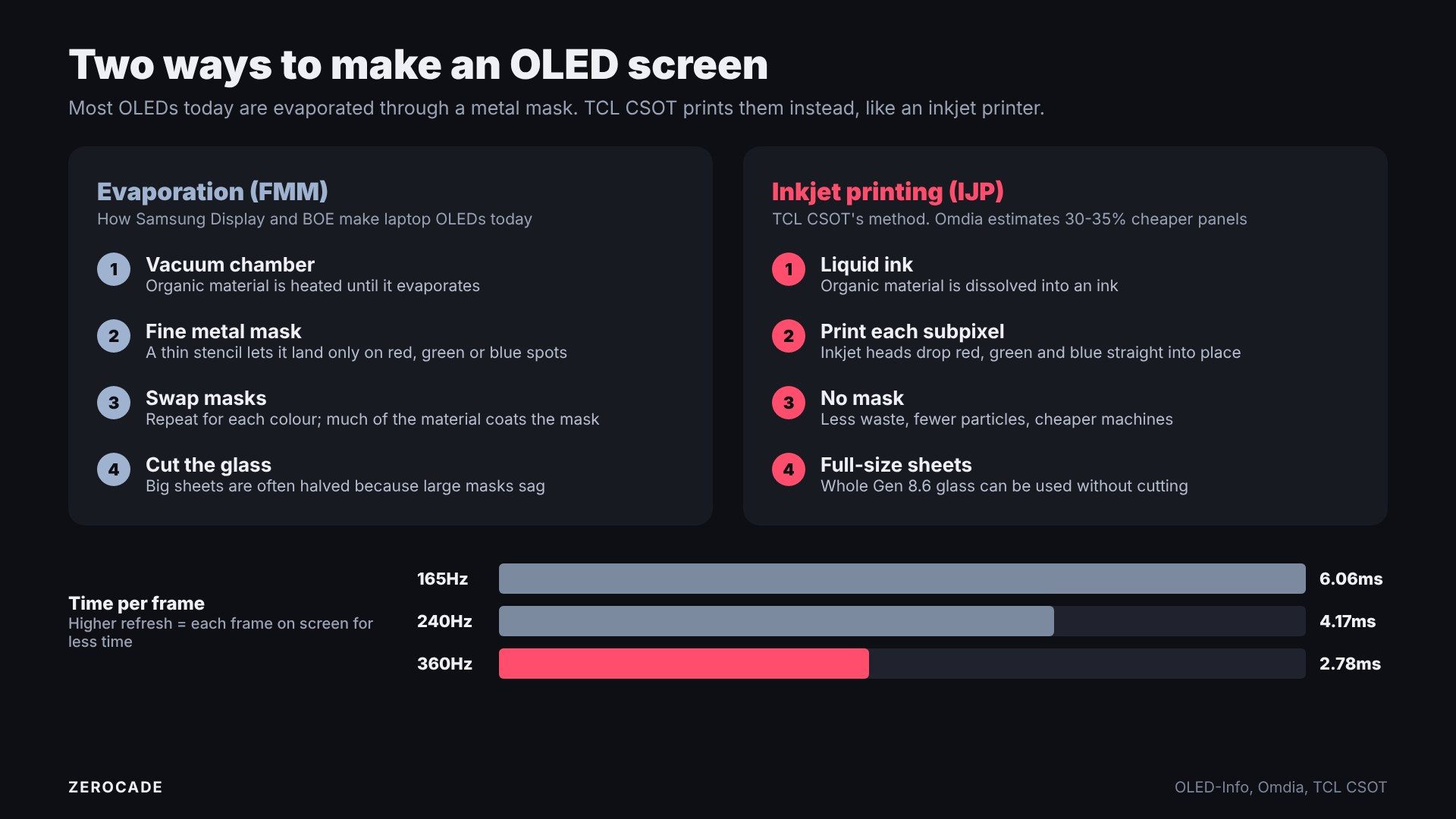
Image: Zerocade
How inkjet printing is different
With IJP, the organic materials are dissolved into liquid inks. Printer heads then drop each colour directly into its subpixel, with no mask at all.
That brings a few advantages, on paper:
- Less waste. TCL claims twice the material efficiency of evaporation, because the ink only goes where it's needed.
- Cheaper machines and bigger sheets. There are no masks to sag, so a whole Gen 8.6 glass sheet can be printed without cutting. Omdia says that fits about 10% more 16-inch panels per sheet.
- Lower cost. Omdia estimates IJP laptop panels could cost 30-35% less than evaporated ones.
- A cleaner subpixel layout. TCL uses a true side-by-side red, green and blue layout, which it says reduces the coloured fringes some OLED laptops show around text.
The catches are real, too. Printable materials have historically been less efficient and shorter-lived than evaporated ones, especially blue, and printing very fine detail is hard. Since printed laptop panels are brand new, there's no long-term burn-in data for them yet.

Image: TCL CSOT
Someone tried this before
Printed OLED isn't a new idea. JOLED, formed in 2015 from Sony's and Panasonic's OLED teams, shipped the first commercial printed OLED panels in 2017, 21-inch 4K screens for Sony medical monitors. Its panels later appeared in ASUS ProArt and LG monitors costing thousands of dollars.
But JOLED never got its yields, the share of usable panels, high enough to bring costs down. It filed for bankruptcy in March 2023, with Japan Display taking over its technology. TCL CSOT, which had invested $281 million in JOLED in 2020, carried on alone.
TCL started mass-producing printed OLEDs in November 2024 on a smaller production line in Wuhan, beginning with a 21.6-inch 4K professional monitor panel. Its big bet is a new Gen 8.6 printing factory in Guangzhou, called t8, which broke ground in October 2025 at a cost of around $4 billion. TCL's CEO said at DTC 2026 that t8 will start mass production in the fourth quarter of 2027. That's when printed OLED laptops could become common.
Does 360Hz matter on a gaming laptop?
A screen's refresh rate is how many times a second it can show a new image. Here's how long each frame stays on screen:
- 165Hz: 6.06 milliseconds
- 240Hz: 4.17 milliseconds
- 360Hz: 2.78 milliseconds
OLED pixels switch almost instantly, so unlike on many LCDs, those extra refreshes turn into visibly sharper motion rather than smear. That's why desktop OLED monitors have already reached 360Hz, 500Hz and beyond.
The catch is your graphics card. To benefit, a game has to render close to 360 frames a second. In big single-player games at 1440p, even an RTX 5090 laptop averages around 107fps across 25 games in Notebookcheck's testing. Fast esports shooters at low settings are the only games where a laptop can get near 360fps. Frame generation adds smoothness but doesn't reduce input delay the way real frames do, as our frame generation guide explains.
So on paper, 360Hz is for competitive players. For most people, the more important part of this news is cost.
What it means for laptops in India
OLED gaming laptops are still expensive here. Lenovo's Legion 5i Gen 11 with a 165Hz OLED is listed at ₹2,65,990, and the Legion Pro 7i with a 240Hz OLED has launched at around ₹2.4 lakh and up. Our guide to OLED vs Mini-LED laptop screens covers the trade-offs.
If printing really cuts panel costs by a third, OLED could spread to cheaper gaming laptops. But that depends on TCL's big factory, which isn't due until late 2027.
What to watch
Watch for Lenovo to name a laptop and launch date for the 360Hz panel, and for whether the R9000P's printed screen comes to India as a Legion Pro model. Samsung Display has also shown a 300Hz laptop OLED, so 240Hz won't be the limit for long.