The short version
- Rockstar shared six new GTA 6 screenshots through The Weather Channel on November 16, showing what it calls Leonida's microclimates: sea fog, swamp storms, night tropical storms and flooded neon streets.
- Most open-world games run one weather state for the whole map and blend between states over a few minutes. GTA 5 worked this way.
- GTA 6's weather is local: Rockstar says you can stand in sunshine and watch rain fall in the distance, with wind that's blocked by islands and buildings, puddles that stay after the rain, and surfaces that dry at different speeds.
- Weather is expensive to draw. On paper, it's part of why GTA 6 targets 30fps on consoles. It launches November 19 in India, from ₹5,999.
What Rockstar showed
The Weather Channel posted the screenshots on social media on November 16, with a joking forecast for the fictional state of Leonida. Rockstar describes it as modelled on one of the most unpredictable weather systems in the US. Owen Shepherd, Rockstar's VP of Art for Light and Rendering, said the team had to "completely reimagine" its weather systems to feel "more localized, persistent, and above all dynamic", from clear blue skies to towering storm clouds.
The six scenes, as described by the outlets that reported them:
| Place | Weather |
|---|---|
| South Ocean Beach, Vice City | Sea fog at dawn |
| Key Lento highway | Gusting wind and downpours |
| The Rusty Anchor | Night tropical storm with lightning, boats pulled ashore |
| Pelican Valley, Grassrivers | Swamp storm, murky water that's harder to cross |
| Gambit Bay | Humid low mist |
| Brian's Marina | Night downpour, neon reflecting off flooded pavement |

Image: Rockstar Games
Step 1: weather as a set of states
The classic approach, used by GTA 5 in 2013, treats weather as a short list of named states. GTA 5's include extra sunny, clear, clouds, smog, foggy, overcast, rain, thunder and clearing. Each state comes with a preset for sky colour, fog density, light and how wet the ground looks.
The game then works like a dice roll with weights. When one state ends, it picks the next from a table of likely follow-ups. The weights let designers make some changes more likely than others, so the forecast feels natural rather than random. It blends the two presets together over a few minutes, so the sky darkens gradually rather than switching instantly.
The catch is that the whole map shares one state. When it rains in GTA 5's Los Santos, it rains in the desert too.
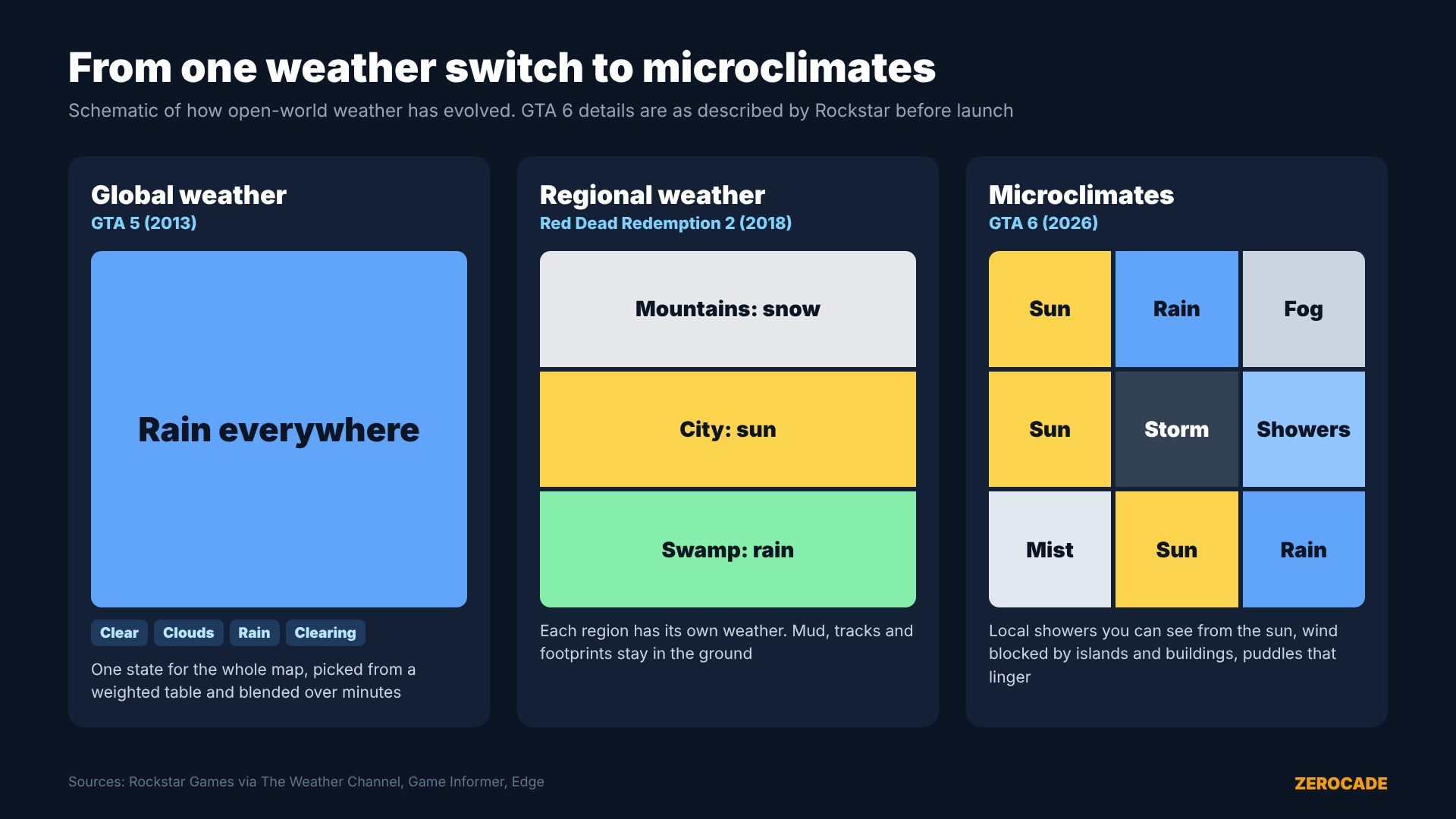
Image: Zerocade
Step 2: weather by region
Red Dead Redemption 2 in 2018 split its map into regions with their own weather. It could snow in the mountains while Saint Denis sat in sunshine. Its weather also left marks on the world: mud, footprints and wheel tracks stayed in the ground.
GTA 6 goes further. Rockstar co-studio head Aaron Garbut told Edge that the weather is "much more granular" than games where it's simply rainy or sunny. According to Rockstar and the Game Informer cover story:
- Rain is local. You can be in sunshine and see a shower falling somewhere else, with rainbows after.
- Wind has shape. Islands and buildings block it. Boats skip over the swell or get "really rocked around", and aircraft get turbulence and light damage in storms.
- The world reacts. People look for shelter when the weather turns.
- It lingers. Puddles stay after the rain, and different surfaces dry at different rates.
- There are tropical storms and hurricanes, plus moving cloudscapes.
Shepherd said the system was rebuilt from RDR2's, with wind visible in hair and ripples on water.

Image: Rockstar Games
Step 3: drawing the sky
Clouds used to be painted onto a big dome around the player. Modern games build them in 3D. The technique, called volumetric clouds, fills the sky with a 3D noise texture and steps through it from the camera, adding up how much light each patch of cloud absorbs and scatters. Guerrilla Games' Nubis system for Horizon Zero Dawn made the approach famous in 2015. Rockstar presented RDR2's own atmosphere and cloud work at SIGGRAPH in 2019.
Because they're real volumes, these clouds can tower into storm cells, cast shadows on the ground and be lit from inside by lightning. That's what Shepherd's "towering vertiginous cumulonimbus clouds" means in practice.
Step 4: making things wet
Rain on screen is only half of it. The bigger effect is what happens to surfaces. Games track a wetness value for the ground and objects. As it rises:
- surfaces get darker, because wet materials absorb more light;
- they get shinier, so they reflect lights around them;
- water fills the low points in the ground to make puddles.
Reflections then pick up streetlights and signs, which is exactly the Brian's Marina screenshot. GTA 6 keeping a separate wetness value for each surface is why a road can stay wet after a wall has dried.
Why weather costs so much
Volumetric clouds, fog, thousands of rain particles and reflections are among the most demanding parts of a frame. Games usually draw clouds at lower resolution, spread the work over several frames, and reuse results where they can.
Rockstar has confirmed GTA 6 targets 30fps on every console, with PSSR upscaling and ray-traced shadows only on PS5 Pro. It hasn't directly blamed weather for that target, but on paper a world this detailed, with storms that move and react, leaves little room for 60fps. Our CPU-bound vs GPU-bound guide explains the trade-off.
What to watch
GTA 6 unlocks at midnight IST on November 19, at ₹5,999 for Standard and ₹7,499 for Ultimate on PS5 and Xbox. Watch for the first technical breakdowns of how its weather actually behaves in play, and whether hurricanes turn up as scripted events or as part of the everyday weather cycle.