The short version
- A new report from Chinese industry forum Board Channels says Nvidia has cancelled the RTX 5080 24GB, the card long rumoured as the RTX 5080 Super. Nvidia hasn't commented.
- The reason given: 3GB GDDR7 memory chips have become very hard and expensive to secure.
- The regular RTX 5080 16GB is said to stay in production, after rumours it would be discontinued. Stock is still thin.
- In India, the cheapest RTX 5080 we tracked is ₹2,69,000, against a ₹1,07,000 launch price and a $999 US list price.
What the report says
The claim comes from a Board Channels insider known as Bobantang, passed on by Japanese site Gazlog and reported by Wccftech on November 11. According to the post:
- Nvidia has cancelled the 24GB RTX 5080 and won't go ahead with it.
- 3GB GDDR7 modules are "incredibly difficult" and costly to get hold of. Every other RTX 50 desktop card uses 2GB modules.
- The RTX 5080 16GB, which had been rumoured to end production, will keep being made.
It isn't the only report this month. On November 2, GameGPU cited Taiwanese site Benchlife saying the card was cancelled before production started. Board partners reportedly never received circuit board or cooler designs for it, and Nvidia is shifting supply towards AI and data centre chips.
How much to trust it
Treat this as a credible rumour, not a confirmed cancellation. Board Channels and Benchlife both get their information from graphics card makers and have decent, if mixed, track records. But this card has been declared delayed, alive and dead several times in the past year, as the timeline below shows. Nvidia has never officially announced a 24GB RTX 5080, so there's nothing for it to cancel publicly.
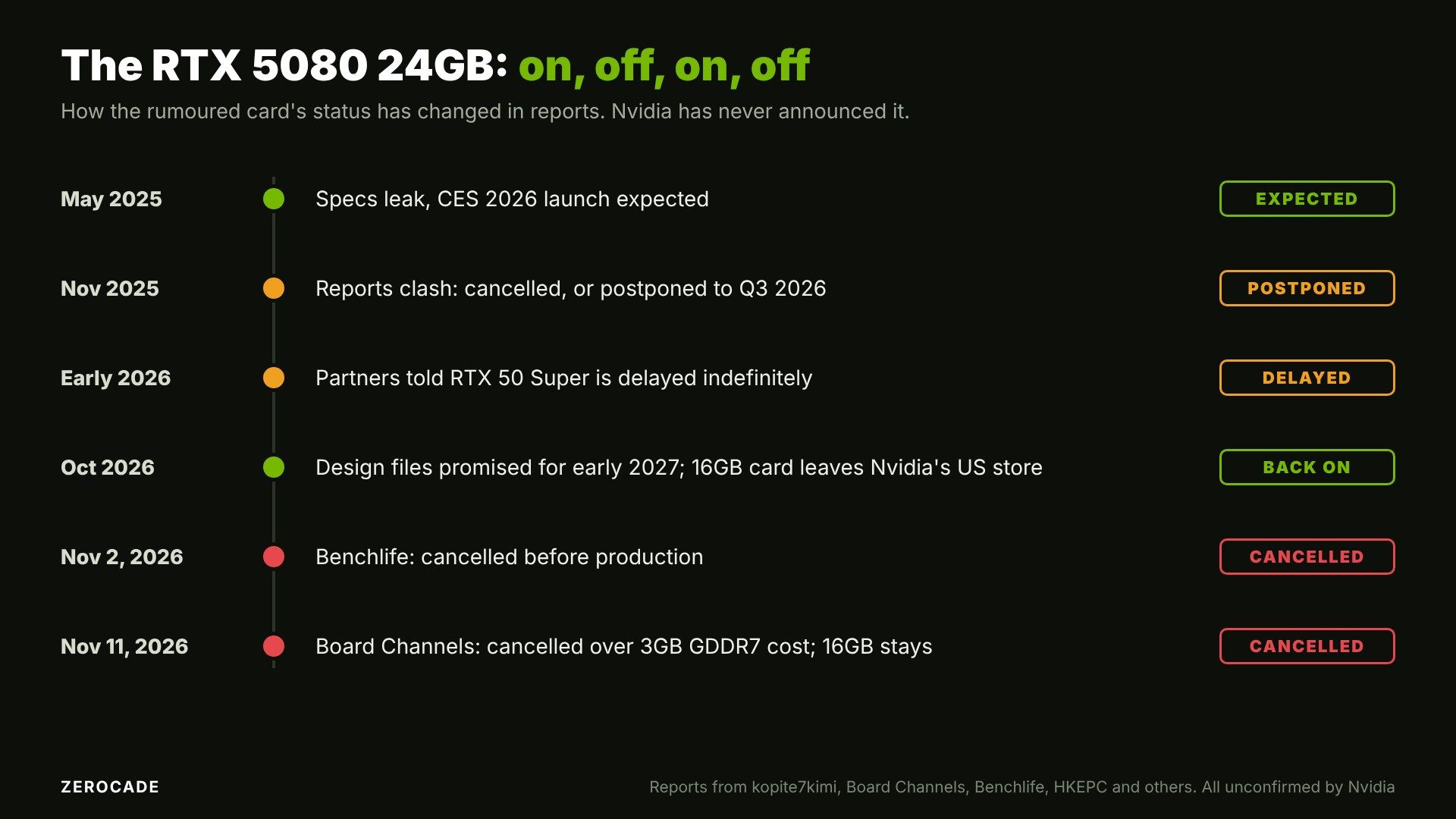
Image: Zerocade
A year of on-again, off-again
- May 2025: leaker kopite7kimi shares RTX 5080 Super specs, and a CES 2026 launch is widely expected.
- November 2025: reports clash. One says the Super line is cancelled, others say Nvidia told partners it's postponed to the third quarter of 2026.
- Early 2026: Board Channels says Nvidia has told partners the RTX 50 Super series is delayed indefinitely because of memory costs and AI demand.
- October 2026: Benchlife says partners have been told 24GB RTX 5080 design files are coming, possibly for early 2027. Around the same time, the RTX 5080 disappears from Nvidia's US store, and a separate leak says a 24GB card will replace the 16GB model in China around January. We covered that 24GB rumour at the time.
- November 2026: the cancellation reports.
What the 24GB card was supposed to be
| RTX 5080 (official) | RTX 5080 24GB (rumoured) | |
|---|---|---|
| Graphics chip | GB203 | GB203 |
| CUDA cores | 10,752 | 10,752 |
| Memory | 16GB GDDR7, 30Gbps | 24GB GDDR7, 32Gbps |
| Memory bus | 256-bit | 256-bit |
| Bandwidth | 960GB/s | 1,024GB/s |
| Power | 360W | 400W or more |
| Price | $999 list | $999-$1,199 in early rumours |
The core count wouldn't change. The upgrade was mostly memory: eight 3GB chips instead of eight 2GB chips on the same 256-bit bus. Our GDDR7 explainer walks through exactly how that maths works.

Image: ASUS
Why memory is the problem
In September, TrendForce relayed reports that a 3GB GDDR7 chip costs about $60-70, against roughly $20 for a 2GB chip. That's around three times the price for 50% more memory. Across eight chips, it would add roughly $320-400 to the cost of making each card, before any markup.
Supply is just as tight. Memory makers are steering their newest lines towards AI chips, and Micron has reportedly stopped making 2GB GDDR7 altogether. The same reports said Nvidia was unlikely to move existing cards to 3GB chips. That leaves 3GB GDDR7 mostly in expensive products: the RTX 5090 laptop GPU and Nvidia's RTX PRO workstation cards.
The other rumoured Super cards, an RTX 5070 Super 18GB and RTX 5070 Ti Super 24GB, relied on the same 3GB chips. There's been no fresh report reviving either.
What an RTX 5080 costs now
Even without a 24GB model, the RTX 5080 is far above its launch price:
- India: the cheapest in-stock listing on price tracker GPUPrix on November 11 was ₹2,69,000 for a Zotac Solid OC White at Vedant Computers. Gigabyte's Windforce was ₹2,75,500, and an ASUS TUF was ₹3,54,000. The card launched at ₹1,07,000.
- US: listings have regularly sat above $2,000, with some over $3,000, while Nvidia's own $999 Founders Edition is unavailable.
We recently reported on MSI's leaked price rises, which could push those prices higher.
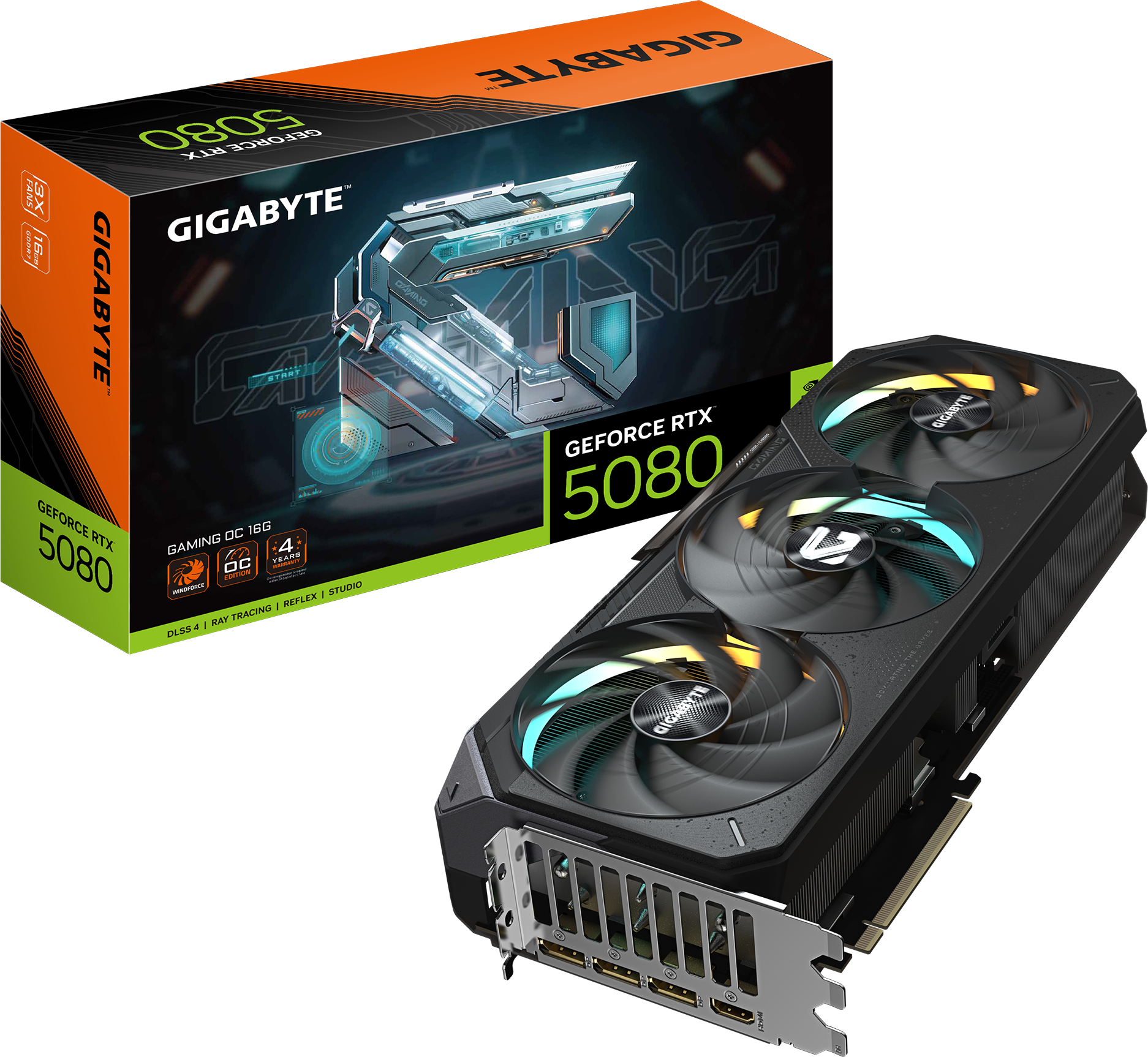
Image: Gigabyte
What to watch
Watch for a 16GB RTX 5080 restock on Nvidia's store, which would back up the report. And keep an eye on CES in January: if Nvidia shows no RTX 50 refresh there, the next big GeForce launch is likely the RTX 60 series. If you need a high-end card now, on paper there's little reason to hold out for a 24GB model that may never arrive.