The short version
- The rumoured RTX 5070 Super has 18GB of GDDR7, up from 12GB on the RTX 5070, plus 6,400 CUDA cores (about 4% more) and a 275W power rating.
- These specs have leaked repeatedly since mid-2025, mostly from the reliable leaker kopite7kimi. Nvidia hasn't confirmed any RTX 50 Super card.
- The cards are reportedly built and sitting with board partners, but on hold because the 3GB memory chips they need cost about three times as much as regular ones.
- The latest reports point to CES in January 2027 at the earliest. Meanwhile, an RTX 5070 costs about ₹1.1 lakh at Indian retailers right now.
The leaked specs
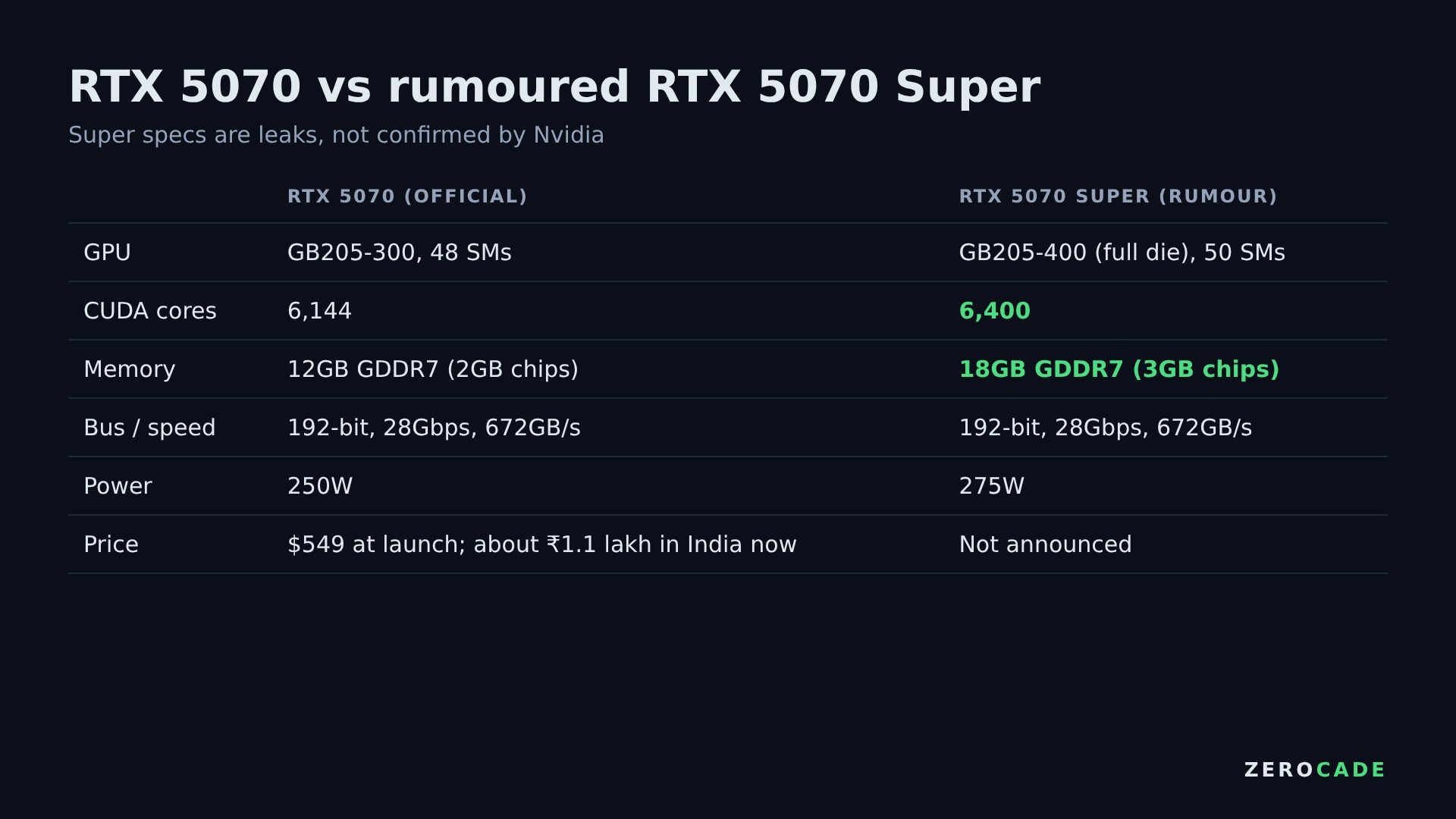
Image: Zerocade
| RTX 5070 (official) | RTX 5070 Super (rumour) | |
|---|---|---|
| GPU | GB205-300, 48 SMs | GB205-400 (full chip), 50 SMs |
| CUDA cores | 6,144 | 6,400 |
| Memory | 12GB GDDR7 | 18GB GDDR7 |
| Memory bus | 192-bit | 192-bit |
| Memory speed | 28Gbps (672GB/s) | 28Gbps (672GB/s) |
| Power | 250W | 275W |
| Launch price | $549 | Not announced |
The headline is memory, not speed. The extra 256 CUDA cores come from turning on the full GB205 chip, which is a small bump. The jump to 18GB is the part that matters.
How you get 18GB on the same bus
A graphics card's memory bus is made of 32-bit lanes, and each lane connects to one memory chip. The RTX 5070's 192-bit bus fits six chips. With today's 2GB GDDR7 chips, that's 12GB.
The Super swaps them for 3GB chips. Same six chips, same bus, same 28Gbps speed, but 18GB in total. Bandwidth doesn't change, but you get 50% more space for textures, which is what newer games at 1440p and higher keep asking for. Some recent releases already go past 12GB with ray tracing and high-resolution textures turned on.
The same trick is rumoured across the range:
- RTX 5070 Ti Super: 8,960 CUDA cores, 24GB (up from 16GB), 256-bit, about 350W.
- RTX 5080 Super: the full GB203 chip with 10,752 CUDA cores, 24GB, 256-bit, about 415W.
Why it keeps slipping
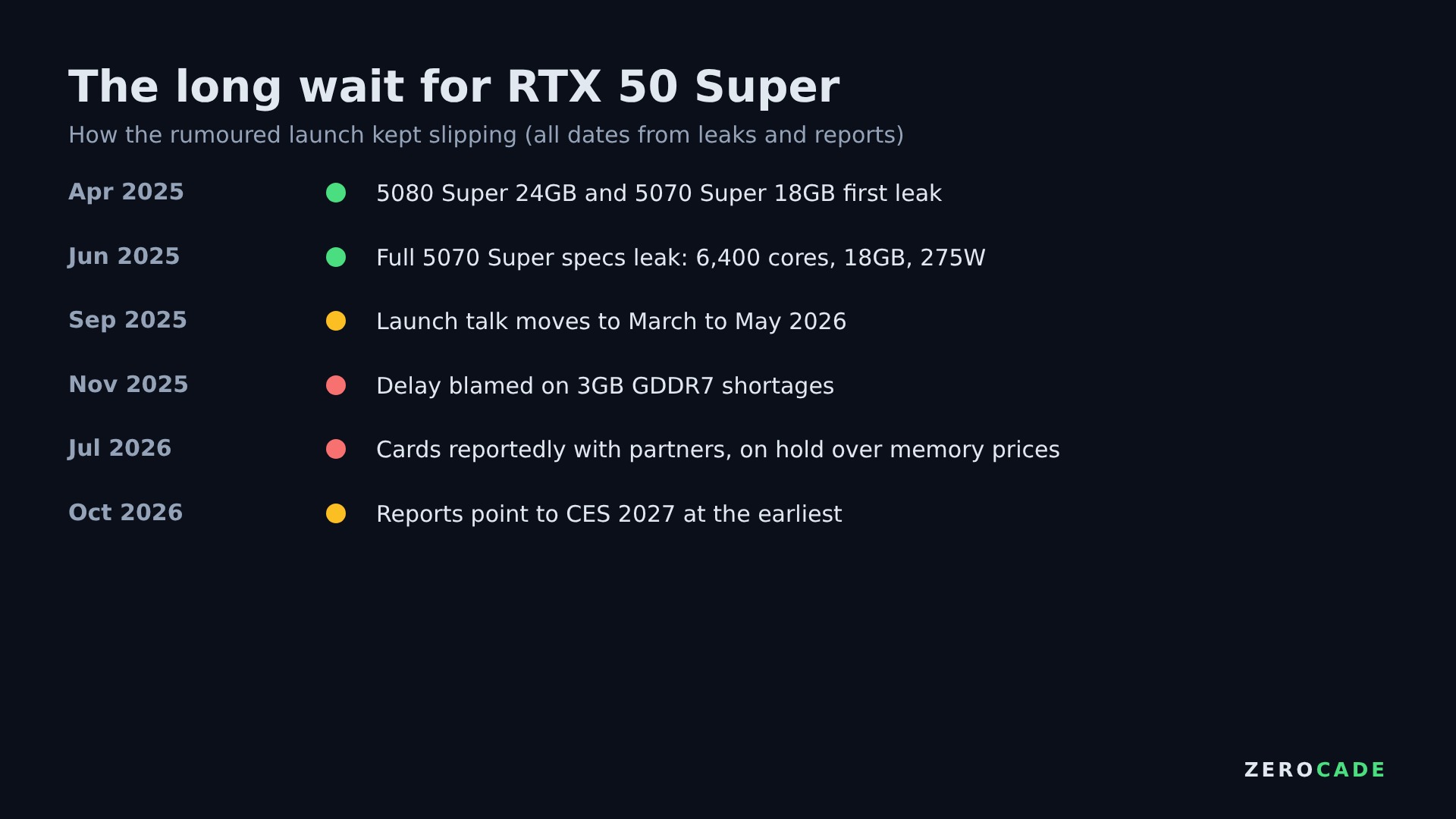
Image: Zerocade
When the specs first leaked in 2025, the Super cards were expected around late 2025 or spring 2026, the same mid-cycle slot the RTX 4070 Super used in January 2024. Then the memory market turned.
The 3GB GDDR7 chips are also in demand for Nvidia's AI data-centre products, and AI has been soaking up DRAM supply across the industry. Reports put a 3GB GDDR7 chip at $60 to $70, against about $20 for a 2GB one. Across six chips, that's a big hit on a card meant to sell for around $549.
In July 2026, Videocardz reported that Nvidia had finished production and the cards had reached board partners, but that partners were told to hold off because of memory prices. Notebookcheck still described them as on hold in early October. Memory maker Micron said on its October 1 earnings call that DRAM contract prices should rise another 10 to 15% this quarter, and that demand will outrun supply into 2027 and 2028. That's not a sign of prices easing soon.
The same memory squeeze is behind rising CPU prices and reports of a pricier PS6.
How credible is this?
The specs are fairly solid as leaks go. kopite7kimi has a strong record on Nvidia hardware, the same numbers have been repeated by several outlets for over a year, and the 5070 Ti Super and 5070 Super have even shown up in a power-supply maker's wattage calculator. The dates are the weak part. Every launch window so far has been missed, and nobody outside Nvidia knows when memory will be cheap enough to make the cards worth selling.
The price is a complete unknown. With the memory costs above, expect the Super to cost more than the RTX 5070's $549 launch price, not the same.
Should you wait if you're buying in India?
GPU prices here have climbed with the memory shortage. A Zotac RTX 5070 Solid OC lists for about ₹1,10,800 to ₹1,12,000 at Indian retailers this week, and price trackers show most in-stock RTX 5070 cards between ₹1.1 lakh and ₹1.16 lakh. That's more than double its $549 US launch price, which works out to about ₹52,000.
On paper, here's the trade-off:
- If you need a card now, the RTX 5070's 12GB is fine for most games at 1080p and 1440p with sensible texture settings.
- If you play at 1440p with ray tracing and keep cards for years, 18GB is a real reason to wait, but you could be waiting until 2027 and still paying more.
What to watch next
Watch for Nvidia at CES 2027 in January, any board partner listing a Super model, and memory prices in Micron's and Samsung's next earnings. We'll update this post if Nvidia announces anything.