The short version
- JEDEC, the industry body that sets memory standards, previewed DDR6 on November 18. It's still in development, and there's no date for the final standard.
- DDR6 starts at 12.8 GT/s, with a roadmap to 14.4 GT/s and beyond. The fastest DDR5 server memory tops out at 9.2 GT/s.
- It widens the data bus from 64 to 96 bits, targets more than 50% more bandwidth at launch, doubles the memory banks and supports chips up to 128Gb.
- Modules shrink to 74mm long, from DDR5's 133mm. Reports point to servers first, around 2028, with gaming PCs later. For now, a 32GB DDR5-6000 kit costs about ₹42,500 in India.
What JEDEC announced
JEDEC published the preview on November 18, describing DDR6 as the next main memory for AI, cloud and data-centre servers as well as client PCs. It stressed that every feature is still being developed and could change before the standard is approved.
Christopher Cox, chair of JEDEC's JC-42 committee for solid-state memories, said DDR6 is being designed to deliver "meaningful advances in memory bandwidth, capacity, and reliability". The release doesn't say when the standard will be finished.
The specs so far
| DDR5 | DDR6 (preview) | |
|---|---|---|
| Speed | 4.8 GT/s at launch, 8.8 GT/s JEDEC top speed, 9.2 GT/s for server RDIMMs | 12.8 GT/s at launch, roadmap to 14.4 GT/s and beyond |
| Data bus per module | 64 bits | 96 bits |
| Bandwidth | More than 50% higher at introduction | |
| Max chip density | 64Gb | 128Gb |
| Memory banks | Twice as many | |
| Module length | 133mm | 74mm |
| Form factors | UDIMM, RDIMM, SODIMM, CAMM2 | Potentially RDIMM, UDIMM and CAMM |
GT/s means gigatransfers per second: how many times a second each data line moves a bit. Speed alone doesn't tell the whole story, though.
Where the extra bandwidth comes from
The biggest change is the wider bus. A DDR5 stick moves 64 bits of data at a time. DDR6 moves 96, so even at the same speed it would carry 50% more data each transfer. That's the same trick we explained in our LPDDR6 guide, which widened phone memory from 64 to 96 bits.
DDR6 also uses pseudo-channels, which split each module into more independent lanes so the memory controller can keep more requests in flight. Twice the number of banks, the separate sections inside each chip that can be opened at once, helps for the same reason. Combined with the faster starting speed, JEDEC targets more than 50% more bandwidth than DDR5 at launch. JEDEC notes that's a bandwidth figure, not a promise that games or apps run 50% faster.
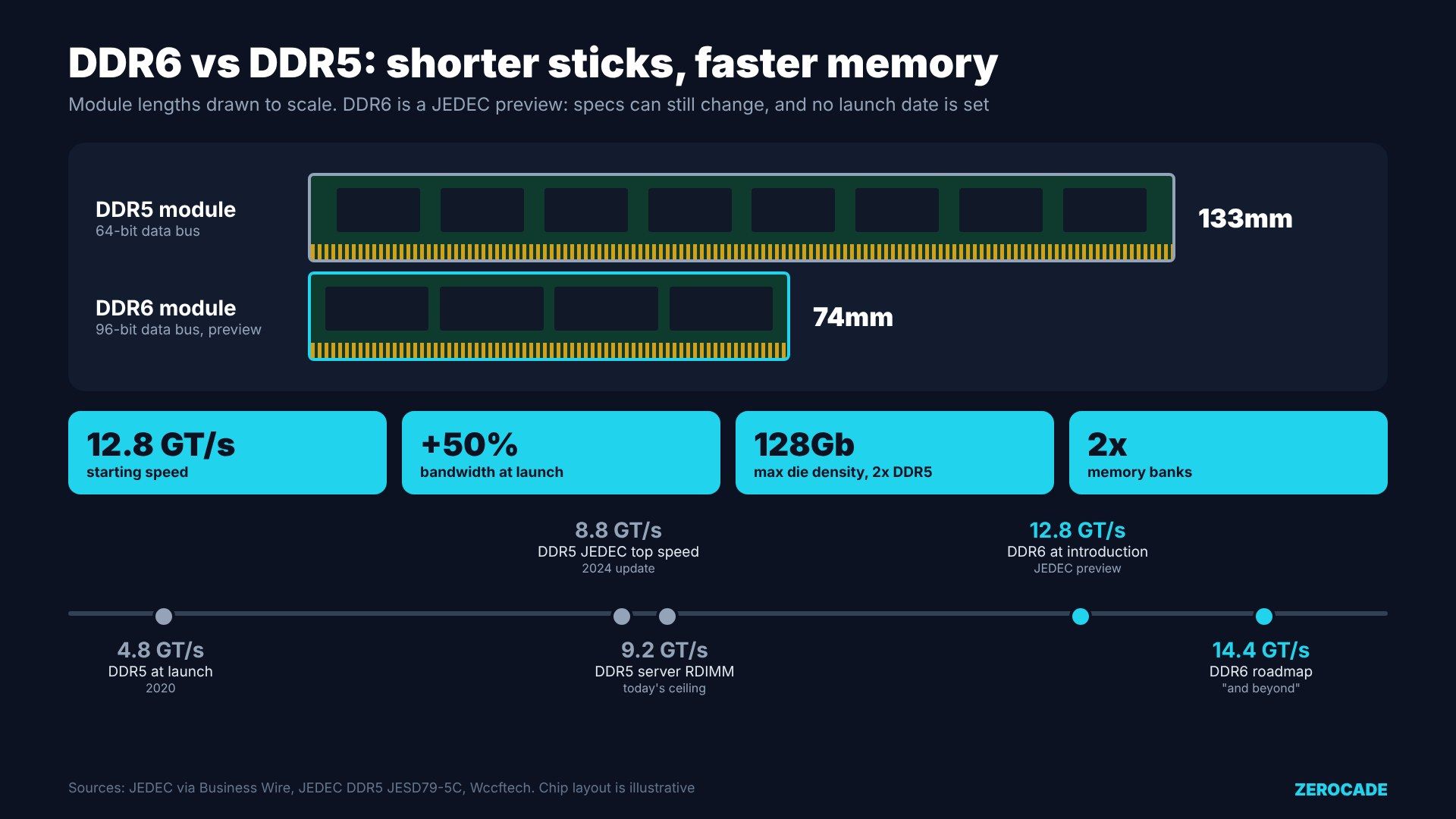
Image: Zerocade
Smaller, denser, more reliable
The 74mm module length is about 44% shorter than DDR5's 133mm. JEDEC hasn't said why, but shorter modules leave more room on crowded server boards. Chips up to 128Gb, double DDR5's 64Gb, mean much bigger modules in the same space.
JEDEC also lists several error-correction options so designers can trade cost against reliability, plus better performance per watt through a new I/O design and low-power modes aimed at data centres. It hasn't given a voltage yet.

Image: Samsung Semiconductor
The form factors JEDEC mentions include CAMM, the flat, screw-down modules that started in laptops. Samsung's LPCAMM2 above is one example. A desktop DDR6 future could look quite different from today's tall sticks, though nothing is confirmed.
When will it reach gaming PCs?
Not soon. JEDEC hasn't set a date, and no memory maker has announced a DDR6 product. In May, Korean outlet The Elec reported that Samsung, SK hynix and Micron had started early DDR6 designs with their suppliers, with commercial DDR6 expected in 2028 or later, servers first. Treat that as a report, not a plan.
On the platform side:
- AMD said at Computex 2026 that its AM5 socket will be supported until at least 2029, and that Zen 6 stays on AM5. AMD's David McAfee said a future AM6 socket will come only when DDR6 and PCIe 6.0 add real value. Wccftech's guess that Zen 8 brings AM6 and DDR6 around 2030 is speculation.
- Intel's next desktop chips, Nova Lake, use DDR5. Intel hasn't talked about DDR6.
So DDR6 is a 2028-2030 story for most gamers, and probably later for budget builds.
What it means for buying RAM now
Your next upgrade is still DDR5, and it's expensive. TrendForce expects PC DRAM contract prices to rise another 13-18% this quarter after a year of sharp increases, as factories favour AI servers. In India, MD Computers lists Corsair's Vengeance 32GB DDR5-6000 kit at ₹42,500, against an MRP of ₹95,000, and other popular kits are out of stock. Our DDR4 vs DDR5 guide covers how much speed actually matters for gaming.
On paper, waiting for DDR6 doesn't make sense for anyone building a PC in the next year or two. It does mean the first AM6 or DDR6 Intel platforms will need new RAM, a new board and a new CPU together.
What to watch
Watch for JEDEC publishing the final DDR6 standard, memory makers showing their first DDR6 chips, and AMD or Intel naming a DDR6 platform.