The short version
- The ASUS XG Core is an external graphics box just 144mm long, with an AMD Radeon RX 9060 XT LP and 16GB of GDDR6 memory inside.
- It connects over a standard 40Gbps USB-C link (USB4 and Thunderbolt 3 or newer), so it works with laptops, handhelds like the ROG Ally and mini PCs, not just ASUS's own.
- The GPU runs at 75W and up to 1,600MHz, roughly half the clock speed of a desktop RX 9060 XT.
- ASUS hasn't announced a price or India launch. The only retailer listing so far, in Sweden, is 13,299 SEK (well over ₹1 lakh), with no stock or date.
What it is
An external GPU, or eGPU, is a graphics card in its own box that you plug into a computer. It's the closest thing to giving a thin laptop or handheld a desktop-style graphics upgrade when you sit down at a desk.
ASUS first showed the XG Core at Computex in June, brought it back at Gamescom in August, and formally announced it in early November. Wccftech covered the launch on November 8.
What's new here is how it connects. ASUS's earlier ROG XG Mobile boxes used a proprietary connector, or more recently Thunderbolt 5, and were aimed at ASUS's own ROG Flow laptops. The XG Core uses a plain 40Gbps USB-C link, and ASUS lists laptops, handhelds and mini PCs as supported devices.
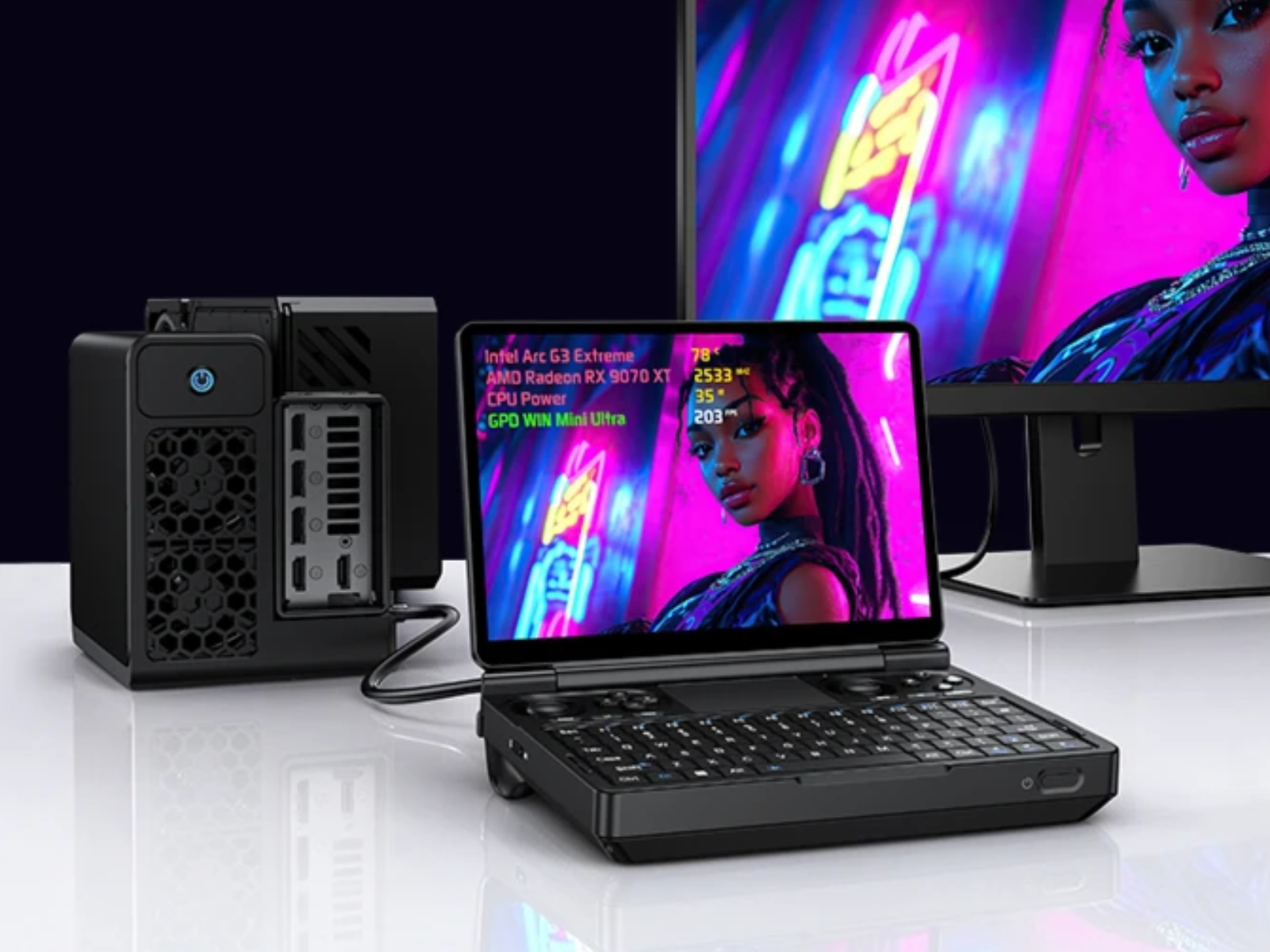
Image: ASUS
Full specs
| ASUS XG Core | |
|---|---|
| Model | XG-CORE-RX9060XT-LP-16G |
| GPU | AMD Radeon RX 9060 XT LP (RDNA 4), 2,048 stream processors |
| Boost clock | Up to 1,600MHz (1,620MHz in OC mode) |
| Game clock | 1,010MHz (1,030MHz in OC mode) |
| Memory | 16GB GDDR6, 20Gbps, 128-bit |
| AI performance | 406.3 TOPS (INT4, with sparsity) |
| Power | 75W, per ASUS's marketing and press coverage |
| Connection to your device | USB-C, 40Gbps (USB4, Thunderbolt 3 or newer) |
| Display outputs | HDMI 2.1b, DisplayPort 2.1a; up to two displays at up to 4K |
| Size | 144 x 117 x 39mm |
| Power supply | External adapter (wattage not listed) |
ASUS claims 60fps or more at 1440p in big games, but hasn't said which games or settings, so treat that as a marketing line until real tests arrive.
How it compares with a desktop RX 9060 XT
Don't let the name fool you. The "LP" chip shares its 16GB memory setup with the desktop RX 9060 XT, but it runs far slower to fit into 75W.
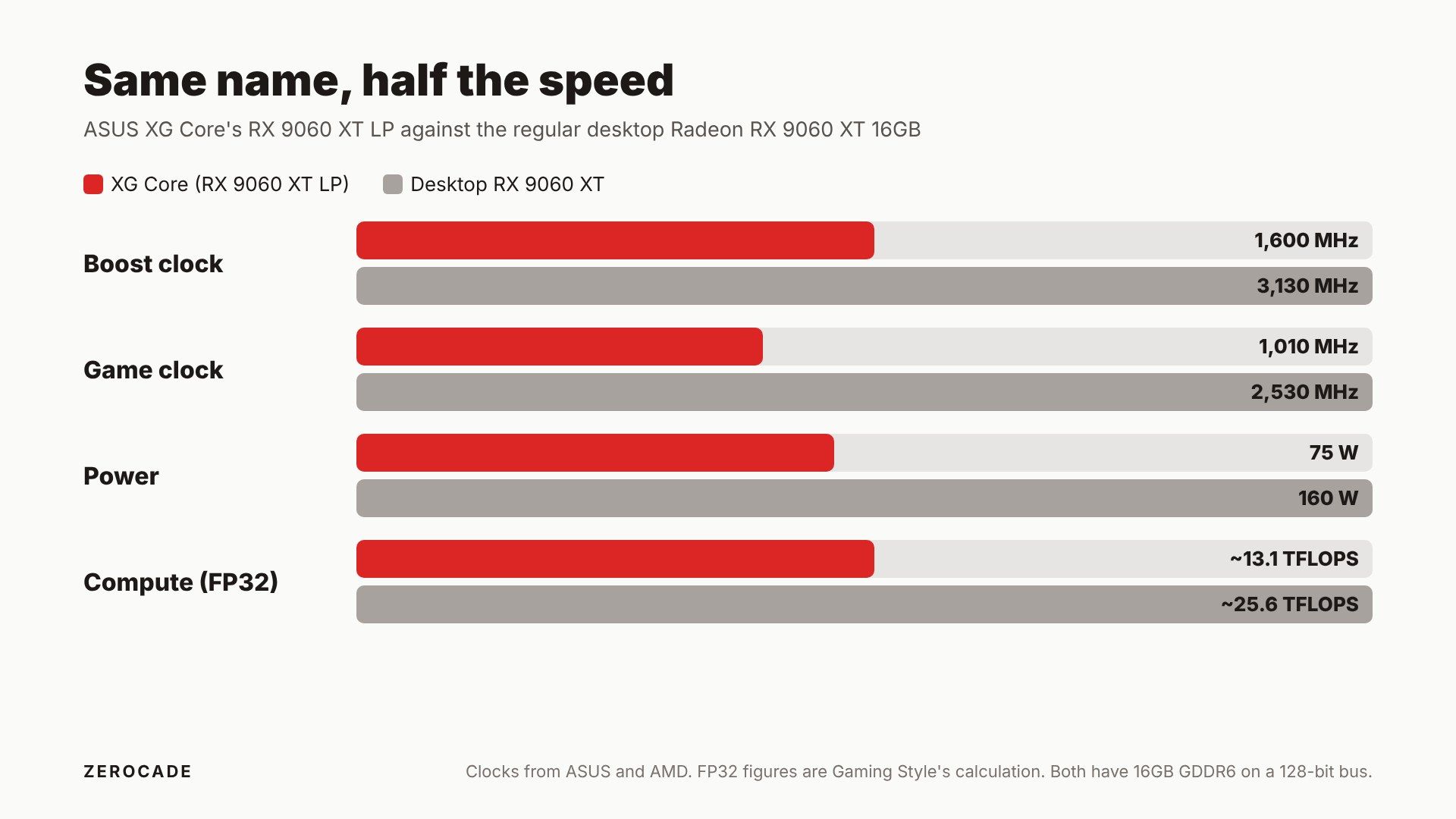
Image: Zerocade
The desktop card launched in June 2025 at $349 for 16GB and draws 160W. Gaming Style worked out that the XG Core's chip has about 13.1 TFLOPS of compute against roughly 25.6 for the desktop card. So on paper, expect something closer to a mid-range laptop GPU than a desktop one.
The cost of a 40Gbps cable
There's another catch every eGPU shares. A desktop graphics card talks to the rest of the PC through a wide PCIe slot. An eGPU squeezes that through a cable.
PC Gamer's 2024 tests showed how much that costs with powerful cards. An RTX 4070 Ti ran about 25% slower over Thunderbolt than over a faster OCuLink connection at 1440p. A big RTX 4090 was only 19% faster than the 4070 Ti over Thunderbolt, against 45% in a desktop slot.
A slower 75W chip like the one in the XG Core should lose less, simply because it needs less bandwidth in the first place. There are no XG Core benchmarks yet to prove it, though.
Compared with ASUS's other eGPUs
| eGPU | GPU | Connection | US price |
|---|---|---|---|
| ROG XG Mobile (2023) | RTX 4090 Laptop | Proprietary | $1,999.99 |
| ROG XG Mobile (2025) | RTX 5070 Ti Laptop | Thunderbolt 5 | $1,299.99 |
| ROG XG Mobile (2025) | RTX 5090 Laptop | Thunderbolt 5 | $2,499.99 |
| XG Core (2026) | RX 9060 XT LP | 40Gbps USB-C | Not announced |
The XG Core is clearly the budget, open-standard option in the lineup. The original 2021 XG Mobile launched in India from ₹69,990, so ASUS has sold eGPUs here before.
The price problem
ASUS hasn't given a price anywhere. The Swedish retailer Inet lists the XG Core at 13,299 SEK, well over ₹1 lakh, with an unknown launch date and no stock. EU listings spotted in July were around €1,205 to €1,399, which look like placeholders.
If anything like those numbers holds, the XG Core would cost about three times as much as the desktop card it's based on. That's the usual eGPU trade-off: you pay for the small box, the cooling and the single-cable convenience, not raw speed.
What to watch
Watch for ASUS's official price and the first independent tests on handhelds like the ROG Ally and on thin laptops. The key question is how close it gets to that 60fps-at-1440p claim through a 40Gbps cable.