The short version
- Frame pacing is how evenly a game's frames arrive on screen. Two games can both average 30fps while one looks smooth and the other stutters.
- Valve's SteamOS 3.9.6 beta fixes a pacing bug where a game capped at 30fps on a 120Hz screen could fall to 24fps, plus problems on 240Hz+ monitors.
- On a fixed-refresh screen, a frame rate is smooth only if it divides evenly into the refresh rate: 30 or 60fps on 60Hz, 40fps on 120Hz, 45fps on the Steam Deck OLED's 90Hz.
- VRR (FreeSync or G-Sync) fixes most of this by letting the screen wait for each frame. In India, the ROG Xbox Ally has it and starts at ₹69,990.
What SteamOS 3.9.6 fixed
Valve posted the SteamOS 3.9.6 beta on November 12 (US time). Most of its fixes are about timing:
- Better frame timing with the frame limiter, both with VRR on and off.
- Capped games no longer run below their target on fixed-refresh screens. Valve's example: a 30fps game capped at 60fps on a 120Hz display could drop to 24fps.
- Games on 240Hz and faster monitors no longer fall short of the refresh rate.
- SDR content no longer looks oversaturated in HDR10 on screens without a wide colour gamut, and Remote Play no longer shows a green screen on Nvidia GPUs.
It's still a beta. The current stable release is 3.9.5. To try it on a Steam Deck, go to Settings, System, and set the System Update Channel to Beta or Preview.

Image: Valve
FPS is an average. Frame time is what you see
"30fps" means 30 frames arrived in one second. It says nothing about the gaps between them. Perfect 30fps means a new frame every 33.3ms. But a game could show some frames for 16.7ms and others for 50ms and still average 30.
Your eyes notice those uneven gaps as stutter, even when the fps counter looks fine. That's why benchmarks track 1% lows and frame-time graphs, which we explain in our 1% lows and frame times guide. Frame pacing is about making every gap the same.
How frames line up with your screen
A normal monitor or TV refreshes at fixed intervals. A 60Hz screen offers a new "slot" every 16.7ms. A finished frame waits for the next slot, and stays up until the next frame is ready for a later one.
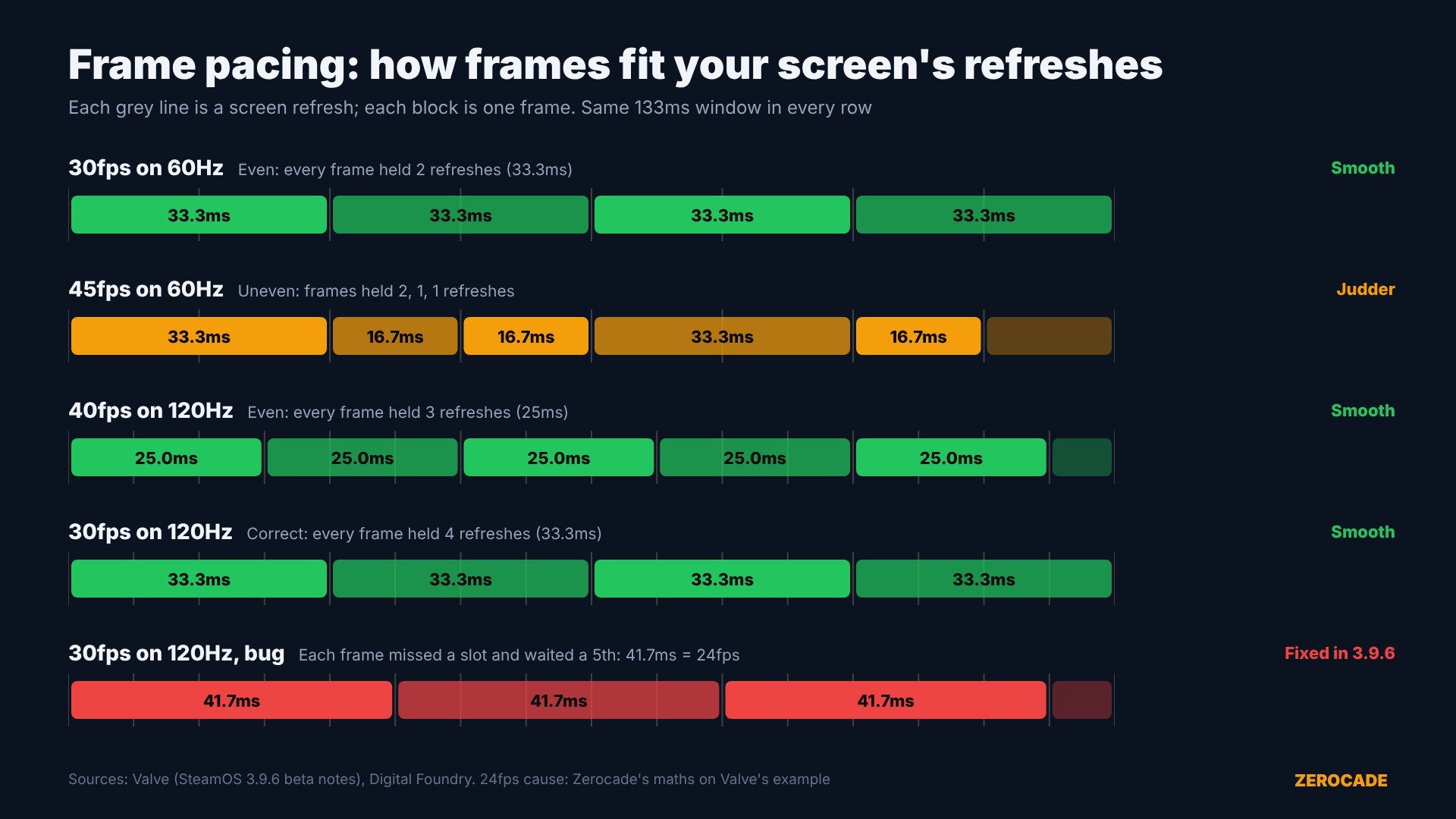
Image: Zerocade
Here's what that means in practice:
- 30fps on 60Hz: every frame gets exactly two slots, 33.3ms each. Even, so it looks steady.
- 45fps on 60Hz: 60 doesn't divide by 45, so some frames get one slot (16.7ms) and others get two (33.3ms). The pattern repeats unevenly, a regular judder.
- 40fps on 120Hz: every frame gets three slots, an even 25ms. Digital Foundry pointed out that 25ms is exactly halfway between 30fps (33.3ms) and 60fps (16.7ms) in frame time, which is why console 40fps modes, first popularised by Ratchet & Clank: Rift Apart in 2021, look so much better than 45fps would on a 60Hz TV.
The SteamOS bug fits this picture. On a 120Hz screen, 30fps should hold each frame for four slots (33.3ms). If the limiter's timing slips so each frame misses its slot and waits for a fifth, every frame lasts 41.7ms instead, and you get 24fps. That's our maths on Valve's example, not Valve's own explanation.
A famous example: Bloodborne
FromSoftware's Bloodborne on PS4 targets 30fps, but Digital Foundry found it often alternates frames of about 16.7ms and 33ms, with occasional gaps around 67ms. The average reads close to 30, yet it feels jerky. FromSoftware never patched it. An unofficial fix for modded PS4s evened the pacing in 2022, but Digital Foundry measured about 78ms of extra input lag in Bloodborne as the cost.
It shows the trade-off at the heart of pacing: holding frames back to keep them even can add delay.
What VRR changes
Variable refresh rate flips the arrangement. Instead of the frame waiting for the screen, the screen waits for the frame and refreshes the moment it's ready. AMD calls it FreeSync, Nvidia calls it G-Sync, and HDMI has its own version. Inside the VRR range, 45fps or 52fps looks even, with no tearing.
It has limits:
- Below the range, the screen repeats frames. AMD's Low Framerate Compensation, required for FreeSync Premium, doubles or triples them to stay in range. Blur Busters measured a G-Sync panel running at 72Hz to show 36fps.
- Above the range, you get V-Sync's lag or tearing again, which is why Blur Busters recommends capping at least 3fps below your maximum refresh.
- Sudden spikes, like shader compilation hitches, still show up as stutter. VRR smooths uneven frame rates, not missing frames.
Our HDMI 2.1 guide covers VRR on PS5 and Xbox.
Frame limiters, and where they help
A frame cap stops the game from rendering faster than you want, so frames come out at a steady rhythm. Where the cap lives matters:
- In-game limiters usually add the least input lag.
- RTSS (RivaTuner) gives very even pacing but can add up to a frame of lag.
- Driver limiters from Nvidia and AMD sit in between, depending on settings.
- Steam Deck's own limiter merges the refresh rate and the cap into one slider, so it can run the screen at a rate that divides evenly, like 45fps at 90Hz on the OLED model or 40fps at 40Hz on the LCD one.
On paper, that slider is one of the Deck's smartest features, which is exactly why a timing bug in it mattered enough for Valve to fix.
Handhelds with VRR in India
The Steam Deck OLED's 90Hz screen doesn't support VRR, and Valve doesn't sell it in India. Grey-market listings on Flipkart run from about ₹74,990 for 512GB to ₹89,999 for 1TB, against $679 for the 1TB model in the US.
The ROG Xbox Ally (₹69,990) and ROG Xbox Ally X (₹1,14,990) are sold officially here, and their 120Hz screens support FreeSync Premium VRR. For more on frame-rate tricks, our frame generation guide explains how fake frames fit in.
What to watch
Watch for SteamOS 3.9.6 to move from beta to stable. If you play capped games on a 120Hz or faster screen, that update is the one to install.