The short version
- Review bombing is when lots of people post negative user reviews at once, usually as a protest, often over something outside the game itself.
- GTA 6 shows the pattern. Critics gave it a 99 on Metacritic, but its user score fell to around 5 out of 10 from roughly 10,000 ratings on November 20, the day after launch, briefly dipping as low as 3.7, according to Fextralife.
- Metacritic now waits 36 hours before opening user reviews, and Steam can flag off-topic review activity and drop it from a game's score.
- A flood of bad reviews isn't always a bomb. Complaints about performance or bugs are real criticism, even when they arrive all at once.
What review bombing means
A user review is supposed to answer one question: will someone like me enjoy this? A review bomb uses the score for something else, usually to send a message to a publisher or platform.
PC Gamer's Tyler Wilde put the line in a useful place back in 2020: a review bomb is a semi-coordinated protest over something outside the game. Lots of negative reviews about crashing servers or bad performance aren't a bomb. They're people describing what the game is like to play.
The trouble is that most real cases are a mix. Some reviewers have genuine complaints, some are piling on, and some haven't played at all. That's exactly what's happening with GTA 6.
What's happening with GTA 6
GTA 6 launched on PS5 and Xbox Series X|S on November 19. Critics loved it. Its PS5 Metascore of 99 ties Ocarina of Time's record, from 150 reviews, and our launch-week coverage of the reviews covers what they said.
The user score went the other way, and the numbers moved by the hour:
| Report (Nov 20) | User score | Ratings |
|---|---|---|
| Fextralife | Low of 3.7, recovering to 5.3 | Not given |
| Notebookcheck | 5.2 | 13,192 |
| KeenGamer | 5.1 ("Mixed or Average") | Nearly 10,000 |
| Tech4Gamers | 4.9 | Over 4,900 |
For comparison, Notebookcheck noted that Rockstar's earlier games sit far higher with users: Red Dead Redemption 2 at 9.0, San Andreas at 9.1 and GTA 5 at 8.5.
The trouble started before launch. On November 16, users noticed GTA 6 already had user reviews, and a 6.5 score, before anyone outside the press could have played it. VGC reported that Metacritic removed them and blocked user reviews until release.
After launch, the reviews are a mix:
- Real complaints: the 30fps lock on every console, including the PS5 Pro, frame drops on the base PS5, bugs and a slow opening. Our post on GTA 6 running at 30fps on all consoles explains that one.
- Taste: realistic chores like shopping, exercise and repair costs, and the focus on Jason and Lucia's relationship.
- Bomb-style reviews: large numbers of 0, 1 and 2 out of 10 scores with no explanation, and claims that some reviewers don't own the game.
KeenGamer made a fair point: nobody can show how many of those ratings were in bad faith. Neither Rockstar nor Metacritic has commented.
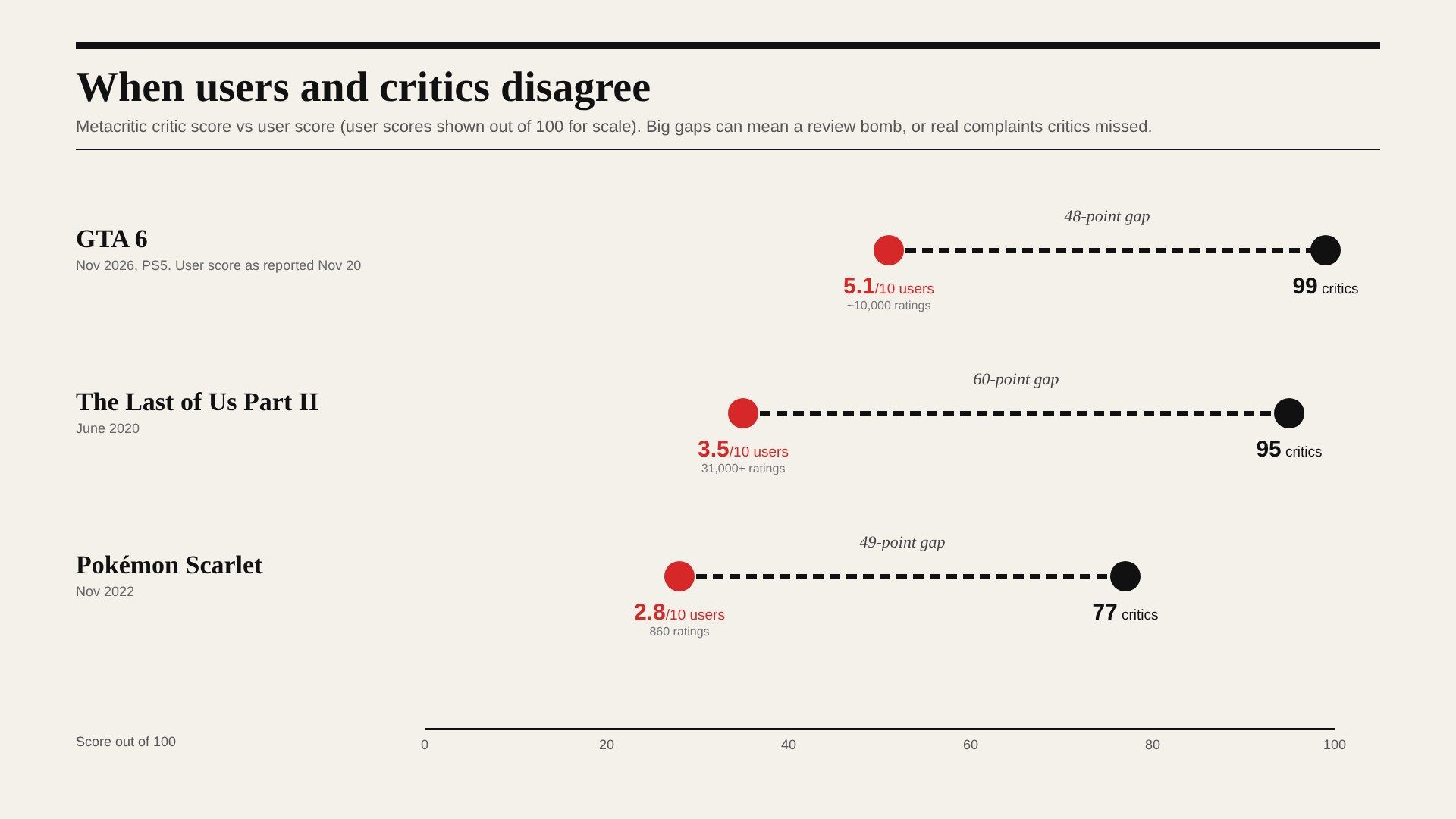 Image: Zerocade
How Metacritic tries to slow it down
Metacritic doesn't check whether you own a game before you rate it. An account with an email address is enough. That makes it the easiest place to bomb.
Its main defence came in July 2020: user reviews now open 36 hours after a game launches. A spokesperson said the idea was to make sure people had time to play before reviewing. It followed bombs on Pokémon Let's Go and Animal Crossing, and Paper Mario: The Origami King was one of the first games under the new rule.
Metacritic also removes reviews that are offensive or spam, which is what it did with GTA 6's early reviews. Our guide to how Metacritic and OpenCritic scores work covers how the critic side is calculated.
OpenCritic handles it differently. Since September 2020 it has allowed audience reviews, but each needs at least 30 words, has to be approved by a moderator, can't be posted until three days after release, and doesn't produce a number.
How Steam handles it
Steam has the advantage that you must own a game to review it there, but it still gets bombed. Valve has changed its system several times:
 Image: Gearbox Software / 2K
- September 2016: reviews from people who got the game through a key, rather than buying it on Steam, stopped counting towards the score after Valve found at least 160 games inflated by free keys. Steam also started showing reviews in your language by default.
- September 2017: Valve added a review histogram, a chart of positive and negative reviews over time, so you can spot a sudden spike. It said it had considered locking reviews or changing the maths, and decided against both.
- March 2019: Valve began flagging "off-topic review activity". A tool spots unusual bursts of reviews, and a Valve team checks them. If the burst is about something unrelated to the game, like DRM or a store deal, those reviews are removed from the score but stay readable, and you can choose to count them again. Valve acted on 44 review bombs that year.
- August 2025: Steam added language-specific scores for games with more than 2,000 reviews and at least 200 in a language, because players in different regions can have very different experiences.
The first big test of the 2019 filter was Borderlands 1 and 2 that April. Fans bombed the older games after Borderlands 3 became a timed Epic Games Store exclusive, and Valve excluded more than 4,000 off-topic reviews from Borderlands 2's score.
Famous cases
 Image: Sony Interactive Entertainment
- Firewatch (September 2017): fans bombed it on Steam after its writer filed a copyright takedown against PewDiePie's videos when the streamer used a slur. PewDiePie later said the bombing was wrong.
- The Last of Us Part II (June 2020): a Metascore of 95 against a user score of 3.5 from more than 31,000 ratings. More than 5,000 user reviews landed within half a day of release, many attacking the story and Ellie's same-sex relationship.
- Pokémon Scarlet and Violet (November 2022): user scores of 2.8 and 3.4 against a Metascore of 77. The complaints were mostly about performance and bugs, so this is closer to genuine criticism than a bomb.
- Overwatch 2 on Steam (August 2023): more than 100,000 reviews, about 91% negative, making it Steam's worst-rated game at the time. Most complaints were about monetisation and Blizzard.
- Helldivers 2 (May 2024): more than 211,000 negative reviews after Sony required PlayStation Network accounts on PC. Sony reversed the rule on May 6, a rare case of a bomb changing a decision. The game stayed delisted in 177 countries without PSN until Sony restored sales in many of them in June 2025.
Bombs can also go positive. Assassin's Creed Unity got a wave of friendly reviews after the Notre-Dame fire in 2019, and Balan Wonderworld collected perfect scores from brand-new accounts in 2021.
How to read user scores before you buy
User scores matter more in India than they might seem. GTA 6 costs ₹5,999 for the Standard Edition and ₹7,499 for Ultimate on the PS Store here, so a misleading score is an expensive mistake either way.
A few habits help:
- Check when the reviews arrived. A pile of zeros in the first day, especially before most people could finish a game, is a warning sign. On Steam, the histogram shows this at a glance.
- Read the 4s to 7s. Middle scores are more likely to describe what the game is actually like than the 0s and 10s.
- Look for specifics. "Drops below 30fps in the city on base PS5" is useful. A one-word review isn't.
- Use Steam's language filter. Reviews in English or your own language can tell a different story from the global score.
- Compare with critics. A huge gap can mean critics missed something, or that users are protesting something outside the game. Either way, it's worth finding out which.
What to watch next
GTA 6's user score will keep moving as more people play through it, and its PC version, whenever it arrives, will face Steam's tougher filters. If you're deciding whether to buy, look past the headline number and read what players actually say about the 30fps cap and the opening hours.