The short version
- Retention is the share of players who come back to a game a set number of days after they first played it.
- D1, D7 and D30 mean day 1, day 7 and day 30. If 10,000 people start a game and 3,500 return the next day, D1 is 35%.
- A common rule of thumb is 40/20/10: 40% on day 1, 20% on day 7, 10% on day 30. Most games land far below that.
- For live-service games, retention matters more than launch sales. It's why Sony just cancelled Fairgames.
Why this came up
When Sony cancelled Fairgames on November 10, the reason in its internal email was blunt: player feedback and retention in testing were mixed and "fell short of the goals" Sony had set. The game ran well in tests. Not enough players came back.
So what is that number, and why does a whole game live or die on it?
How retention is worked out
Retention is always measured on a cohort: a group of players who started on the same day.
- Pick a start day. Say 10,000 players try a game for the first time on Monday. That's day 0.
- Count who returns. On Tuesday, 3,500 of those same players open the game again.
- Divide. 3,500 ÷ 10,000 = 35%. That's the game's D1 retention.
- Repeat later. Count the same group on day 7 and day 30 to get D7 and D30.
New players who join on Tuesday don't count toward Monday's cohort. That's what makes retention so honest: a big marketing push can raise player numbers, but it can't hide that last week's players have quietly left.
A few related terms you'll see:
- Churn is the flip side of retention: the share of players who stopped playing.
- DAU/MAU compares daily players with monthly players. It shows how often people return, sometimes called "stickiness".
- Lifetime value is how much a typical player spends over the whole time they play.
What normal numbers look like
Analytics firm GameAnalytics, whose tools sit inside thousands of games, publishes yearly benchmarks. Its 2026 report, using 2025 data, shows how steep the drop really is:
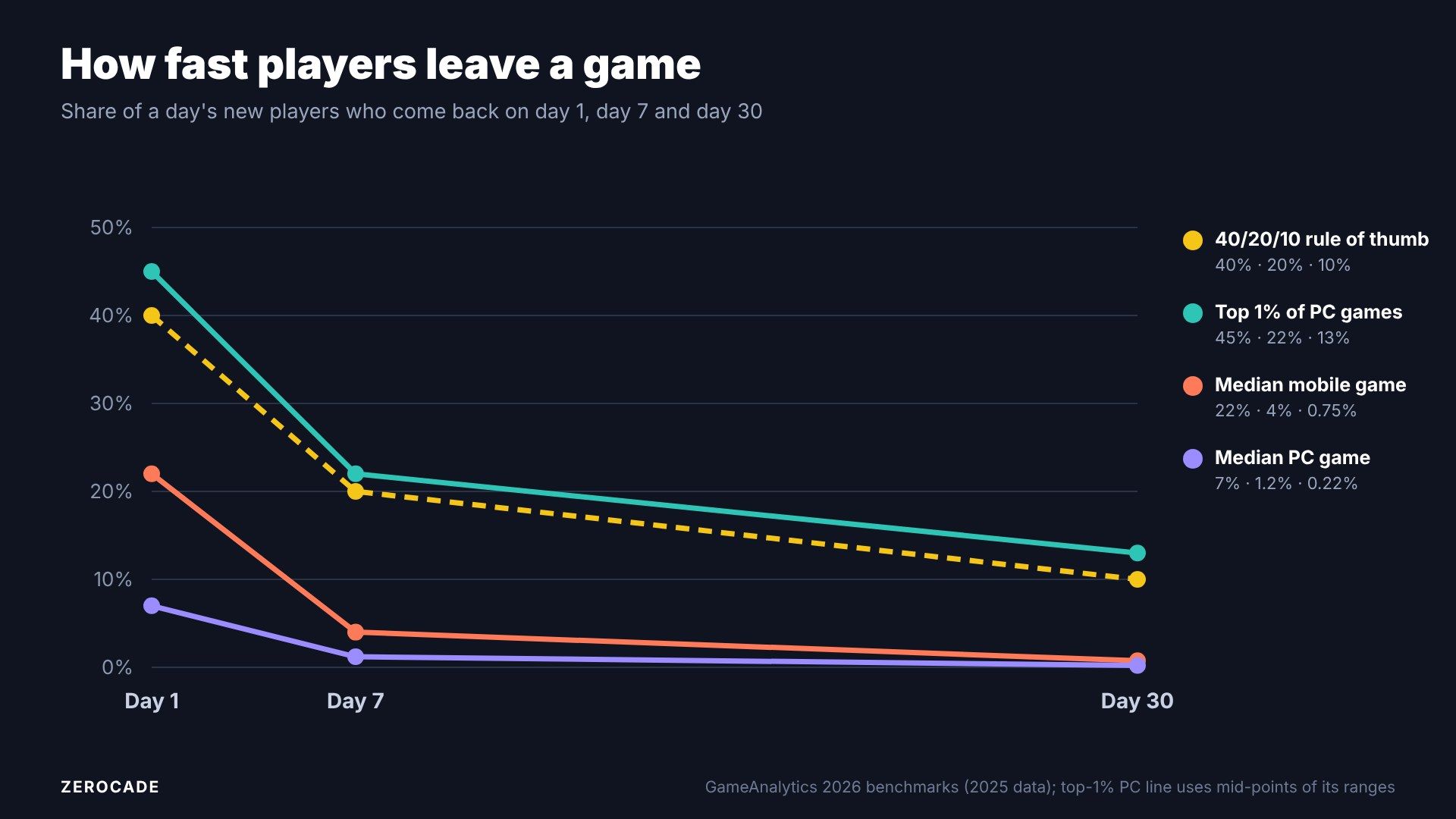
Image: Zerocade
| Median game | Top 1% | |
|---|---|---|
| Mobile D1 | about 22% | 64-68% |
| Mobile D7 | just under 4% | above 25% |
| Mobile D30 | under 1% | 13-15% |
| PC D1 | about 7% | 40-50% |
| PC D7 | about 1.2% | 18-27% |
| PC D30 | about 0.2% | 10-16% |
Two things stand out. First, the typical game loses almost everyone within a week. Second, the best games aren't slightly better: they keep players at many times the median rate. GameAnalytics calls 40/20/10 a baseline, not a guarantee, and also found mobile D1 fell in 2025 compared with 2024.
Why retention matters more than sales for live service
A single-player game makes most of its money at launch. A live-service game is built to earn over years, so the maths is different.
- Spending comes from returning players. Battle passes, skins and seasonal content only sell to people still playing. A free game with weak retention earns almost nothing.
- Matchmaking needs a crowd. PvP games need enough players online to fill matches quickly at similar skill levels. Our skill-based matchmaking explainer covers why thin player pools make matches worse, which pushes even more people away.
- Running costs don't stop. Servers, anti-cheat, live ops teams and new seasons cost money every month, whatever the player count.
That's why a playtest's retention is such a strong warning. If testers who got the game free don't come back, paying players probably won't either.

Image: Sony Interactive Entertainment
What retention looks like in real games
- Concord launched on August 23, 2024 at $40 (about ₹3,500), peaked at just 697 players on Steam and went offline on September 6 with full refunds. Sony closed its studio in October. Sony's Hiroki Totoki later said the company "should have done those gates much earlier", meaning player tests.
- Highguard, from a team of ex-Respawn developers, launched in January 2026 and drew over 2 million players. Its studio said it couldn't build "a sustainable player base", and servers closed just 45 days after launch. Lots of players tried it; too few stayed.
- Marvel Rivals peaked at 644,269 players on Steam in December 2024. About ten months later its daily peak was around 95,000, down more than 85%. That sounds bad, but a game that big can lose most of its players and still have a huge, healthy base.
- Helldivers 2 sold 12 million copies in 12 weeks and has since passed an estimated 23 million. Its Warbonds, its version of battle passes, never expire, so players can return at their own pace. It's priced at ₹2,499 on the Xbox Store in India.
PlayStation Studios boss Hermen Hulst summed up Sony's newer approach to the Financial Times: when a game fails, he wants it to "fail early and cheaply". Fairgames is that idea in action: cancelled after testing, not two weeks after launch like Concord.

Image: Sony Interactive Entertainment
How studios try to raise retention
- Better first hours. Clear tutorials and quick early wins. Most players are lost on day 1, so onboarding matters most.
- Daily and weekly goals. Quests and login rewards give a reason to come back tomorrow.
- Seasons. New maps, characters and events every few months bring lapsed players back.
- Battle passes. A reward track that fills as you play.
These tricks have critics. Battle passes that expire at the end of a season can turn a game into a chore driven by fear of missing out. That's one reason Helldivers 2's non-expiring Warbonds get so much praise from players.
What to watch
When a live-service game launches, check its Steam player count a week and a month later, not just on day one. That gap is retention in action, and it tells you far more about whether the servers will still be running next year than any launch-week headline.