
The short version
- A shader is a small program that runs on your graphics card. A shader compiler turns the code a developer writes into instructions the GPU can actually run, and a better compiler can make the same shader run faster.
- Microsoft's October Xbox GDK adds an experimental shader compiler based on ACO, the open-source compiler Valve funded for Linux. Developers have seen gains of 2% to 16% on Xbox Series X|S.
- It's an optional tool for developers, not a free update to existing games. Microsoft hasn't named any games.
- Consoles compile shaders before a game ships. PCs can't, which is why PC games stutter. A Series S lists for about ₹37,990 in India and a Series X for about ₹59,990 on Flipkart, both as bundles.
What Microsoft announced
The October 2026 release notes for the Xbox GDK, Microsoft's toolkit for console developers, include an "experimental new shader compiler" for Xbox Series X|S "based on ACO from Mesa". Microsoft says developers in early testing saw 2-16% better performance, "depending on game engine, content, and current shader bottlenecks", covering both how fast shaders compile and how fast they run.
Microsoft calls it an optimisation tool developers can use. Wccftech reports it isn't the default, so games won't speed up unless their developers choose to rebuild with it. Microsoft didn't share per-game results.
The same GDK brings AMD's FSR 4.1.2 upscaler to Series X|S for the first time, which we covered when FSR 4.1 was announced for Xbox.

Image: Microsoft
What a shader is
Almost everything you see in a 3D game passes through shaders. A vertex shader works out where each corner of a model lands on screen. A pixel shader decides the colour of each pixel: the lighting, the shadow, the reflection on a wet road. Compute shaders handle effects like particles and upscaling. A big modern game can have tens of thousands of shader variations.
Developers write shaders in a readable language, usually HLSL on Windows and Xbox. Your GPU can't run HLSL directly. It needs its own machine code, and every GPU family speaks a slightly different dialect.
How a shader gets compiled, step by step
- The developer writes HLSL. For example, a few lines that mix a texture with a light.
- A front-end compiler (Microsoft's DXC) turns it into an in-between form that works on any GPU: DXIL for DirectX 12, or SPIR-V for Vulkan. On PC, this is what ships with the game.
- A back-end compiler inside the graphics driver turns DXIL or SPIR-V into machine code for your exact GPU and driver. This is the step ACO does.
- The GPU runs it, many thousands of times per frame.
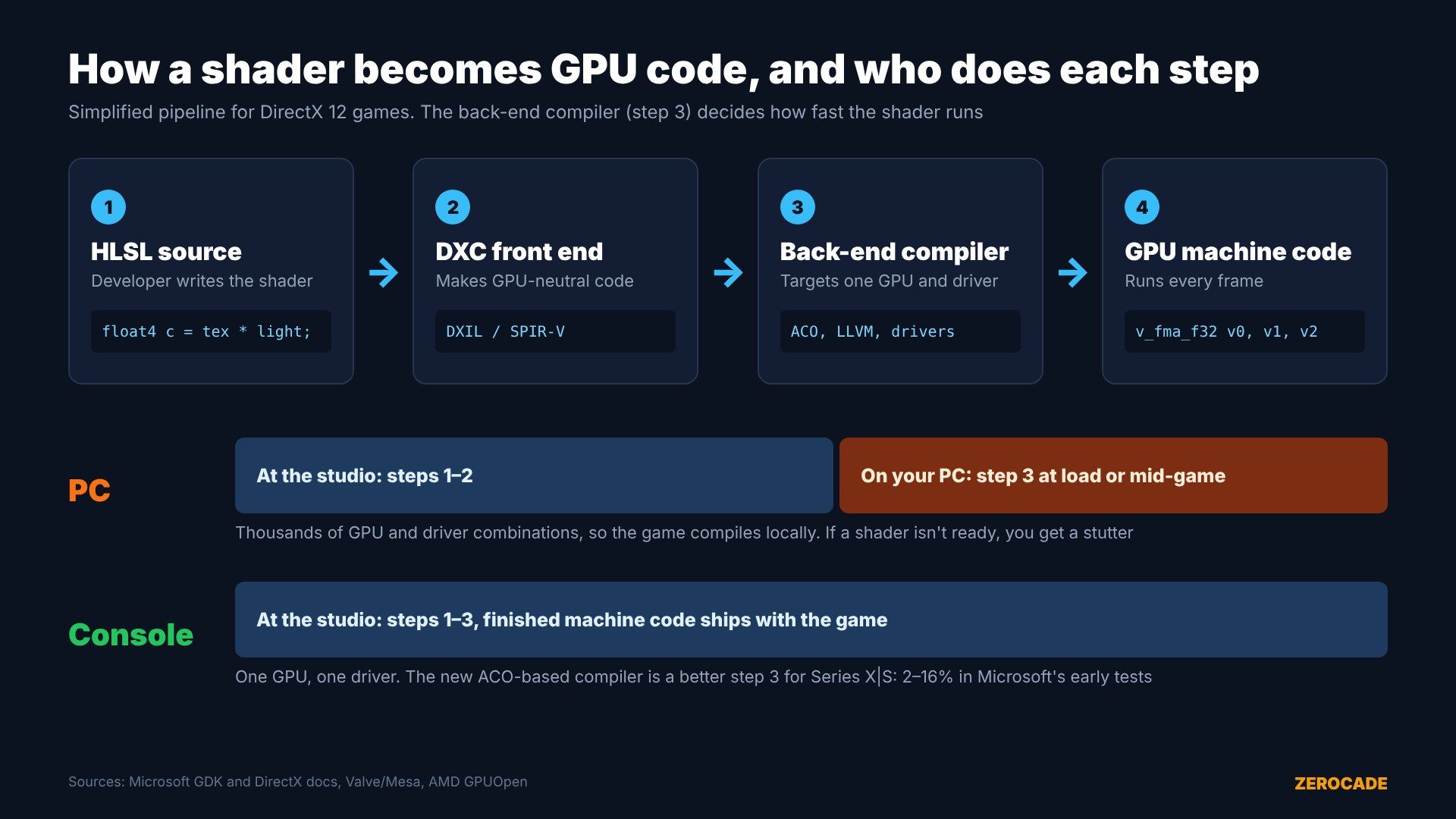
Image: Zerocade
Why a better compiler means more fps
The back-end compiler makes thousands of small decisions, and one of the biggest is register allocation.
A GPU runs threads in groups called waves. Each wave needs its own small, very fast memory slots called registers. AMD's RDNA 2 GPUs, the design inside Series X and S, have a fixed pool of registers, and a single SIMD unit can hold up to 16 waves at once. If a shader needs lots of registers, fewer waves fit. AMD's own example: on an RX 7900 XTX, a shader using 120 registers per thread fits only 12 waves instead of 16.
Why does that matter? While one wave waits for data from memory, the GPU switches to another. Fewer waves means fewer chances to hide that wait, and the GPU sits idle more. A compiler that squeezes the same shader into fewer registers, or into fewer instructions, gets more work done in the same time. It also picks how to pack threads, since RDNA can run waves of 32 or 64.
That's where ACO's 2-16% comes from. The game's code doesn't change; the machine code does.
Where ACO came from
ACO stands for AMD COmpiler. Valve-funded developer Daniel Schürmann proposed it in July 2019 for RADV, the open-source Vulkan driver for AMD GPUs on Linux. Valve's argument was simple: in games, compile time is critical.
Until then, RADV used LLVM, a general-purpose compiler built for ordinary CPU code. ACO was built only for AMD GPU shaders. It tracks exactly how many registers a shader needs as it goes. Early tests showed compile times cut by almost half. It became RADV's default in Mesa 20.2 in 2020.
It now runs on every Steam Deck through SteamOS. In January 2024, work on ACO by the Steam Deck team cut shader instruction counts, and Phoronix measured up to 14% higher fps in Cyberpunk 2077. Five years later, Microsoft is borrowing it for its own consoles.

Image: Valve
Why PC games stutter and consoles don't
Step 3 is the problem on PC. A compiled shader only works on the GPU and driver it was compiled for, and there are thousands of combinations of GPUs and drivers. So PC games ship the in-between DXIL and compile on your machine, either on a long loading screen or in the middle of play. When a new effect appears and its shader isn't ready, the game freezes for a moment. Elden Ring at launch in 2022 was the famous case: Digital Foundry saw stutter even on an RTX 3090 at 720p. Our frame times guide shows how those spikes appear in benchmarks.
A console has one GPU and one driver. Studios compile every shader before release and ship finished machine code on the disc or download, so there's nothing to compile while you play. That's why Microsoft can offer ACO as a developer tool: the compiling happens at the studio.
How PC is catching up
- Steam shader pre-caching (since 2017) downloads shaders already compiled for your GPU and driver. It only works for Vulkan and OpenGL games, but on the Steam Deck, Proton turns DirectX 12 into Vulkan, so it covers most games there. Valve shipped an Elden Ring cache in March 2022.
- Advanced Shader Delivery, from Microsoft, compiles shaders in the cloud and ships them with the download from the Xbox app. It launched on the ROG Xbox Ally in 2025, where Avowed loaded up to 85% faster. Since October 21 it works on any Windows 11 24H2 PC with a recent AMD, Intel, Nvidia or Snapdragon X2 GPU. Microsoft says Steam and Epic support is coming soon.
What to watch
Watch for the first games to say they're built with the new Xbox compiler, and for real before-and-after numbers. If the 16% end of Microsoft's range shows up in a big release, ACO could become Xbox's default compiler.