The short version
- A loot box is a paid random reward. You spend real money, or a currency bought with real money, without knowing exactly what you'll get. Card packs in EA FC and "pulls" in gacha games like Genshin Impact work the same way.
- On November 11, the European Commission proposed the Digital Fairness Act (DFA). It would ban paid loot boxes and pay-to-win for minors, require odds and real-money prices to be shown, and let all players switch loot boxes off.
- Countries already treat loot boxes very differently: Belgium calls them gambling, South Korea forces odds disclosure, and the UK leaves it to the industry.
- India has no loot box law. Its 2025 online gaming law bans real-money games, but loot boxes you can't cash out probably fall outside it.
What a loot box is
Strip away the animation and a loot box is simple: you pay, and the game picks a reward at random from a list. Some items are common, some are rare, and the rare ones are usually what players actually want.
They come in a few forms:
- Paid boxes and packs. EA FC's Ultimate Team packs are the best-known example. You buy a pack and get random players.
- Gacha pulls. Named after Japanese capsule-toy machines, gacha games like Genshin Impact sell "pulls" on a banner, with characters rated by stars.
- Crates and spins. BGMI sells crates and lucky spins using its UC currency.
- Earned boxes. Some games hand out boxes for playing. Most rules, including the EU's proposal, focus on the paid kind.
How gacha and "pity" work
Gacha games add a safety net called pity. The idea is to guarantee a rare item if you've been unlucky for long enough. HoYoverse's games, for example, guarantee at least a 4-star item every 10 pulls, and some gacha games guarantee a 5-star after 80 or 90 pulls.
Pity sounds generous, and it does cap how unlucky you can get. But it also sets a price: if the top prize is guaranteed at 90 pulls, the real worst-case cost of that character is 90 pulls' worth of money. Most players never do that maths, which is part of why regulators want odds and prices shown up front.
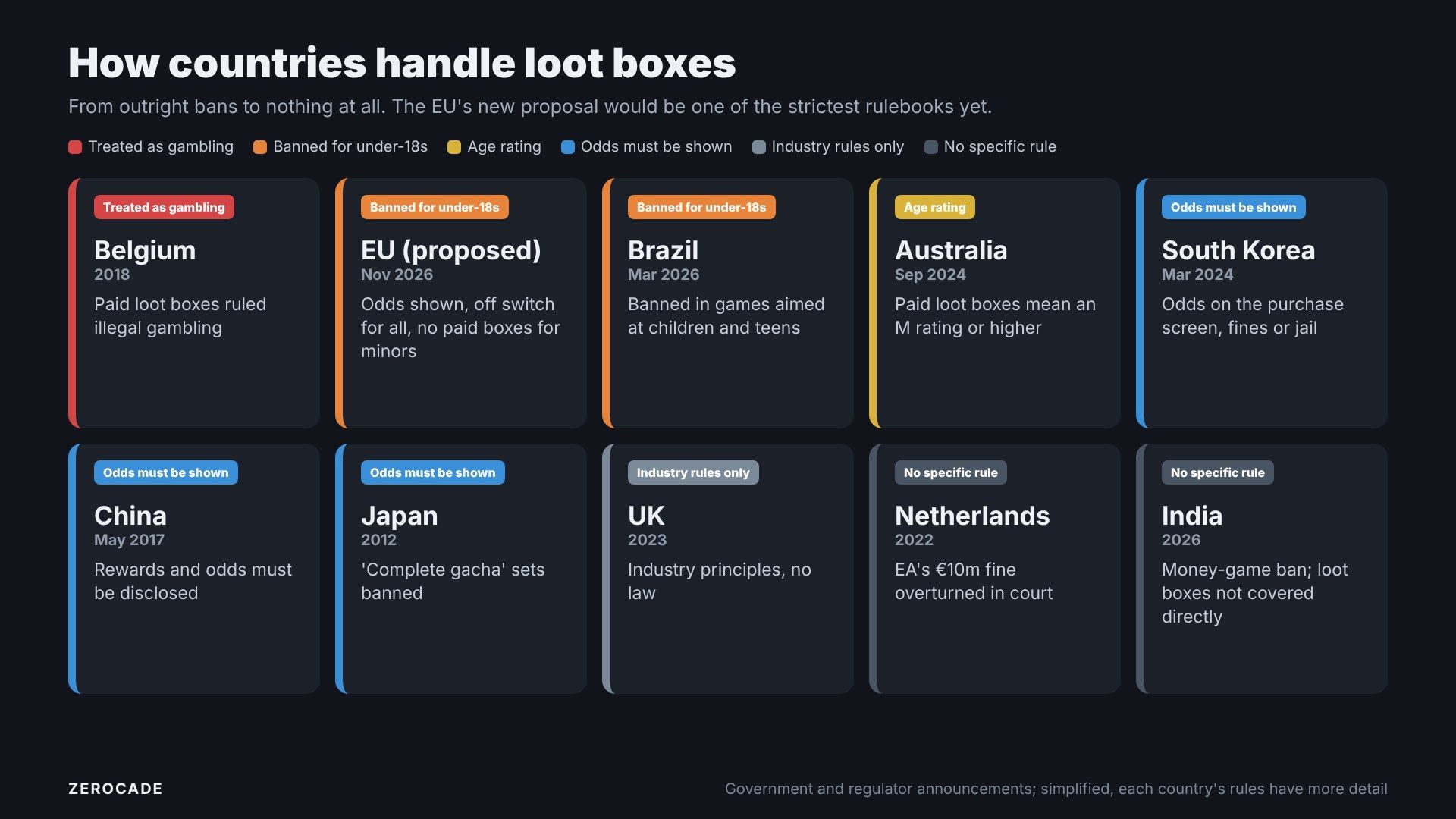
Image: Zerocade
How virtual currency hides the price
Most games don't sell loot boxes for rupees or dollars. They sell a currency first, then sell boxes for that currency. That extra step makes prices much harder to judge.
Take EA FC 26 on Steam. FC Points come in bundles of 100, 500, 1,050, 1,600, 2,800, 5,900, 12,000 and 18,500, priced from $0.99 to $149.99. Pack prices don't line up neatly with those bundles, so you often have to buy more points than you need, and the leftovers nudge you towards the next purchase.
BGMI works the same way in India. On one top-up site, 60 UC costs ₹75, 660 UC costs ₹750 and 8,100 UC costs ₹7,500, and crates are priced in UC, not rupees.
What the EU's Digital Fairness Act would change
The DFA is a proposed regulation, so once passed it would apply directly in all 27 EU countries. It replaces a 2005 consumer law and covers a lot more than games, from hard-to-cancel subscriptions to fake countdown timers. For games, the key parts are:
| Rule | What it would mean |
|---|---|
| Odds and contents | Games must show what a loot box can contain and the chance of each item. |
| An off switch for everyone | All players, adults included, get an easy way to turn paid loot boxes off. |
| No paid loot boxes for minors | Paid boxes can't be sold to children. |
| No pay-to-win for minors | Paying to win, or to skip artificial difficulty, is banned for children too. |
| Real-money prices | Items bought with virtual currency must show their real cost, or an estimate. |
| Currency off by default for kids | In games aimed at children, paid currencies stay off unless a parent turns them on. |
| Engagement tricks | Players can switch off daily login rewards, streaks, penalties for missing them, and pushy notifications. |
Companies that break the rules could be fined up to 6% of global annual turnover.
Consumer Commissioner Michael McGrath framed it as fairness: "We are not making it harder to do business, we are making it harder to do business unfairly."
The games industry strongly disagrees. Video Games Europe and the European Games Developer Federation called the proposal "unworkable, unjustified and disproportionate", saying existing protections like PEGI ratings and parental controls already work.

Image: Electronic Arts
Why regulators care
The turning point was Star Wars Battlefront II in 2017. Players worked out how much grinding or spending it took to unlock heroes, and the backlash was so big that EA switched off all in-game purchases hours before launch.
Research followed. A 2018 study of 7,422 adult gamers by Zendle and Cairns found that the more people spent on loot boxes, the more severe their problem gambling tended to be. The link was stronger than for other in-game purchases. It showed a connection, not that loot boxes cause gambling problems, but it shaped a lot of later policy.
Some games simply dropped them. Overwatch 2 replaced loot boxes with a battle pass when it launched in 2022.
How other countries handle them
- Belgium (2018): ruled that paid loot boxes in games like Overwatch, FIFA 18 and CS:GO were illegal gambling. EA FC Points still aren't sold there.
- Netherlands: fined EA €10 million over Ultimate Team packs, but the country's top administrative court overturned it in 2022.
- UK (2023): decided not to legislate, and the industry agreed to its own principles instead, including parental consent for under-18s.
- China (2017): games must publish loot box rewards and odds.
- Japan (2012): banned "complete gacha", where you have to collect a whole random set to win a prize.
- South Korea (2024): odds must appear on the purchase screen, and regulators found 266 games breaking the rule within months.
- Australia (2024): games with paid loot boxes get at least an M rating, and simulated gambling gets R18+.
- Brazil (2026): banned loot boxes in games aimed at children and teens from March.
Apple and Google have also required games on their stores to show loot box odds since 2017 and 2019.
Where India stands
India's Promotion and Regulation of Online Gaming Act 2025 bans "online money games": games where you pay expecting to win money or something of value back. Its rules took effect on May 1, 2026, with penalties of up to three years in jail or a ₹1 crore fine.
It doesn't mention loot boxes. One factor in deciding whether a game counts as a money game is whether its items can be cashed out or used outside the game. Most loot boxes, like BGMI crates or EA FC packs, give items you can't sell for money, so on paper they likely fall outside the ban. Law firms say it depends on each game. In-game purchases are taxed at 18% GST.
What to watch
The DFA now goes to the European Parliament and EU governments, who have to agree a final text. That's likely to take until at least 2027, so don't expect changes in your games before 2028. Watch whether the "off switch for adults" survives negotiations, and whether big publishers redesign their games worldwide rather than run a separate EU version.